In 2026, the Canton Network is rapidly emerging as one of the most consequential blockchain ecosystems for institutional finance and real‑world asset (RWA) tokenization. Purpose‑built as a public layer‑1 blockchain optimized for regulated markets, compliance, privacy, and interoperability, Canton is now delivering on its early promise with production‑ready deployments, multi‑institution tokenization workflows, and broad infrastructure integrations.
Recent developments — including real use cases in cross‑border repo markets, oracle and data partnerships with Chainlink, expanding institutional participation, and broader ecosystem utility through index tokenization and JPM Coin integration — underscore Canton’s shift from concept to concrete financial infrastructure. Below are the five most important news developments shaping the Canton story in 2026.
1. Canton and Chainlink Go Live with Institutional Oracle & Data Infrastructure
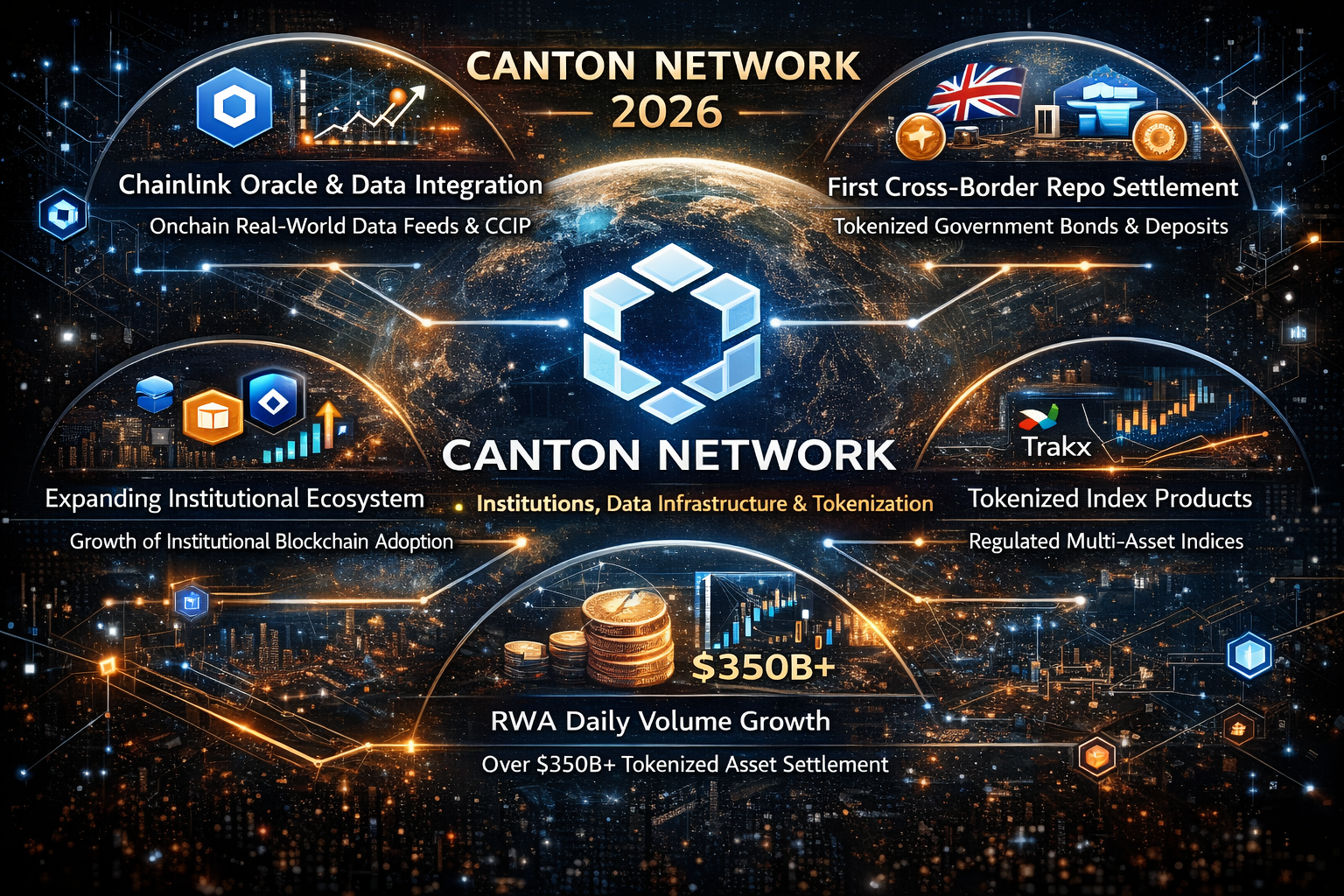
One of the most impactful breakthroughs for the Canton ecosystem in early 2026 has been the live deployment of Chainlink Labs infrastructure across Canton’s network to support regulated tokenization workflows and real‑world asset markets.
Under this integration:
-
Chainlink Data Streams, SmartData NAV/AUM feeds, and Proof of Reserve are now available to applications running on Canton, providing verifiable real‑time pricing, portfolio valuation, and collateral backing data essential for institutional use cases.
-
The deployment covers Chainlink’s recently launched 24×5 equities data streams, unlocking secure access to stock and ETF price data even outside traditional market hours.
-
Future integration of the Chainlink Cross‑Chain Interoperability Protocol (CCIP) is targeted to enable secure cross‑chain transfers of tokenized assets.
-
Canton ecosystem partners such as BitSafe Finance, Unhedged, Thetanuts Finance, Kairo, and Temple are already using these standards in production environments.
What makes this development particularly significant is that Canton now combines regulated, privacy‑preserving blockchain infrastructure with industry‑leading data services — a combination critical for adoption by banks, asset managers, and compliance‑focused institutional actors. Unlike many traditional DeFi chains that operate with generic oracle feeds, Canton’s stack integrates data feeds designed for regulated financial markets that must meet know‑your‑customer (KYC), audit, and compliance requirements.
This partnership underscores a broader trend in 2026: institutional blockchains are no longer hypothetical; they are delivering functional, robust infrastructure that supports financial workflows at real scale.
2. First Cross‑Border Intraday Repo Transactions Demonstrate Real‑World Tokenization
In late February 2026, a consortium of leading traditional finance institutions marked a milestone by executing the first cross‑border intraday repurchase agreement (repo) on Canton Network involving tokenized U.K. government bonds — a significant leap in institutional blockchain adoption.
This milestone repurchase transaction demonstrates several critical attributes of the Canton ecosystem:
-
Cross‑currency and multi‑asset support: The transaction bridged tokenized gilts for tokenized deposits in a currency other than sterling, showing the network’s capacity to handle multi‑jurisdictional financial instruments.
-
Institutional collaboration: Major market participants such as DTCC, LSEG, Societe Generale, and others participated in the workflow, reflecting real market confidence in Canton’s institutional use cases.
-
High throughput in real financial volume: Onchain asset movement routinely exceeds $350 billion daily across protocols like U.S. Treasury repo markets.
Repos are foundational to short‑term funding markets and cash management for institutional actors. The ability to conduct them onchain with tokenized financial instruments — including government bonds and tokenized commercial bank deposits — shows that Canton’s infrastructure is not just theoretical but active in real‑world institutional workflows.
Moreover, the expansion of the global collateral network to include tokenized deposits — such as the LSEG DiSH program — means that onchain cash alternatives now exist, enabling 24/7 liquidity movements without requiring direct bilateral banking relationships.
3. JPMorgan and Other Institutional Partners Expand Blockchain Use Cases
Another important development for the Canton Network in 2026 is the step toward mainstream financial infrastructure adoption. Notably, **JPMorgan Chase — via its Kinexys division — plans to make its USD deposit token (JPMD) native to the Canton Network.
This move signals several long‑term implications:
-
Integration of a major bank’s deposit token on Canton brings regulated banking assets directly onto public blockchain infrastructure, enabling faster settlement and deeper liquidity for institutional participants.
-
It illustrates trust by traditional finance in Canton’s compliance‑oriented architecture and privacy features, positioning the network as a viable backbone for regulated stablecoin and deposit token issuance.
Beyond JPMorgan, strategic investments from institutions such as Nasdaq, S&P Global, BNY, and iCapital are further proof of Wall Street’s growing interest in blockchain infrastructure.
This institutional momentum reinforces the idea that blockchain protocols can serve as secure, auditable rails for regulated markets — a major step toward bridging TradFi and decentralized protocols.
4. Tokenized Financial Products, Multi‑Asset Support & Index Tokenization
Canton’s ecosystem is also expanding to accommodate tokenized investment products beyond basic repo and treasury workflows.
For example, Paris‑based asset manager Trakx announced that its Crypto Tradable Indices (CTIs) are now live on Canton Network, enabling institutional issuance of multi‑asset tokenized index products directly on a regulated blockchain.
This has several important implications for 2026:
-
Tokenized index products allow institutions and investors to gain exposure to diversified strategies while maintaining compliance and auditability.
-
These products can be used as collateral in decentralized lending and financing workflows while remaining compatible with partner systems operating in the ecosystem.
-
Index tokenization on an institutional blockchain opens doors for structured products that are difficult or impossible to execute on traditional public blockchains without privacy and compliance features.
This trend highlights how Canton is not just a settlement layer but a technical foundation for structured financial engineering with regulated assets.
5. Governance, Foundation Expansion & Network Participation
Institutional growth is also reflected in governance and ecosystem structure.
Most recently, Canton Strategic Holdings’ CEO Mark Wendland was appointed to the board of the Canton Foundation, strengthening institutional governance influence within the protocol’s governing body.
This appointment:
-
Deepens strategic alignment between institutional stakeholders and the fundamental governance of the Canton ecosystem.
-
Signals that institutions want a seat at the table where infrastructure decisions, compliance policies, and network strategy are determined.
In addition, blockchain infrastructure providers such as Hex Trust have been added as Super Validators on the Canton Network, contributing to essential services like governance, transaction sequencing, and privacy‑preserving interoperability.
These developments indicate that’s not just technical integration but organizational participation that aligns Canton with regulated markets.
Strategic Analysis: Canton’s Role in Institutional Blockchain Adoption
When viewed in context, Canton’s 2026 achievements reflect a broader industry shift: blockchain infrastructure is maturing into a usable layer for regulated financial markets — not just a playground for speculative tokens.
Institutional Integration
Canton’s use cases — from tokenized repo markets to deposit tokens and tokenized indices — are anchored in workflows familiar to institutional actors. These are not speculative products but tools for liquidity, settlement, and regulatory compliance.
Privacy & Compliance as Core Features
Unlike many public blockchains that prioritize openness over privacy, Canton’s configurable privacy guarantees that different institutions can transact and share data confidentially — a requirement often stated by banks legal counsel long before any blockchain adoption.
Data Infrastructure & Interoperability
Integration with Chainlink’s oracle and cross‑chain services further expands Canton’s viability as an institutional platform by adding real‑time pricing, valuation metrics, and future cross‑chain connectivity — essential features for risk management, margining, and settlement in regulated asset environments.
Real‑World Asset (RWA) Market Leadership
With more than $8 trillion in onchain RWAs and approximately $350 billion in daily transaction volume, Canton’s throughput and ecosystem usage are meaningful indicators of adoption scale — far exceeding many retail‑oriented networks.
Conclusion: Canton Network in 2026 — More Than Blockchain, a Regulated Financial Backbone
Canton’s evolution in 2026 is best understood as a transition from pilot experimentation to production‑grade infrastructure. With oracle integrations, cross‑border financial workflows, tokenized products, governance participation from strategic stakeholders, and real use cases involving major financial institutions, Canton is positioning itself not just as another blockchain, but as a foundational infrastructure layer for regulated markets and institutional finance.
As traditional financial systems continue exploring onchain settlement, real‑time collateralization, and token‑based asset management, Canton’s blend of configurable privacy, compliance readiness, and interoperability could make it a central component in the future of regulated, decentralized markets.
In an era where blockchain technology must prove its business value, Canton’s 2026 progress offers one of the most compelling cases for institutional and enterprise adoption — not just in theory, but in real‑world financial workflows operating at scale.