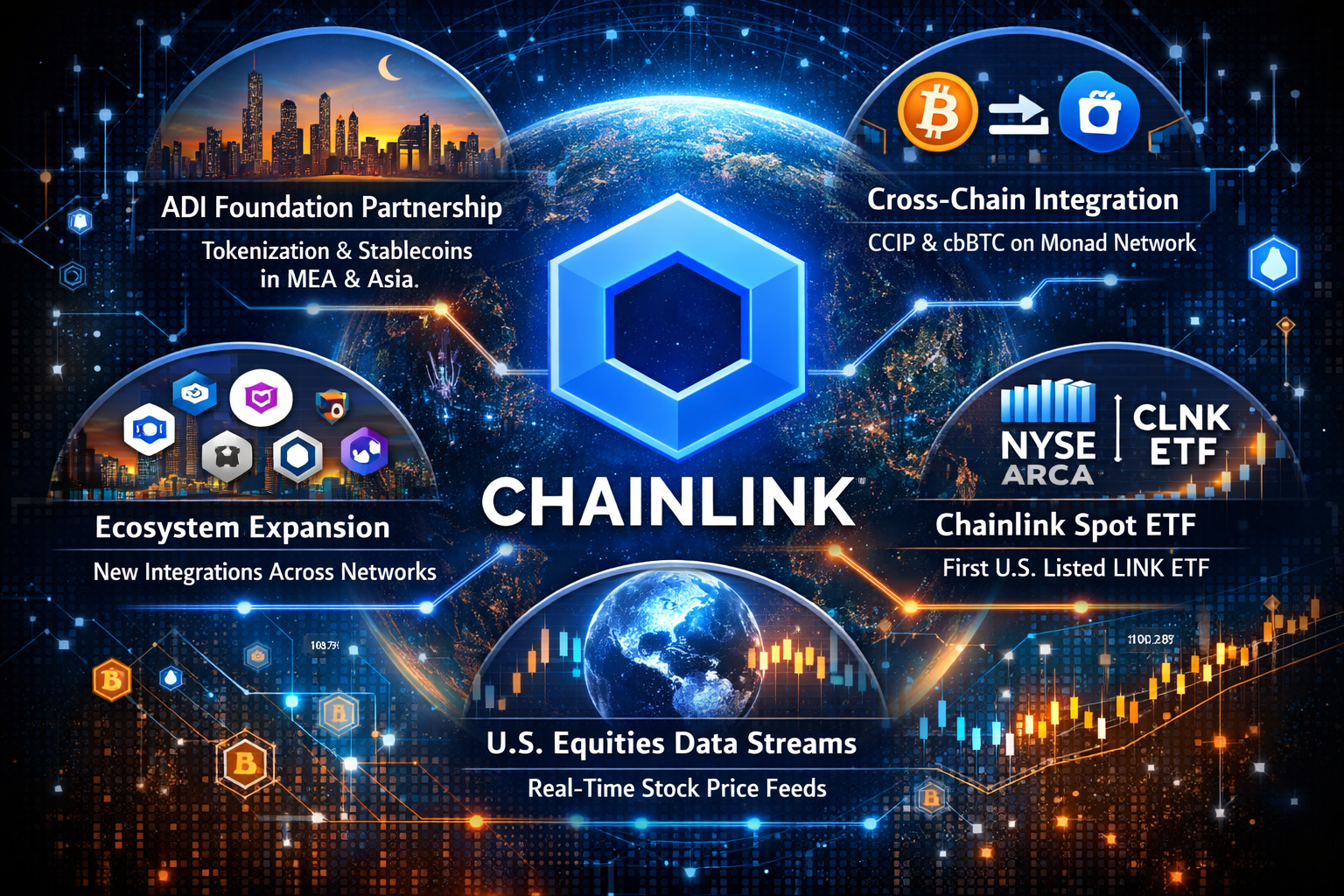
In 2026, Chainlink’s narrative continues to evolve beyond simply providing decentralized price feeds to smart contracts. As blockchain networks mature and institutional interest in tokenization and interoperability grows, Chainlink has positioned itself as a critical infrastructure layer — powering real‑world data, secure cross‑chain connectivity, and enterprise‑grade blockchain adoption.
Over the past several months, five major developments have shaped Chainlink’s trajectory:
-
Strategic global partnership with the ADI Foundation to enable stablecoins and tokenization across the Middle East, Africa, and Asia
-
Significant ecosystem expansion with dozens of integrations across multiple blockchains and services
-
Cross‑chain infrastructure growth with integrations such as Coinbase’s wrapped Bitcoin on other networks
-
Launch of continuous real‑time U.S. equity data streams for DeFi markets
-
Institutional exposure via the first U.S.‑listed spot ETF tracking LINK
Collectively, these developments signal Chainlink’s push into institutional blockchain infrastructure, cross‑chain interoperability, and real‑world asset tokenization — positioning it as a foundational Web3 network.
1. Chainlink Partners With ADI Foundation for Tokenization and Stablecoin Infrastructure
One of the most consequential announcements for Chainlink in 2026 was its strategic partnership with the ADI Foundation based in Abu Dhabi. This collaboration centers on integrating Chainlink’s Cross-Chain Interoperability Protocol (CCIP) and oracle services into the emerging ADI Chain ecosystem — with a focus on stablecoin infrastructure and tokenization across the Middle East, Africa, and Asia.
Under the partnership:
-
Chainlink’s decentralized oracle network will power stablecoin price feeds and reserve transparency mechanisms for regulated digital assets tied to real‑world currencies such as the dirham‑backed stablecoin (DDSC) licensed by the Central Bank of the UAE.
-
Chainlink’s CCIP will provide secure cross‑chain asset transfers and blockchain connectivity across major networks, enabling interoperable institutional‑grade token movements.
-
The integration is designed to support institutional DeFi, tokenized asset markets, and secure data infrastructure for financial applications built on ADI Chain and its partner networks.
This move marks an expansion of Chainlink’s footprint into regulated and institutional markets, with the partnership’s reach extending to over one billion users across emerging regions. By supplying oracle and interoperability infrastructure for DDSC and other tokenized assets, Chainlink anchors itself as a trusted infrastructure provider for blockchain‑enabled financial services backed by established institutions.
2. Broad Ecosystem Expansion Across Networks and Services
Chainlink’s adoption continues to grow across multiple blockchains and services, signaling robust developer and application engagement in early 2026.
A recent wave of expansion added 16 new integrations spanning six different Chainlink services — including Data Feeds, CCIP, Verifiable Random Function (VRF), Automation, and Functions — across five blockchains such as Arc, Canton Network, DogeOS, MegaETH, and World Chain.
Some notable integrations include:
-
Real‑time price feeds and oracle connectivity for niche blockchains that are now interoperable with Chainlink’s infrastructure.
-
Strategic adoption by networks like Canton Network, where Chainlink’s data standards and CCIP have been integrated to support regulated tokenized financial instruments.
-
Increased service adoption across broader ecosystem layers, consolidating Chainlink’s role as a multi‑service oracle infrastructure provider rather than a single function provider.
These ongoing integrations highlight the network’s continued relevance as developers build on multiple blockchains that require secure, high‑integrity data and interoperability. They also build momentum for cross‑chain applications and institutional use cases where reliable external data and chain‑agnostic messaging are essential.
3. Cross‑Chain Infrastructure: CCIP and cbBTC on Monad
Another milestone in Chainlink’s evolution involves its cross‑chain infrastructure gaining real traction through practical asset interconnectivity. The Chainlink Cross‑Chain Interoperability Protocol (CCIP) enabled the integration of Coinbase’s wrapped Bitcoin (cbBTC) onto the Monad blockchain — a development that opens more than $5 billion in Bitcoin‑linked liquidity to decentralized finance (DeFi) applications on new chains.
This integration allows users to move cbBTC — a Bitcoin representation from Coinbase — directly from Base (Coinbase’s layer‑2 network) to Monad without relying on third‑party bridges.
Why This Matters
-
Expanded Bitcoin Liquidity: By bringing a multi‑billion‑dollar Bitcoin derivative into new on‑chain markets, Chainlink helps unlock liquidity that can be deployed in lending, yield strategies, and other DeFi services across different ecosystems.
-
Strengthens Institutional Infrastructure: CCIP’s role in facilitating cross‑chain transfers underscores Chainlink’s positioning as a gateway between traditional assets and blockchain‑native finance.
-
Encourages Secure Interoperability: Integrations like this reduce reliance on less secure bridging methods, helping institutional players feel more confident about on‑chain asset transfers.
This development is part of a broader trend where Chainlink’s cross‑chain protocols become the connective tissue between disparate blockchains, enabling a more integrated and versatile Web3 infrastructure.
4. Real‑Time U.S. Equities Data Streams: Bridging TradFi & DeFi
In January 2026, Chainlink made headlines with the launch of its 24×5 U.S. Equities Streams — a data infrastructure breakthrough that provides continuous sub‑second price feeds for thousands of U.S. stocks and exchange‑traded funds.
This service addresses a long‑standing challenge: blockchain networks operate continuously, while traditional stock markets typically have set trading hours. Chainlink’s equities streams extend coverage beyond regular trading windows so that on‑chain applications can reference prices even during pre‑market and after‑hours sessions.
Implications of Equities Streams
-
Enables Institutional DeFi Products: On‑chain derivatives, lending platforms, and synthetic asset protocols can now reference real‑time equity prices, enhancing the viability of tokenized traditional assets.
-
Bridges TradFi and Web3: Markets that were historically siloed — such as equities and DeFi — now share synchronized data, enabling converged financial products on blockchain.
-
Improves Financial Infrastructure: High‑frequency, reliable price data expands Chainlink’s appeal to financial institutions and developers building regulated financial products.
This launch demonstrates Chainlink’s emphasis on connecting real‑world financial markets with decentralized finance, helping unlock broader utility for programmable financial systems.
5. Bitwise Spot ETF Launch Brings Chainlink to Traditional Markets
Another major development in early 2026 was the approval and launch of the first U.S.‑listed spot ETF tied to Chainlink’s token, trading under the ticker CLNK on the NYSE Arca exchange.
Unlike futures‑based products, the ETF holds actual LINK tokens in custody, allowing mainstream investors to gain exposure to Chainlink infrastructure without interacting directly with crypto exchanges or crypto wallets.
Why the ETF Matters
-
Broader Investor Access: Retail investors, institutions, and advisors can hold exposure to Chainlink through traditional brokerage accounts, increasing accessibility and liquidity.
-
Regulatory Recognition: Approval from the U.S. Securities and Exchange Commission suggests increasing regulatory acceptance of utility‑based blockchain infrastructure tokens.
-
Portfolio Diversification: The ETF expands digital asset investment choices beyond Bitcoin and Ethereum, potentially attracting a different class of institutional capital.
This marks a significant milestone in the evolution of blockchain infrastructure tokens — legitimizing them as investable assets in regulated financial markets.
Strategic Implications: Chainlink’s Role in Web3 Infrastructure
When viewed collectively, these developments point to several strategic themes:
Institutional Integration and Real‑World Asset Tokenization
Chainlink’s partnerships — especially with the ADI Foundation — emphasize its role in powering regulated tokenization strategies, bridging stablecoin infrastructure and institutional DeFi.
Cross‑Chain Interoperability as a Growth Vector
By driving integrations like cbBTC on Monad and expanding CCIP adoption across networks, Chainlink strengthens its position as a leading cross‑chain infrastructure provider.
Data Infrastructure Beyond Price Feeds
Expanding into continuous equity price streams positions Chainlink as an indispensable data backbone for decentralized markets that reference real‑world financial assets.
Mainstream Financial Access
The launch of the Chainlink spot ETF on NYSE Arca reinforces Chainlink’s transition into regulated investment environments.
These themes reinforce Chainlink’s core philosophy: secure, decentralized connectivity between on‑chain logic and off‑chain data — whether that data represents market prices, tokenized assets, cross‑chain messaging, or institutional liquidity flows.
Conclusion
2026 is shaping up to be a transformative year for Chainlink. The network is no longer just a provider of decentralized oracle services; its infrastructure now supports institutional tokenization platforms, real‑time financial data streams, cross‑chain connectivity, and regulated investment products.
From powering stablecoin and tokenized asset frameworks in the Middle East and Africa to enabling continuous U.S. equities data for decentralized markets, Chainlink’s expanding value proposition underscores why it is increasingly regarded as critical infrastructure for Web3 and institutional blockchain adoption.
The integration of advanced services like CCIP across multiple networks and the launch of a dedicated spot ETF affirm Chainlink’s positioning at the intersection of traditional finance and decentralized technology — building the connective rails that enable digital assets, financial products, and institutional participation at scale.