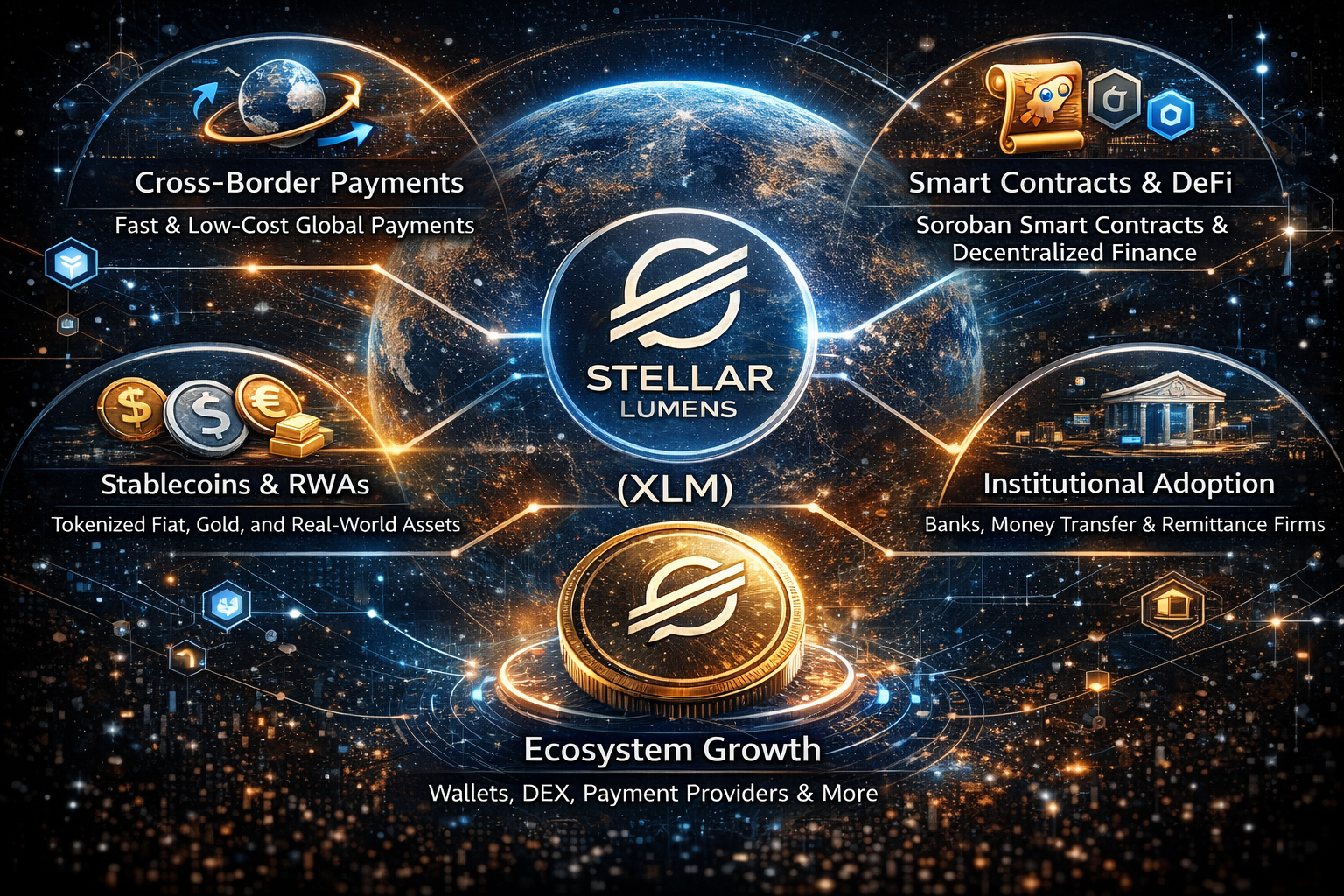
Stellar Lumens (XLM) has emerged as one of the most influential blockchain platforms aimed at financial inclusion, cross-border payments, and decentralized finance (DeFi). Founded in 2014, Stellar has positioned itself as a high-speed, low-cost blockchain network designed to bridge traditional finance with blockchain technology. In this evergreen article, we explore Stellar’s history, technology, use cases, ecosystem growth, and its long-term potential in 2026 and beyond.
What is Stellar Lumens?
Stellar is an open-source blockchain platform designed to connect banks, payment providers, and individuals in a fast, secure, and affordable network for transferring digital assets. Its native cryptocurrency, Lumens (XLM), acts as a bridge currency to facilitate cross-border transactions and maintain liquidity across different fiat currencies.
Key objectives of Stellar include:
-
Financial inclusion: Bringing unbanked populations access to digital financial services.
-
Fast, cheap transactions: Reducing the cost and time of cross-border payments to seconds and fractions of a cent.
-
Decentralized exchange functionality: Allowing users to trade any asset on the network via its built-in distributed exchange (DEX).
Unlike Bitcoin or Ethereum, Stellar’s main focus is not speculative investment but efficient asset transfer and financial interoperability, making it highly relevant for real-world payment solutions.
How Stellar Works
At the heart of Stellar is the Stellar Consensus Protocol (SCP), which allows for faster transaction validation without relying on energy-intensive proof-of-work mechanisms. SCP enables the network to reach consensus among nodes quickly and securely while maintaining decentralization.
Key components include:
-
Nodes: Participants validating transactions. Unlike mining-based networks, nodes in Stellar vote on transaction validity.
-
Lumens (XLM): The native asset used to pay transaction fees and prevent spam on the network.
-
Anchors: Trusted entities that issue fiat-backed tokens on the network. For example, a bank might issue digital USD on Stellar that users can transact with.
-
Decentralized Exchange (DEX): Users can trade assets issued by anchors directly on the network.
-
Payment Channels & Multi-Currency Transactions: Lumens act as a bridge between different currencies, enabling instant exchanges without intermediaries.
Stellar’s Use Cases
Stellar has evolved from being a simple payment blockchain into a network capable of supporting multiple real-world financial applications. Some of its key use cases include:
1. Cross-Border Payments
Stellar’s primary goal is to make cross-border transactions fast and cheap, enabling remittances to underserved regions. Partnerships with organizations like IBM World Wire and MoneyGram have demonstrated the network’s capability to handle large-scale international payments.
For example:
-
A user in Kenya can send money to a relative in India in seconds, paying a fraction of traditional remittance fees.
-
Banks can settle transactions across borders in near real-time using Stellar as the settlement layer.
2. Tokenization of Assets
Stellar supports tokenized assets, allowing businesses and individuals to issue digital representations of fiat currencies, commodities, or even loyalty points. This functionality expands Stellar’s utility beyond payments into tokenized finance.
Examples include:
-
USD, EUR, and other fiat-backed stablecoins issued on Stellar.
-
Gold-backed tokens enabling easier trading and global liquidity.
3. Decentralized Finance (DeFi)
While Stellar is not primarily a DeFi network like Ethereum or Solana, its built-in decentralized exchange and smart contract platform (Soroban) allow for financial applications such as:
-
Lending and borrowing platforms
-
Automated market makers (AMMs)
-
Token swaps and liquidity pools
Soroban, Stellar’s smart contract framework, introduced more flexible, secure, and low-cost programming for decentralized applications in 2025-2026, allowing developers to build DeFi products without high transaction fees or congestion.
Stellar’s Ecosystem
Over the years, Stellar has grown a robust ecosystem of wallets, exchanges, anchors, and applications that support both individuals and institutions.
Wallets & Payment Platforms
Popular Stellar wallets include:
-
Lobstr Wallet: A user-friendly mobile and web wallet for managing XLM and tokenized assets.
-
Solar Wallet: Supports multi-signature accounts and advanced trading on Stellar DEX.
-
Ledger & Trezor: Hardware wallets provide secure offline storage for XLM.
Exchanges
Stellar is listed on major exchanges globally, allowing for easy fiat-to-crypto transactions. Platforms like Binance, Kraken, and Bitstamp support XLM trading paired with USD, EUR, BTC, and other cryptocurrencies.
Anchors & Payment Providers
Stellar’s network relies on anchors, trusted entities that issue fiat-backed tokens and provide liquidity. Anchors can be banks, fintech companies, or remittance providers. Examples include:
-
Tempo Money: Uses Stellar for remittances across Europe.
-
SatoshiPay: Implements microtransactions using XLM to support online content payments.
Enterprise Partnerships
Stellar has focused heavily on enterprise adoption, with partnerships including:
-
IBM World Wire: A blockchain-powered cross-border payment network.
-
Stripe & Keychain: For tokenized payments and fast settlement.
These collaborations highlight Stellar’s potential as a global financial rail for both individuals and institutions.
Key Advantages of Stellar Lumens
Stellar offers several advantages compared to other blockchain networks:
-
Low Transaction Fees: Sending XLM costs only fractions of a cent, making microtransactions feasible.
-
Speed: Transactions are confirmed within 3–5 seconds, unlike Ethereum’s 10–15 seconds or Bitcoin’s 10 minutes.
-
Decentralization with Scalability: The Stellar Consensus Protocol ensures decentralized validation while maintaining high throughput.
-
Bridging Traditional Finance and Crypto: Stellar’s anchors and partnerships facilitate integration with banks and payment networks.
-
Smart Contracts with Soroban: New smart contract capabilities enable DeFi, tokenization, and programmable financial applications.
Challenges and Considerations
While Stellar has many advantages, it faces challenges:
-
Competition from Other Networks: Ethereum, Solana, Algorand, and Avalanche offer competing DeFi and smart contract ecosystems.
-
Regulatory Uncertainty: Cross-border payment platforms must comply with various jurisdictions’ regulations.
-
Adoption Rate: While Stellar has enterprise partnerships, broad adoption among smaller businesses and individual users is ongoing.
Despite these challenges, Stellar’s focus on simplicity, speed, and affordability gives it a unique position in the global financial ecosystem.
The Future of Stellar
Stellar’s roadmap for 2026–2027 includes several promising developments:
-
Soroban Smart Contract Expansion: Increased support for complex DeFi applications and programmable financial instruments.
-
Stablecoin and RWA Integration: Growth in tokenized fiat, gold, and other real-world assets for payments and lending.
-
Institutional Adoption: More banks and financial institutions adopting Stellar as a settlement layer for cross-border payments.
-
Partnership Expansion: Collaborations with fintechs and governments to enable financial inclusion initiatives.
-
Decentralized Finance Growth: Increased developer activity on Soroban, enabling low-cost DeFi applications.
As more financial institutions and developers leverage Stellar for both payments and tokenized financial instruments, its role as a global settlement layer is expected to grow significantly.
Why XLM Matters
The Lumens token (XLM) is more than just a cryptocurrency for speculation. Its primary roles include:
-
Facilitating cross-border transactions as a bridge currency
-
Reducing transaction spam and costs on the network
-
Enabling decentralized exchange functionality
-
Supporting microtransactions and programmable finance
By maintaining liquidity and acting as the backbone of Stellar’s financial operations, XLM ensures that the network remains efficient, scalable, and attractive for both retail and institutional users.
Conclusion
Stellar Lumens (XLM) represents one of the most practical and forward-thinking blockchain projects in the cryptocurrency ecosystem. Its focus on financial inclusion, low-cost transactions, and enterprise-ready solutions distinguishes it from networks primarily targeting DeFi speculation or NFT platforms.
With continued ecosystem growth, smart contract expansion via Soroban, and partnerships with global financial institutions, Stellar is well-positioned to bridge the gap between traditional finance and blockchain technology.
For beginners and seasoned investors alike, Stellar remains a compelling project, not just for its token XLM, but for its vision of a decentralized, fast, and inclusive financial network capable of powering payments, DeFi, and tokenized assets across the globe.