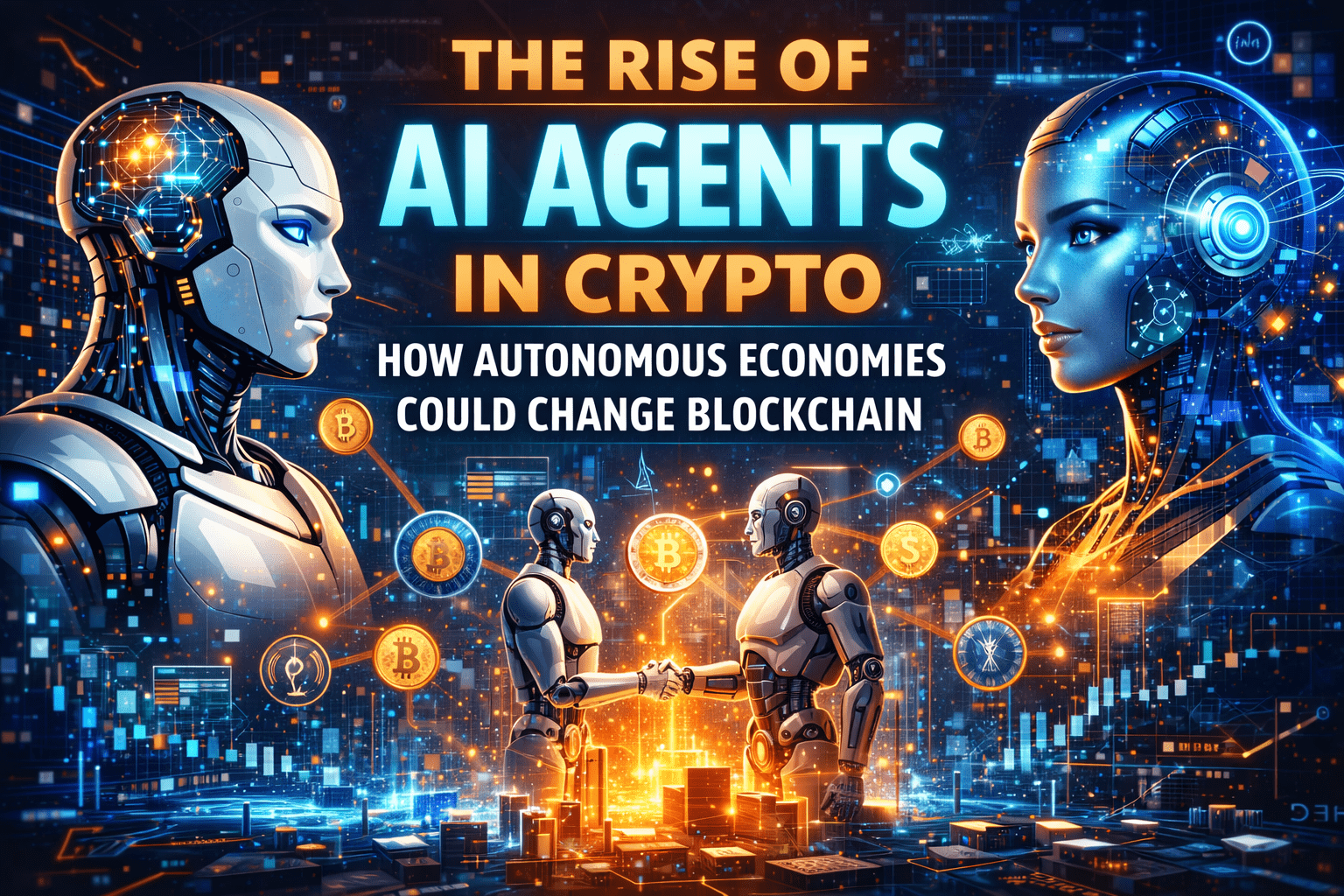
Artificial intelligence is rapidly transforming the global technology landscape. At the same time, blockchain technology continues to evolve as a decentralized infrastructure for financial systems, digital ownership, and secure data exchange. When these two powerful technologies converge, they create a new concept that many experts believe could reshape the future of digital economies: AI agents operating on blockchain networks.
AI agents are autonomous software programs capable of making decisions, executing tasks, and interacting with other systems without human intervention. When powered by decentralized blockchain infrastructure, these agents can operate in open networks where trust, payments, and coordination occur automatically.
This emerging model is often described as the foundation of autonomous digital economies, where machines interact with machines, negotiate services, exchange data, and execute financial transactions on their own.
In this AltcoinsAnalysis deep dive, we explore how AI agents work, why they are becoming important in the blockchain ecosystem, and which crypto projects are leading the development of this revolutionary technology.
What Are AI Agents?
AI agents are software entities designed to perform tasks independently based on data inputs, machine learning models, and predefined objectives. Unlike traditional software programs that follow rigid instructions, AI agents can adapt their behavior as they process new information.
In the context of blockchain networks, these agents can perform activities such as:
-
Executing trades on decentralized exchanges
-
Managing supply chain logistics
-
Coordinating decentralized finance strategies
-
Automating payments between services
-
Negotiating contracts with other digital agents
By combining artificial intelligence with blockchain-based trust mechanisms, these systems can operate in decentralized environments without centralized control.
Why Blockchain Is Essential for AI Agents
AI agents require a secure infrastructure to operate effectively. Blockchain networks provide several important features that make them ideal environments for autonomous systems.
1. Trustless Transactions
Blockchain enables secure transactions without intermediaries. AI agents can send and receive cryptocurrency payments directly when executing services.
For example, an AI-powered logistics agent could automatically pay a shipping provider once goods arrive at their destination.
2. Smart Contracts
Smart contracts allow agreements to be executed automatically when specific conditions are met. This enables AI agents to interact with financial systems and digital marketplaces securely.
Platforms like Ethereum have already demonstrated how programmable smart contracts can automate complex transactions across decentralized applications.
3. Decentralized Identity
Blockchain systems allow AI agents to maintain persistent identities on decentralized networks. These identities can store reputational data, transaction history, and permissions.
This makes it possible for AI agents to build trust relationships with other agents and human users.
4. Digital Payments Infrastructure
Cryptocurrencies such as Bitcoin and other blockchain-based assets allow AI agents to exchange value instantly across global networks.
This payment capability is essential for autonomous economies where machines transact with each other continuously.
The Concept of Autonomous Economies
One of the most exciting ideas emerging from AI and blockchain integration is the concept of machine-driven economic systems.
In these systems, AI agents can:
-
Offer services
-
Purchase computing resources
-
Exchange data
-
Manage supply chains
-
Execute financial strategies
All without direct human oversight.
These machine-to-machine economies could operate continuously, optimizing efficiency across industries such as logistics, energy distribution, financial trading, and digital infrastructure.
For example, an AI agent managing a renewable energy grid could automatically sell excess power to another network through a blockchain marketplace.
Leading Crypto Projects Building AI Agent Ecosystems
Several blockchain projects are already building infrastructure designed specifically for autonomous AI agents.
Fetch.ai (FET)
Fetch.ai is one of the most prominent projects focused on AI agent economies.
The platform enables developers to create autonomous economic agents (AEAs) capable of performing tasks like:
-
Booking transportation services
-
Managing smart city infrastructure
-
Optimizing logistics networks
These agents can interact with each other through decentralized marketplaces powered by blockchain technology.
The project aims to create a global network where AI agents coordinate complex systems more efficiently than traditional centralized platforms.
Ocean Protocol (OCEAN)
AI agents rely heavily on access to large datasets. Ocean Protocol provides decentralized data marketplaces where information can be shared securely while preserving privacy.
This infrastructure allows AI agents to purchase or access datasets needed for machine learning models.
Ocean Protocol’s system enables organizations to monetize data without losing control over sensitive information.
SingularityNET (AGIX)
SingularityNET is building a decentralized marketplace for artificial intelligence services.
The platform allows developers to upload AI algorithms that can be accessed by other applications and AI agents.
Founded by AI researcher Ben Goertzel, the project aims to create an open and decentralized ecosystem for artificial intelligence development.
AI agents within this network could access specialized AI tools, enabling complex collaborative intelligence systems.
Bittensor (TAO)
Bittensor takes a different approach by creating a decentralized network where machine learning models collaborate and compete.
Participants contribute AI models to the network and receive rewards based on the value their models provide.
This structure incentivizes the development of increasingly powerful AI systems within a decentralized environment.
Over time, Bittensor could evolve into a global decentralized neural network.
Real-World Applications of AI Agent Economies
The combination of AI agents and blockchain infrastructure could unlock entirely new applications.
Smart Cities
AI agents could coordinate traffic systems, transportation networks, and energy usage across urban environments.
Autonomous Supply Chains
Logistics agents could automatically negotiate shipping contracts, track inventory, and optimize delivery routes.
Decentralized Finance
AI trading agents could manage complex investment strategies across multiple decentralized finance platforms.
Energy Markets
Autonomous agents could manage renewable energy distribution, automatically trading surplus power between grids.
Cloud Computing
AI systems could dynamically purchase computing resources from decentralized networks.
Challenges Facing AI Agent Economies
While the technology is promising, several challenges must still be addressed.
Regulatory Uncertainty
Governments are still developing regulations for both artificial intelligence and cryptocurrencies.
Security Risks
Autonomous systems must be designed carefully to prevent malicious behavior or vulnerabilities.
Technical Complexity
Building scalable networks capable of supporting millions of interacting AI agents remains a significant engineering challenge.
The Future of AI Agents in Crypto
Despite these challenges, the integration of artificial intelligence and blockchain technology continues to accelerate.
Many researchers believe that AI agents could become one of the most important innovations in the crypto ecosystem over the next decade.
As decentralized networks mature and artificial intelligence models become more sophisticated, autonomous agents could begin performing increasingly complex economic activities.
In this future, digital economies may no longer rely solely on human participation. Instead, machines, algorithms, and intelligent agents could collaborate with people to manage financial systems, infrastructure, and digital marketplaces.
For the blockchain industry, this evolution could represent the next major phase of technological innovation.
Final Thoughts
The rise of AI agents in crypto represents a powerful shift toward autonomous digital economies. By combining artificial intelligence with decentralized blockchain infrastructure, developers are building systems capable of coordinating economic activity without centralized control.
Projects like Fetch.ai, Ocean Protocol, SingularityNET, and Bittensor are among the pioneers exploring this new frontier.
While the technology remains in its early stages, the potential impact could be enormous. As AI continues advancing and blockchain networks expand globally, the idea of autonomous economies may move from theory to reality.
For investors, developers, and technology enthusiasts following the future of crypto, AI agents could become one of the most important trends shaping the next generation of blockchain innovation.