

IOTA Works. The Price Doesn’t. Here’s the Problem.
If you bought IOTA at the start of 2021 and held it to today, the chart has been merciless. On Jan. 1, 2021, IOTA closed around $1.43; on Jan. 1, 2022, it was $0.17; on Jan. 1, 2023, it was $0.32; on Jan. 1, 2024, it was $0.29; on Jan. 1, 2025, it was $0.084; and today it is around $0.0568. That is not a normal drawdown. That is a five-year collapse in market belief, with the token now roughly 96.0% below the Jan. 1, 2021 level and 98.9% below its $5.25 all-time high.
That is why so many IOTA holders sound tired instead of bullish. They are not complaining because nothing is being built. They are complaining because they have watched real work pile up while their portfolios kept shrinking, and the market has not rewarded the effort in any meaningful way. In Reddit threads, long-term holders repeatedly describe the same emotional pattern: years of overhype, slow delivery, missed expectations, and the feeling that they are still being asked for patience after already paying the price.
Related: IOTA Tried to Build Everything… Here’s Why It Didn’t Work
The uncomfortable truth is that the Foundation is doing something real. The clearest proof is TWIN, the Trade Worldwide Information Network, which the foundation now describes as fully integrated with the IOTA mainnet since early January 2026. The Foundation says the first transactions are already live and expects a rapid rollout through 2026 across Kenya, Ghana, the UK, and more partner countries. That matters because it moves IOTA out of the “someday” category and into actual trade infrastructure.
This was not dropped into the world overnight. In May 2025, IOTA co-hosted the East Africa Web3 Innovation Summit in Nairobi with TradeMark Africa, explicitly framing the network around trade, logistics, and sustainability in the region. The Foundation also used that moment to introduce TWIN as a decentralized data infrastructure built on IOTA for cross-border trade. The message was clear: IOTA was no longer trying to win the crypto crowd first; it was trying to wire itself into real economic systems.
By Q2 2025, the Foundation was already calling the Rebased mainnet launch and the debut of the TWIN Foundation a landmark quarter. That same report said the foundation had entered a new phase of collaboration with the Tony Blair Institute for Global Change through an MoU around trusted digital public infrastructure, while also pushing adoption of IOTA Identity and Gas Station tools. The strategy is obvious: build infrastructure for trade, identity, and compliance, then connect it to institutions that actually move real-world value.
There is also newer evidence that the Foundation is still trying to broaden the story beyond trade alone. In March 2026, IOTA announced support on Bullish, describing the listing as a path to regulated institutional access and deeper liquidity. In the Q1 2026 progress update, the Foundation said the MasterZ × IOTA Hackathon drew more than 60 teams, with many concepts clustering around trade, real-world assets, and identity. That suggests the Foundation is not standing still; it is trying to build a full stack around the same core thesis.
Related: IOTA Expands With 66 New Products From European Hackathon
And yet Shimmer still hangs over the conversation like a reminder of how messy IOTA’s ecosystem has been. In November 2024, the Foundation said the IOTA Rebased proposal would make Shimmer a staging network redundant, even while allowing it to pursue a different role. Before that, official governance results in 2024 showed that some Shimmer votes failed to reach quorum, which is exactly the sort of detail that feeds community cynicism: a network built to decentralize participation still struggling to mobilize it. For holders who already feel ignored, that is not a small issue. It looks like another sign that the project keeps changing shape faster than the community can keep up.
That is where the grief really sits. Many holders are not saying IOTA is fake. They are saying the price has stopped reflecting the work, and they do not know whether that is because the market does not understand the roadmap or because the roadmap does not translate into token demand fast enough. Today, IOTA is trading around $0.0568, with a market cap of nearly $249.8 million and daily volume around $11.9 million, which is a long way from the enthusiasm that once surrounded the project. The market is not calling this a failure of engineering. It is calling it a failure of timing, capture, and narrative.
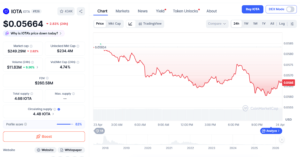
IOTA Price chart
That is the core of the investor’s frustration. A trade infrastructure can be useful without being price-accretive in the short run, and that may be exactly what has happened here. TWIN can grow, Kenya and the UK can deepen usage, Bullish can improve access, and the market can still leave the token behind for longer than holders think is reasonable. That is an inference, but it is the only one that fits the data, the roadmap, and the mood inside the community all at once.
Related: IOTA Powers Healthcare Transformation in Argentina With Vitalnode Project
So the IOTA story is not simply “community versus Foundation.” It is more painful than that. It is a story of believers who watched a project keep building, then watched the market keep refusing to care. It is a story of investors who are still hopeful because the work is real, but sad and frustrated because years of progress have not undone years of losses.
And until IOTA proves that its real-world traction can become visible market demand, that emotional divide will keep widening.
Related: IOTA Just Flipped a Major Switch: Starfish Is Live on Mainnet (And It Changes Everything)
About The Author