It started as a post buried in a fast-moving thread tied to Shiba Inu, the kind that usually disappears within hours. This one didn’t. It spread, got reposted, screenshotted, and echoed across groups, not because it was outrageous, but because too many people recognized themselves in it. The details were extreme—selling a truck, tracking “adoption metrics,” and defending the ecosystem at all costs—but the reaction made something clear: this wasn’t one person’s mindset; it was a shared one.
What made the post land wasn’t the exaggeration; it was the familiarity beneath it. Over the past five years, SHIB has taken holders through one of the most volatile journeys in crypto, from explosive gains in 2021 to long stretches where the price failed to recover meaningfully.
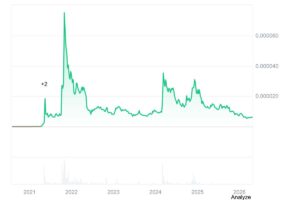
The chart above reflects that gap between expectation and outcome, but inside the community, it shows up differently. It shows up as endurance, as reframing, as a refusal to accept that the story might not play out the way it once seemed certain to.
The lead developer of SHIB told me to buy the ecosystem.
I did not ask questions. Questions are for people who do not trust Shytoshi.
I sold the truck the same afternoon.
I have sent the phrase "few understand" to 1,400 people since then. Eleven bought in. Seven still speak to… pic.twitter.com/r0dVKnESpc
— Pulse Digital (@CryptoPulse9) April 23, 2026
Five Years of Price Action, One Persistent Narrative
The post didn’t ignore the price; it absorbed it and reshaped it. Losses were described as positioning, delays as development, and underperformance as proof of being early rather than wrong. That framing is not unique to one user, and the widespread agreement it received suggests it has become part of the ecosystem’s internal logic. When enough people repeat the same interpretation, it stops sounding like justification and starts feeling like truth.
At the same time, the underlying tension remains unresolved. The SHIB ecosystem has continued to evolve through initiatives like Shibarium and expanding utility narratives, yet the price has not consistently reflected that progress. Over five years, each cycle has reinforced this contradiction, with development moving forward while market validation lags behind. That gap is where most of the frustration lives, even when it isn’t openly expressed.
Related: Dogecoin, Shiba Inu, and Pepe Surge, but Analysts Warn of a Dead Cat Bounce
Conviction That Outlasts the Market
What the post ultimately revealed is how deeply conviction has taken root within parts of the community. It is no longer just about holding an asset but about maintaining alignment with a belief system that explains both the highs and the lows. Phrases like “few understand” are not just slogans; they are a way of maintaining cohesion when external validation disappears. The more the market resists, the more tightly that belief is held.
Figures like Shytoshi Kusama continue to shape that belief, providing direction and narrative for a community that is still searching for its next defining moment. But the longer price and progress remain disconnected, the more pressure that narrative has to carry on its own. The viral post didn’t create that tension; it exposed it. And the fact that so many agreed with it suggests that, for now, the defining state of SHIB is not hype or collapse, but something far more uncertain: a community still holding on, still hoping, and still convinced that understanding will eventually be enough.
Related: Shiba Inu Sees 5,000+ New SHIB Holders Overnight… But There’s a Catch
About The Author