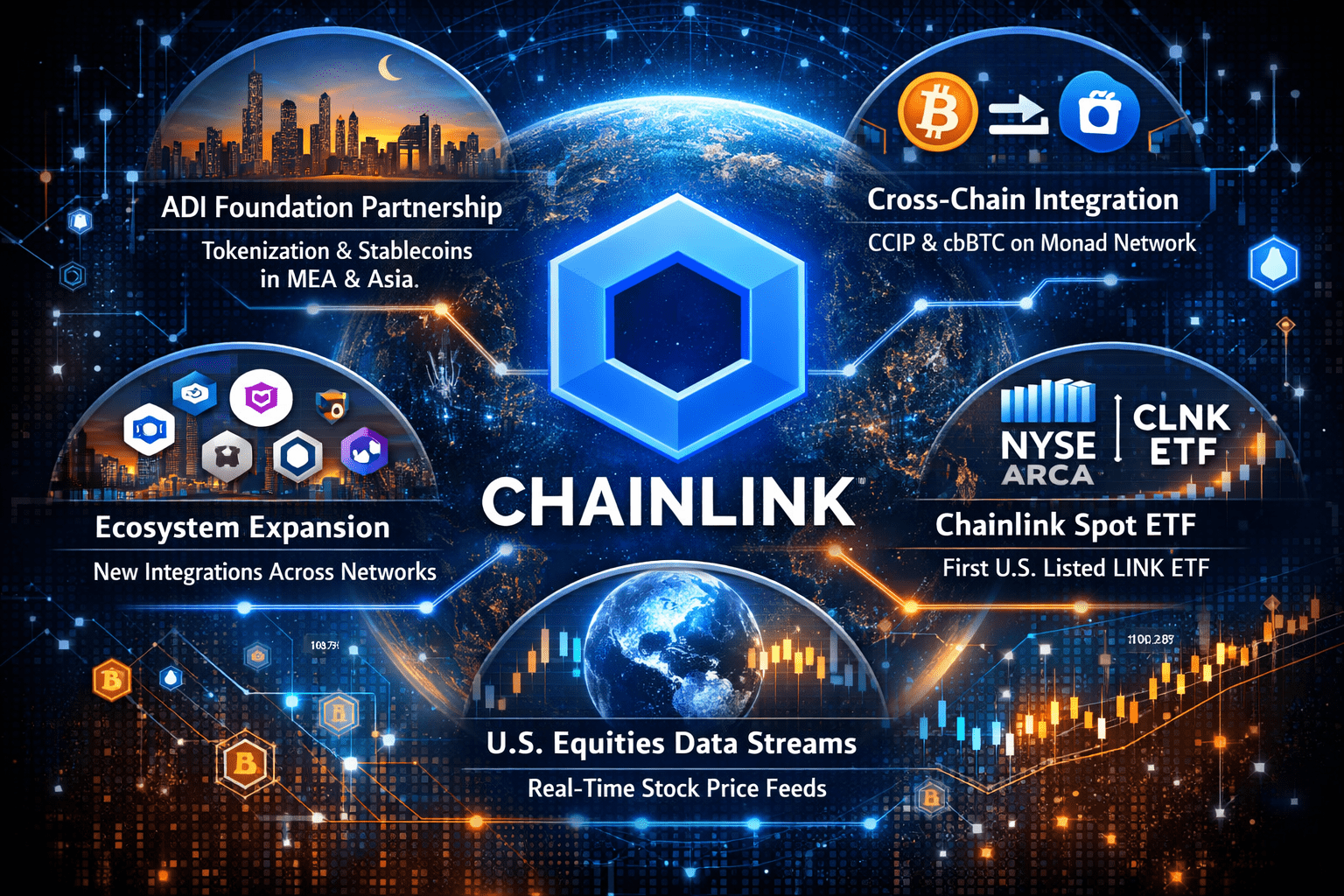
This article explores how Chainlink (LINK) powers DeFi.
The rise of decentralized finance (DeFi) has created a new financial ecosystem powered by blockchain technology and smart contracts. Platforms built on networks like Ethereum allow developers to create decentralized exchanges, lending protocols, derivatives platforms, and countless other financial tools without relying on banks or centralized intermediaries.
However, smart contracts have a major limitation: they cannot access real-world data on their own. This challenge, commonly referred to as the oracle problem, has become one of the biggest obstacles to the expansion of blockchain-based applications.
This is where Chainlink plays a crucial role. Chainlink is a decentralized oracle network that connects blockchains with real-world data sources, enabling smart contracts to operate using accurate and secure information. Over time, Chainlink has evolved into one of the most important infrastructure layers in the crypto ecosystem.
In this comprehensive guide, we explore how Chainlink powers DeFi price feeds, whether LINK may be undervalued, the top projects within the Chainlink ecosystem, how staking works, how it compares with Band Protocol, and its role in tokenizing real-world assets.
How Chainlink (LINK) Powers DeFi Price Feeds
One of the most important services provided by Chainlink is its decentralized price feed system. DeFi platforms rely heavily on accurate pricing data to function properly. Lending platforms, derivatives markets, and decentralized exchanges all require reliable asset valuations.
For example, if a lending protocol accepts cryptocurrency as collateral, it must know the exact value of that collateral at all times. If the price data is incorrect or manipulated, the entire platform could face liquidation errors, financial losses, or even system failure.
Chainlink solves this problem through decentralized oracle networks that gather data from multiple sources and deliver verified price feeds to smart contracts.
Instead of relying on a single centralized data provider, Chainlink aggregates price information from multiple exchanges and independent oracle nodes. This process significantly reduces the risk of manipulation because no single entity controls the data.
Many leading DeFi platforms rely on Chainlink price feeds to maintain accurate market data. These feeds help ensure secure operations for decentralized applications across several blockchain ecosystems, including Avalanche, Polygon, and BNB Chain.
Without reliable oracle systems like Chainlink, many DeFi protocols would struggle to operate safely and efficiently.
Is Chainlink Undervalued? A Fundamental Analysis
Within the cryptocurrency market, Chainlink has long been considered one of the most important infrastructure projects. Yet many analysts believe its long-term value is still underestimated compared to its role in the blockchain ecosystem.
Several factors support the argument that Chainlink could be undervalued.
First, Chainlink serves as critical infrastructure rather than a standalone financial platform. Much like internet protocols that power the web behind the scenes, Chainlink operates as a foundational service used by many other projects.
Second, the growth of decentralized finance and tokenized real-world assets increases demand for reliable oracle systems. As more applications rely on external data, oracle networks become increasingly important.
Third, Chainlink continues expanding its technology stack. Features like Chainlink CCIP (Cross-Chain Interoperability Protocol) aim to connect multiple blockchains, enabling secure data and asset transfers between networks.
Additionally, the project was founded by Sergey Nazarov and Steve Ellis, both of whom remain active in guiding the network’s long-term development.
While cryptocurrency prices are influenced by market cycles and investor sentiment, Chainlink’s role as an infrastructure provider gives it long-term relevance across many blockchain sectors.
Top 10 Chainlink Ecosystem Projects
The Chainlink ecosystem includes hundreds of decentralized applications that use its oracle services. Below are some notable projects and protocols connected to the Chainlink infrastructure.
1. Aave
A major decentralized lending protocol that relies on Chainlink price feeds to determine collateral values.
2. Synthetix
A derivatives platform that uses Chainlink data feeds to track synthetic asset prices.
3. dYdX
A decentralized trading platform that integrates oracle data for derivatives markets.
4. Curve Finance
A DeFi protocol specializing in stablecoin trading and liquidity pools.
5. PancakeSwap
A decentralized exchange on BNB Chain that utilizes oracle feeds for price data.
6. Venus Protocol
A lending and borrowing platform that depends on secure price information.
7. Kyber Network
A liquidity protocol that aggregates liquidity from multiple sources.
8. Nexus Mutual
A decentralized insurance platform that benefits from external data feeds.
9. Arbol
A blockchain-based climate risk platform using weather data through oracles.
10. Truflation
A decentralized inflation tracking platform powered by oracle data.
These projects demonstrate how Chainlink supports a wide variety of decentralized financial applications.
How to Stake LINK and Earn Rewards
Staking has become an important feature of the Chainlink ecosystem. LINK staking helps improve the security and reliability of the oracle network while rewarding participants.
In the staking model, participants lock their LINK tokens into the network to support oracle operations. These tokens act as collateral, ensuring that node operators provide accurate data.
If a node behaves dishonestly or provides inaccurate information, part of its staked LINK can be penalized. This mechanism encourages honest behavior across the oracle network.
The staking process typically involves the following steps:
-
Acquire LINK tokens from a cryptocurrency exchange.
-
Connect a compatible wallet to the Chainlink staking platform.
-
Deposit LINK tokens into the staking pool.
-
Earn rewards based on network participation.
Staking also aligns incentives between developers, node operators, and token holders, strengthening the overall ecosystem.
Chainlink vs Band Protocol: Which Oracle Network Is Better?
While Chainlink dominates the oracle sector, it is not the only project addressing the oracle problem. One notable competitor is Band Protocol.
Both networks aim to deliver reliable data to smart contracts, but they differ in architecture and adoption.
Chainlink is widely considered the market leader due to its extensive integrations, long development history, and strong partnerships within the DeFi ecosystem.
Band Protocol operates on the Cosmos ecosystem and focuses on providing cross-chain oracle services with lower transaction costs.
However, Chainlink maintains several advantages:
-
Larger developer ecosystem
-
More integrations across blockchains
-
Highly trusted price feeds
-
Advanced services like CCIP and VRF
While competition in the oracle sector continues to grow, Chainlink remains the most widely adopted oracle network in the blockchain industry.
Chainlink and the Future of Real-World Asset Tokenization
One of the most exciting developments in the blockchain space is the rise of tokenized real-world assets (RWAs).
Tokenization involves representing traditional financial assets such as stocks, bonds, commodities, or real estate on blockchain networks. These digital tokens can then be traded, transferred, or used in decentralized finance applications.
However, tokenized assets require accurate real-world data to function correctly. For example, a tokenized bond must reference interest rates, payment schedules, and financial data from traditional markets.
Chainlink plays a critical role in this process by providing secure data feeds that connect blockchain systems to external financial infrastructure.
Through innovations like the Cross-Chain Interoperability Protocol (CCIP), Chainlink aims to enable seamless communication between traditional financial institutions and blockchain networks.
Major financial institutions have begun exploring blockchain solutions for asset tokenization, and oracle networks are expected to be essential components of this emerging sector.
Final Thoughts
Chainlink has established itself as one of the most essential infrastructure projects in the cryptocurrency ecosystem. By solving the oracle problem and enabling smart contracts to interact with real-world data, the network powers many of the applications driving the decentralized finance revolution.
From secure price feeds and staking mechanisms to cross-chain interoperability and real-world asset tokenization, Chainlink continues expanding its capabilities and strengthening its role within the blockchain industry.
As decentralized applications grow more sophisticated and traditional finance begins integrating blockchain technology, the demand for reliable oracle services will likely increase. In that environment, Chainlink’s infrastructure could remain a foundational component of the decentralized internet for years to come.
About The Author