

IOTA Has Changed Almost Everything Since Launch. Has the Coin Benefited?
IOTA is no longer the project that launched in 2015.
The technology has changed dramatically, even changed from the MIOTA token to simply IOTA token. Furthermore, the network has moved from its original Tangle architecture and Internet of Things narrative through Chrysalis, Coordicide research, Stardust, IOTA 2.0 and finally the Move-based IOTA Rebased mainnet. In September 2026, the network is already running Starfish consensus and has just activated StarfishSpeed through Protocol 36.
The problem is that the IOTA token has not followed the same trajectory.
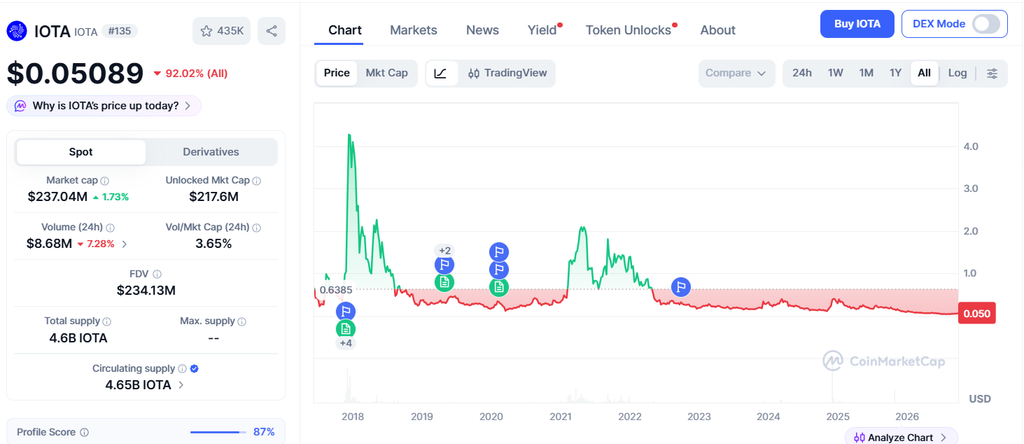
The community has watched the protocol repeatedly evolve while the token remains roughly 95% below its historical high of around $5.69. That gap between technological development and market performance is now the central issue for IOTA holders.
The question is no longer whether IOTA has changed. It clearly has.
The question is whether all those changes have finally put the network in a position to generate the adoption and economic activity the community has been waiting for.
From the Tangle to a Completely Different IOTA
IOTA launched around the Tangle, a DAG-based distributed ledger designed to approach distributed transactions differently from conventional blockchains. Its original proposition centered heavily on machine-to-machine transactions and the Internet of Things.
The early architecture was ambitious, but it also came with significant technical limitations.
The network depended on the Coordinator, a mechanism operated by the IOTA Foundation that helped protect the early network. Removing that Coordinator — Coordicide — became one of the project’s defining technical objectives. IOTA’s own research into Coordicide eventually became one of the longest-running development efforts in its history.
Then came Chrysalis.
Chrysalis, or IOTA 1.5, was effectively a major engineering reset. The upgrade replaced significant portions of the original infrastructure, introduced UTXO-based transactions, new addresses, new APIs, improved node software and substantially improved performance. IOTA described Chrysalis as the path toward an enterprise-ready network and eventual Coordicide.
For the community, however, this created the first major frustration.
IOTA was no longer simply improving the original system.
It was repeatedly rebuilding it.
Stardust Changed the Economic Model
The next major step was Stardust.
Stardust introduced native digital assets and smart-contract capabilities while also changing IOTA’s tokenomics. The total supply was increased to 4.6 billion IOTA, with additional tokens distributed through an ecosystem fund over several years. The upgrade also replaced the original Coordinator with a validator committee as an intermediate step toward greater decentralization.
This was a major shift from the IOTA many early investors bought.
The project was moving away from a narrow IoT-payment narrative toward becoming a programmable Layer 1.
That meant IOTA now had to compete directly with established smart-contract ecosystems.
For holders, this was where the question became more difficult: if IOTA was effectively becoming a new Layer 1, could it attract the developers, liquidity and applications required to justify its valuation?
IOTA Rebased Was the Biggest Reset Yet
Then came IOTA Rebased.
On May 5, 2025, IOTA moved from Stardust to a new Move-based mainnet. The change represented one of the largest architectural transformations in the project’s history, with delegated Proof-of-Stake, a new execution environment and a substantially different foundation for smart contracts and decentralized applications.
This is important because it changes what IOTA is technically competing to become.
The old IOTA was primarily associated with the Tangle.
The current IOTA is a programmable Layer 1 built around Move, smart contracts, digital assets, interoperability and real-world infrastructure.
That is a completely different proposition. And yet the market has not rewarded the transformation.
That is why the community remains frustrated.
Holders who bought IOTA because of the original vision have now watched the project undergo multiple major architectural transitions. Many are effectively holding a token attached to a network that is technically very different from the one they originally invested in.
Starfish Is the Latest Stage of That Evolution
The latest development is Starfish.
IOTA activated Starfish on mainnet in April 2026, marking another major change to the network’s consensus architecture.
Then, in September, Protocol 36 activated StarfishSpeed, an optimistic commit mechanism designed to reduce consensus latency under favorable network conditions while retaining the more resilient consensus path when conditions deteriorate. The latest release also includes changes to validator selection, networking, synchronization, storage and transaction validation.
This is technically significant.
IOTA is no longer trying to prove that its original Tangle architecture can become the final answer.
It has moved through several generations of consensus and execution design to reach the current architecture.
The problem is that every technical improvement ultimately leads back to the same question:
Who is using it?
The Community Has a Right to Ask About the Token
This is where the conversation needs to move beyond technology.
IOTA can have better consensus.
IOTA can have faster finality.
IOTA can have smart contracts.
IOTA can have Move.
IOTA can have interoperability.
IOTA can have digital identity applications.
IOTA can have trade-finance experiments.
And IOTA can still fail to create sufficient demand for the IOTA token.
That is the uncomfortable part.
Recent activity provides some evidence that the network is finally being used. AltcoinsAnalysis reported nearly 50,000 digital certificate notarizations on IOTA Mainnet over a four-week period, while other developments include trade-finance applications, interoperability testing and DeFi experimentation.
Those developments are more meaningful than another roadmap announcement.
But they are still the beginning of the adoption argument.
The community needs to see sustained mainnet activity, multiple independent applications, real users, liquidity, developers and measurable economic activity.
Related: IOTA LayerZero Test Token Points to USDT0 as Stablecoin Route Takes Shape
Most importantly, it needs to see how that activity creates demand for IOTA itself.
That is the missing link. This is The IOTA Token Problem Nobody Wants to Discuss
IOTA Is Technically Almost a Different Project
Looking at IOTA from 2015 to 2026 makes one thing obvious: the project has not stood still.
It went from:
Tangle → Chrysalis → Coordicide research → Stardust → IOTA Rebased → Starfish → StarfishSpeed.
The technology has been repeatedly redesigned to address scalability, decentralization, programmability, developer requirements and network performance.
The irony is that the token chart tells a very different story.
The community has therefore reached an understandable point of exhaustion.
They do not necessarily need another explanation of what IOTA could become.
They want to know whether the latest version of IOTA can finally do something the previous versions could not: generate sustained economic demand.
Related: The IOTA Comeback Nobody Is Talking About
If digital identity becomes a major production use case, if trade finance moves beyond pilots, if interoperability brings liquidity, if developers remain on the network and if applications generate sustained mainnet activity, the market will have new data with which to value IOTA.
Until then, technical progress remains exactly that: progress in the technology.
Related: IOTA Has Never Been More Useful—So Why Is the Price Near Record Lows?
About The Author