

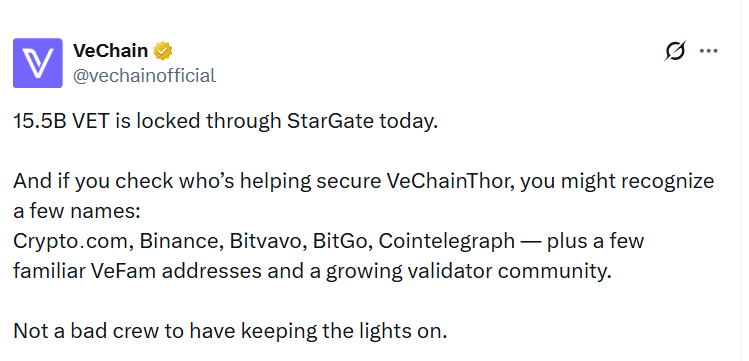
VeChain has reached a new staking milestone, with 15.5 billion VET now locked through its StarGate platform as network participation continues to expand. VeChain highlighted the figure on September 29, 2026, while pointing to a growing group of recognizable names and community participants involved in securing VeChainThor. The development puts renewed attention on how VET holders are participating in the network following the transition to the StarGate staking model.
15.5B VET Locked Through StarGate
According to VeChain, 15.5 billion VET is currently locked through StarGate. Independent tracking data also places the amount at roughly 15.5 billion VET, equivalent to about 18% of the VET supply tracked by the staking dashboard.
The size of the locked position is significant because StarGate is not simply a mechanism for holding VET. It connects staking with VeChainThor’s validator structure, allowing participants to delegate their staking positions to validators and receive VTHO rewards. The current system was introduced alongside VeChain’s broader Renaissance upgrades and the Hayabusa transition.
VeChain’s latest post specifically highlighted Crypto.com, Binance, Bitvavo, BitGo and Cointelegraph among the names helping secure VeChainThor. It also pointed to familiar VeFam addresses and a growing validator community, suggesting that network participation extends beyond major crypto companies to individual and community-based participants.
Related: VeChain Confirms Interstellar Stability as Renaissance Roadmap Moves Forward
StarGate uses an NFT-based staking structure, with users able to delegate their staking positions to validators. VeChain’s official StarGate documentation states that users can evaluate validators using information such as APY, cycle duration, stake amount, number of delegations and reliability. Validators can select seven-, 15- or 30-day cycles, while delegation is automatically renewed by default unless the user or validator exits.
The validator system also has a relatively low entry requirement compared with the large balances associated with some major staking operations. VeChain’s StarGate documentation says a validator needs to run the Thor client, meet the required hardware specifications and stake 25 million VET. This structure allows the network to combine professional operators with a broader delegation community.
What the Growing Stake Means for VeChainThor
The 15.5 billion VET figure also provides a snapshot of how much VET is being committed to active network participation rather than simply sitting in wallets or exchanges. However, the amount locked should not automatically be interpreted as a signal for VET’s short-term price direction. Staking can reduce immediately available liquidity, but market prices remain influenced by demand, selling activity, broader crypto conditions and other factors.
StarGate also creates an economic connection between VET holders and VeChainThor’s activity. Participants lock VET and receive rewards in VTHO, while validators play a role in processing and securing the network. Current StarGate validator pages show active validators with delegated VET from multiple wallets, demonstrating how staking positions can be distributed across individual participants rather than concentrated in a single operator.
The model represents a change from VeChain’s earlier node structure. Under the newer system, staking participation is built around delegator NFTs and validator selection, making participation more flexible. VeChain has described the approach as part of its effort to broaden network participation while creating a more transparent staking environment.
Related: VeChain Highlights StorySnap AI Agent Built to Turn Memories Into Videos
The expanding validator community is therefore an important part of the 15.5 billion VET milestone. More participating validators and delegators can create a wider distribution of network responsibilities, although the actual degree of decentralization depends on factors such as stake concentration, validator distribution and voting or delegation behavior.
For VET holders, the development also gives StarGate a larger role in the VeChain ecosystem. The platform provides a direct route for holders to put VET to work while participating in the network’s economic model. Rewards are locked during an active staking cycle and become claimable when the cycle ends, according to StarGate’s support documentation.
VeChain’s latest milestone comes as its broader Renaissance roadmap continues to reshape the network’s tokenomics and validator architecture. The 15.5 billion VET locked through StarGate shows that the staking system has attracted substantial participation, while the presence of recognizable industry names alongside community addresses highlights the mix of participants involved.
For the VeChain community, the next important metric will be whether the amount of staked VET continues to grow and how the validator set develops over time. A larger stake alone does not determine the network’s future performance, but continued participation will remain an important measure of how VET holders are engaging with VeChainThor’s evolving infrastructure.
About The Author