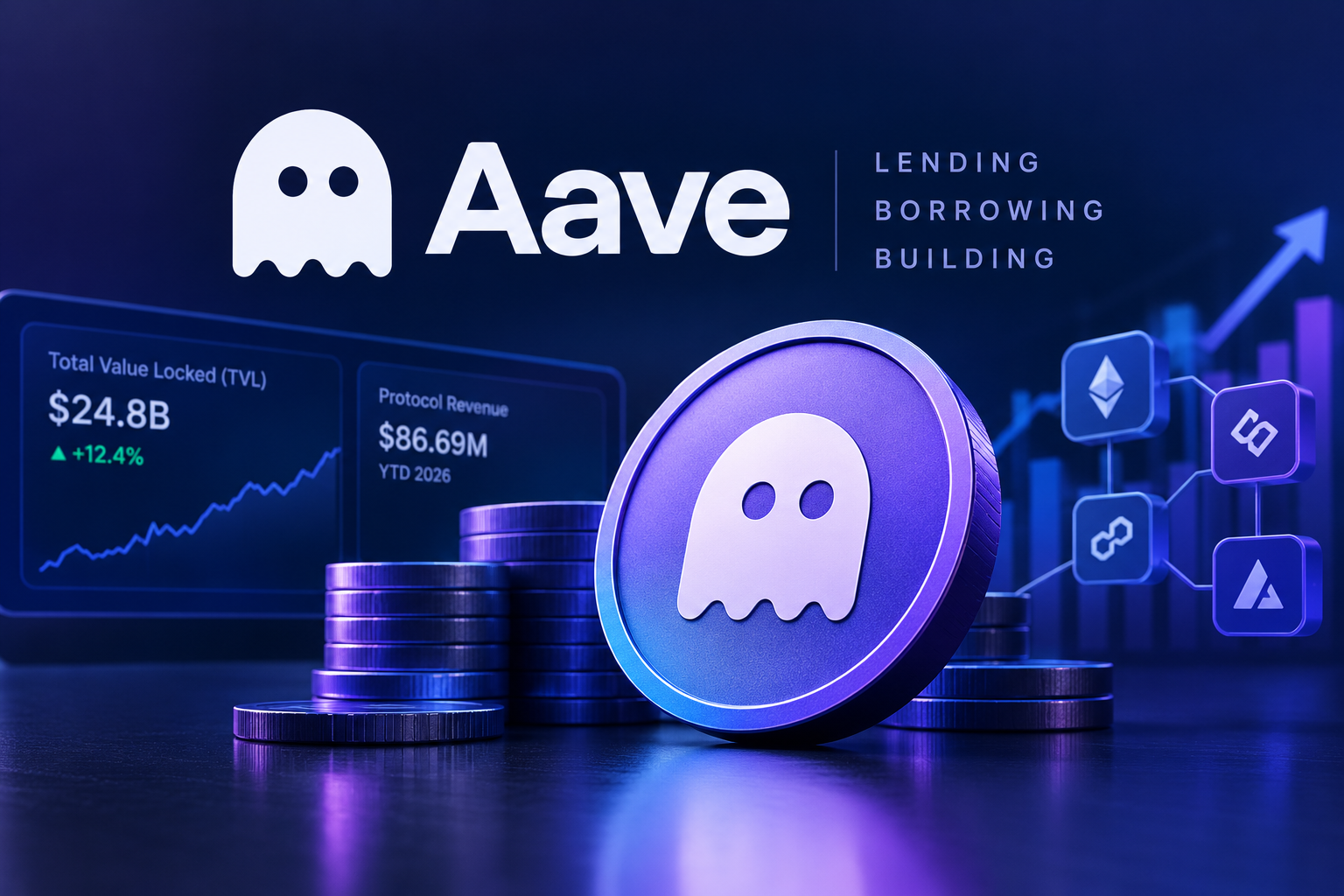
Aave has become one of decentralized finance’s major lending businesses. Its protocol generates revenue from borrowing activity, operates across multiple blockchain networks and supports a growing stablecoin business through GHO. But for investors, protocol success and token performance are two different questions.
Aave can generate millions of dollars in revenue without automatically delivering that money to AAVE holders. The crucial issue is how much revenue remains after expenses, how much the DAO allocates to token purchases, and whether those purchases create lasting value for holders.
As of October 2026, the numbers offer a more complicated picture than a simple bullish argument about Aave’s growth.
Aave’s Revenue Is Real. So Is the Cost of Running It.
Aave’s official financial dashboard reports the following figures for 2026:
| Period | Revenue | Net income |
|---|---|---|
| Q1 2026 | $37.88 million | $18.40 million |
| Q2 2026 | $24.56 million | $1.35 million |
| Q3 2026 | $18.01 million | $1.85 million |
| 2026 year to date | $86.69 million | $24.71 million |
Source: Aave Insights dashboard. Q3 figures cover the completed quarter; figures may be subject to subsequent revisions.
The distinction between revenue and net income matters. Aave’s dashboard records $86.69 million in revenue against approximately $61.98 million in expenses, leaving $24.71 million in net income.
That means net income represents roughly 28.5% of reported revenue.
The quarterly trend also deserves attention. Revenue fell from $37.88 million in Q1 to $18.01 million in Q3. Net income declined from $18.40 million to $1.85 million over the same periods.
Aave remains profitable on these reported figures, but the difference between revenue and net income demonstrates why investors should not treat every dollar generated by the protocol as money available for token purchases.
The figures also cover only the periods shown. They do not establish what Aave will earn over the next year, and a strong quarter should not automatically be annualized.
The Buyback Was the Missing Link Between Revenue and AAVE
Aave’s buyback program was designed to connect protocol revenue with demand for its governance token.
The program began executing purchases in April 2025. Rather than relying solely on investors buying AAVE speculatively, the DAO used funds to acquire tokens on the open market.
According to Aave’s official token documentation, the program was approved as part of the Aavenomics overhaul. Its original annual budget was $50 million, with purchases executed according to market conditions, liquidity and volatility.
By February 2026, a TokenLogic governance report said the program had acquired more than 205,000 AAVE over its first ten months.
However, the program subsequently faced a significant interruption.
Following the April 2026 rsETH bridge incident, the DAO formally documented a pause in buybacks. The stated reason was to preserve treasury flexibility while the potential financial consequences of the incident were assessed. The incident raised questions about possible bad debt and the resources needed to protect the protocol.
The latest available buyback tracker reports approximately $42.9 million in cumulative purchases, with no purchases recorded after June 24, 2026.
That is an important distinction for investors evaluating AAVE today: the historical buyback program demonstrated that protocol resources could be used to purchase the token, but the existence of that program does not mean the DAO is currently buying AAVE.
A budget is not the same as an executed purchase.
Buybacks Do Not Automatically Mean Tokens Are Burned
There is another detail investors should understand.
Aave’s buyback mechanism is not equivalent to a permanent token burn. According to the protocol’s documentation, purchased AAVE is sent to the DAO Ecosystem Reserve, where it can support staking rewards, grants and service-provider payments through governance-approved programs.
This means buybacks can create market demand and increase the DAO’s token holdings, but they do not necessarily reduce the total supply permanently.
The economic outcome depends on what happens next.
If purchased tokens remain in the reserve, the DAO accumulates an asset. If those tokens are subsequently distributed to service providers or used for ecosystem incentives, some may return to the market. The result is different from permanently removing tokens from circulation.
Investors therefore need to distinguish between three separate mechanisms:
- Market purchases: The DAO buys AAVE from existing holders, creating direct demand at the time of execution.
- Treasury accumulation: Purchased tokens increase the DAO’s holdings, subject to their future use.
- Token burns: Tokens are permanently removed from circulation, reducing supply.
These mechanisms can have different effects on token economics. AAVE’s buyback program should not be described as a burn mechanism.
The Numbers Investors Should Watch
A useful way to assess AAVE’s economics is to compare protocol profitability with the amount spent on token purchases.
A simple measure is:
Buyback coverage ratio = Annualized buyback spending ÷ Annualized net income
Using the original $50 million annual buyback budget and the 2025 net income of $41.52 million reported by Aave Insights, the planned spending would have equaled approximately 120% of that historical net income.
[
\frac{$50\text{ million}}{$41.52\text{ million}}
\times 100 \approx 120.4%
]
This is an illustration of the original budget’s scale, not a claim that the program spent $50 million in that year or that the budget was funded entirely from net income.
It also shows why revenue allocation matters. A DAO cannot sustainably direct every available dollar toward token purchases while ignoring operating expenses, security, incentives and treasury reserves.
For a more complete assessment, investors should monitor four indicators:
- Net income: How much money remains after protocol expenses?
- Executed buybacks: How much AAVE is actually purchased, rather than merely budgeted?
- Net token accumulation: How much AAVE does the DAO acquire after accounting for distributions and emissions?
- Treasury resilience: Does the DAO retain enough liquid assets to manage unexpected losses and fund operations?
The fourth measure became especially important after the April incident. A treasury that accumulates AAVE but lacks sufficient liquid reserves can face a difficult choice between supporting the token and protecting the protocol.
AAVE Holders Have Governance Rights, Not Automatic Dividends
AAVE is a governance token. Holders can participate in decisions concerning protocol parameters, deployments, treasury management and other matters through the governance process.
That gives holders influence over how the ecosystem develops, but it does not make them shareholders entitled to a fixed percentage of corporate profits.
There is no automatic mechanism under which each AAVE holder receives a proportional share of all protocol revenue simply because Aave generates income.
Instead, holders depend on governance decisions and the protocol’s token-economic mechanisms to determine whether success translates into benefits for token ownership.
Staking can provide rewards, subject to the applicable program and its risks. Buybacks can generate market demand. Treasury accumulation can strengthen the DAO’s financial position. But none of these mechanisms guarantees a particular AAVE price or a direct cash payment to every holder.
That is the central distinction between a successful DeFi protocol and an attractive token investment.
What Would Strengthen the AAVE Investment Case?
A stronger case for AAVE would require more than growing lending volume.
First, Aave would need to sustain healthy net income rather than relying on temporary spikes in fees. Second, the DAO would need a transparent and financially sustainable policy for allocating revenue between reserves, operations, growth and token purchases.
Third, investors would need evidence that buybacks have resumed and that actual purchases are being executed consistently. Finally, the DAO should demonstrate that its treasury can absorb financial shocks without repeatedly sacrificing its token-acquisition strategy.
None of these conditions requires Aave to burn tokens. But they do require a credible, measurable connection between the protocol’s economic performance and the interests of token holders.
The opposite scenario is also possible. Aave could remain a major lending platform while spending more on operations, rebuilding reserves or funding growth initiatives. In that case, the protocol could continue to succeed without delivering the same level of direct demand for AAVE.
The Verdict
Aave’s financial performance gives investors something tangible to analyze: $86.69 million in reported revenue and $24.71 million in net income for the first three quarters of 2026.
But those numbers do not settle the AAVE investment question.
The buyback program demonstrated one way the DAO could connect protocol resources with token demand. Its subsequent pause showed that this connection depends on financial priorities, governance decisions and the condition of the treasury.
Aave’s success is not automatically AAVE holders’ success. The strongest investment case will emerge when sustainable net income, executed token purchases, responsible treasury management and transparent governance work together.
Until then, investors should judge AAVE not only by how much the protocol earns, but by how much economic value it can consistently direct toward the token without compromising the business that generates that revenue.
This article is for informational purposes only and does not constitute investment advice.
About The Author