
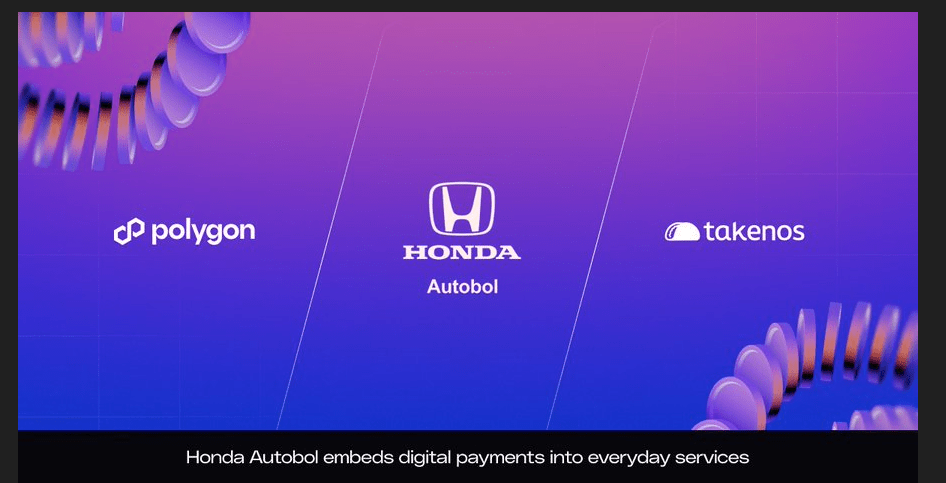
Polygon says Honda Autobol has integrated Polygon-powered payments through Takenos, bringing onchain payments into vehicle maintenance and after-sales services in Bolivia.
Honda Autobol has integrated Polygon-powered payments.@TakenosApp just brought a digital wallet on Polygon into Honda’s after-sales experience, embedding onchain payments into everyday automotive services in Bolivia. pic.twitter.com/oHzawtrQ74
— Polygon (@0xPolygon) March 25, 2026
That might not sound as dramatic as a memecoin mania or another “AI x DeFi x agents” press blast.
But in terms of actual real-world utility, this is far more meaningful.
Because if blockchain is ever going to matter outside crypto circles, it probably will not start with people bragging about wallet screenshots on X.
It will start with something much less glamorous:
paying for ordinary services more cheaply and more smoothly than before.
And in this case, that service is car maintenance.
Honestly? That is a much healthier use of blockchain than 80% of the industry deserves.
What happened?
According to Polygon’s March 25 case study, Honda Autobol and Takenos launched a “200 x 200” campaign in Santa Cruz, Bolivia, where the first 200 customers who pay for preventive vehicle maintenance through Takenos receive Bs. 200 off (about $29 USD). The offer applies to vehicles of any brand, not just Honda, and closes once the 200 slots are filled.
That means this is not just a blockchain “pilot” hidden inside a conference deck.
It is a consumer-facing payment incentive attached to a real, everyday service.
That matters.
Because one of the biggest problems in crypto adoption has always been this:
a lot of blockchain “use cases” are technically functional but socially irrelevant.
This one is socially relevant.
People understand car servicing.
People understand discounts.
People understand paying less.
That is exactly the kind of bridge blockchain needs.
Why this is a bigger story than a discount campaign
Let’s be clear:
A Bs. 200 discount on maintenance is not, by itself, some civilization-altering event.
But the infrastructure underneath it is the real story.
According to Polygon’s own write-up, the campaign is designed to show how low-cost onchain payment rails can create real savings in sectors people already use, with Takenos handling the payment layer on Polygon. Polygon (POL) says the point is not speculation, but embedding practical digital payment infrastructure into real commerce.
That is where this gets interesting.
Because when blockchain payments actually work, the consumer benefit usually does not look like:
- “decentralized finance”,
- “yield opportunities”,
- or “financial sovereignty narratives.”
It looks like this:
- lower payment friction,
- cheaper settlement,
- fewer middlemen,
- and better consumer offers.
That is much less exciting on crypto Twitter.
It is also much more likely to survive in the real world.
Why Bolivia is actually a very important market for this kind of rollout
This is not random geography.
Bolivia is a meaningful place to test blockchain-powered payments because the country sits at the intersection of several important conditions:
- rising digital wallet usage,
- growing smartphone penetration,
- consumer demand for easier dollar-linked access,
- and a real need for more flexible payment infrastructure.
Takenos positions itself as Bolivia’s “No. 1 mobile wallet”, emphasizing QR payments, digital dollar balances, and tools for local and international spending. The company also says it has become one of the most downloaded wallets in Bolivia and has processed $500M+ in transaction volume to date across its broader footprint.
That context matters because blockchain payments are much more likely to gain traction in markets where traditional payment rails are:
- expensive,
- fragmented,
- limited,
- or simply inconvenient.
And Latin America has repeatedly proven to be one of the strongest regions for practical fintech adoption when the product solves a real pain point.
This is not a coincidence.
It is exactly where better payment rails can matter most.
Why “car maintenance” is actually a very smart entry point
At first glance, vehicle servicing sounds like a weird category for a blockchain payments showcase.
It is not.
In fact, it is one of the smarter ones.
Why?
Because car maintenance is:
- routine,
- trust-sensitive,
- price-conscious,
- and tied to real-world local commerce.
That makes it a much better test case than trying to force onchain payments into some hyper-online niche nobody actually needed fixed.
If a customer can:
- book or show up for service,
- pay through a digital wallet,
- get an immediate discount,
- and leave without payment friction,
then blockchain has done something useful.
Not sexy.
Useful.
And “useful” is exactly what crypto has historically been terrible at prioritizing.
The Takenos angle is arguably the most important part
A lot of the attention will naturally go to Polygon because that is the blockchain brand people recognize.
But Takenos may actually be the most strategically important player in this whole setup.
That is because Takenos is the consumer-facing layer.
It is the product people actually touch.
Takenos describes itself as a wallet focused on fast, low-friction payments, digital dollars, QR-based spending, and international usability for users in Bolivia. Its consumer offering includes local funding, cross-border balance management, and the TakeCard, which is positioned for global spending and online services.
And that is a big deal because real blockchain adoption rarely happens when users are forced to think about the chain first.
It happens when the blockchain disappears behind a product that just works.
That is the real formula.
Not:
“Teach everyone about L2 architecture.”
But:
“Make the payment smooth enough that nobody cares what rail it ran on.”
That is how mass adoption actually sneaks up on industries.
Polygon’s real strategy is hiding in plain sight
Polygon has been increasingly explicit about what it wants to become:
not just “a crypto chain,” but a backend settlement layer for modern payments, wallets, and enterprise financial infrastructure.
This Honda Autobol campaign fits that direction almost perfectly.
Polygon’s case study openly frames the rollout as part of a broader push around payments, wallet infrastructure, and what it calls the Open Money Stack. It emphasizes that the goal is for blockchain to disappear into the background while still delivering low-cost settlement and a normal consumer experience.
That is a much smarter positioning strategy than trying to sell ordinary people on abstract token economics.
Because normal people do not care about “layer-2 modularity.”
They care whether:
- the payment worked,
- the discount applied,
- and the app did not behave like it was built during a caffeine emergency.
That is the actual product standard.
This is what “onchain commerce” is supposed to look like
Crypto has spent years promising “real-world adoption,” but most of the time what it delivered was:
- synthetic trading loops,
- token incentives,
- speculative volume,
- and enough jargon to frighten a competent accountant.
This Honda Autobol rollout is much closer to what real onchain commerce should look like.
A customer:
- uses a digital wallet,
- pays for a physical service,
- receives a clear monetary benefit,
- and probably does not need to care that blockchain was involved.
That is good.
Actually, that is more than good.
That is necessary.
Because blockchain does not win by becoming more visible.
It wins by becoming more useful and invisible at the same time.
That is the sweet spot.
Why this matters for emerging markets more than rich ones
There is also a bigger structural point here that a lot of Western crypto commentary tends to miss.
The strongest real-world blockchain payment use cases may emerge outside the most financially comfortable markets first.
Why?
Because in many emerging markets, users are already used to navigating:
- payment friction,
- currency stress,
- limited card utility,
- banking gaps,
- and inconsistent cross-border financial access.
That means the threshold for “this is actually better” is easier to hit.
If Takenos on Polygon can reduce costs or improve payment flexibility in Bolivia, then the implications go far beyond one auto workshop.
The same model could theoretically extend into:
- healthcare,
- insurance,
- utilities,
- local retail,
- travel,
- and broader service commerce.
And that is exactly why these smaller rollout stories often matter more than giant “partnership” headlines that never leave the press release stage.
The bullish case for Polygon here
The optimistic interpretation is pretty strong.
If Polygon can continue becoming the settlement rail behind:
- consumer wallets,
- stablecoin-based spending,
- service payments,
- and low-cost merchant experiences,
then it strengthens its case as one of the few crypto ecosystems actually building toward practical financial infrastructure.
And unlike purely speculative crypto cycles, this kind of adoption compounds differently.
Because once a payments stack works in one vertical, it becomes much easier to test it in another.
That is how infrastructure grows:
not through one giant magical moment,
but through a thousand smaller integrations that quietly make the system harder to ignore.
This Honda Autobol case is exactly that kind of integration.
The realistic caution
Of course, none of this means blockchain payments have “won.”
There are still real questions.
1) Incentive-driven usage is not the same as habit formation
A discount gets people in the door. It does not automatically mean they keep using the rail afterward.
2) Merchant-side operations still matter
Payments only scale if the business side finds the system genuinely easier, cheaper, or more reliable than existing options.
3) Regulation and compliance remain huge factors
Consumer-facing payment infrastructure in Latin America is not a “move fast and improvise later” category.
4) UX still decides everything
If Takenos feels smooth, adoption grows. If it feels “too crypto,” mainstream usage gets kneecapped immediately.
That is the real test.
Not whether crypto people think this sounds exciting.
Whether ordinary customers do it twice.
Final thoughts
Polygon’s Honda Autobol and Takenos rollout is not just another ecosystem update.
It is one of the clearest examples of what blockchain adoption looks like when it stops trying to impress crypto natives and starts solving ordinary commercial problems instead.
That is the future if this industry wants one.
Not more complicated dashboards.
Not more token theater.
Not more desperate narratives about “the next trillion onchain.”
Just this:
cheaper payments, cleaner user experiences, and real value passed back to the customer.
One oil change at a time, apparently.
And honestly, that might be one of the most believable crypto adoption stories you will read all week.
About The Author