
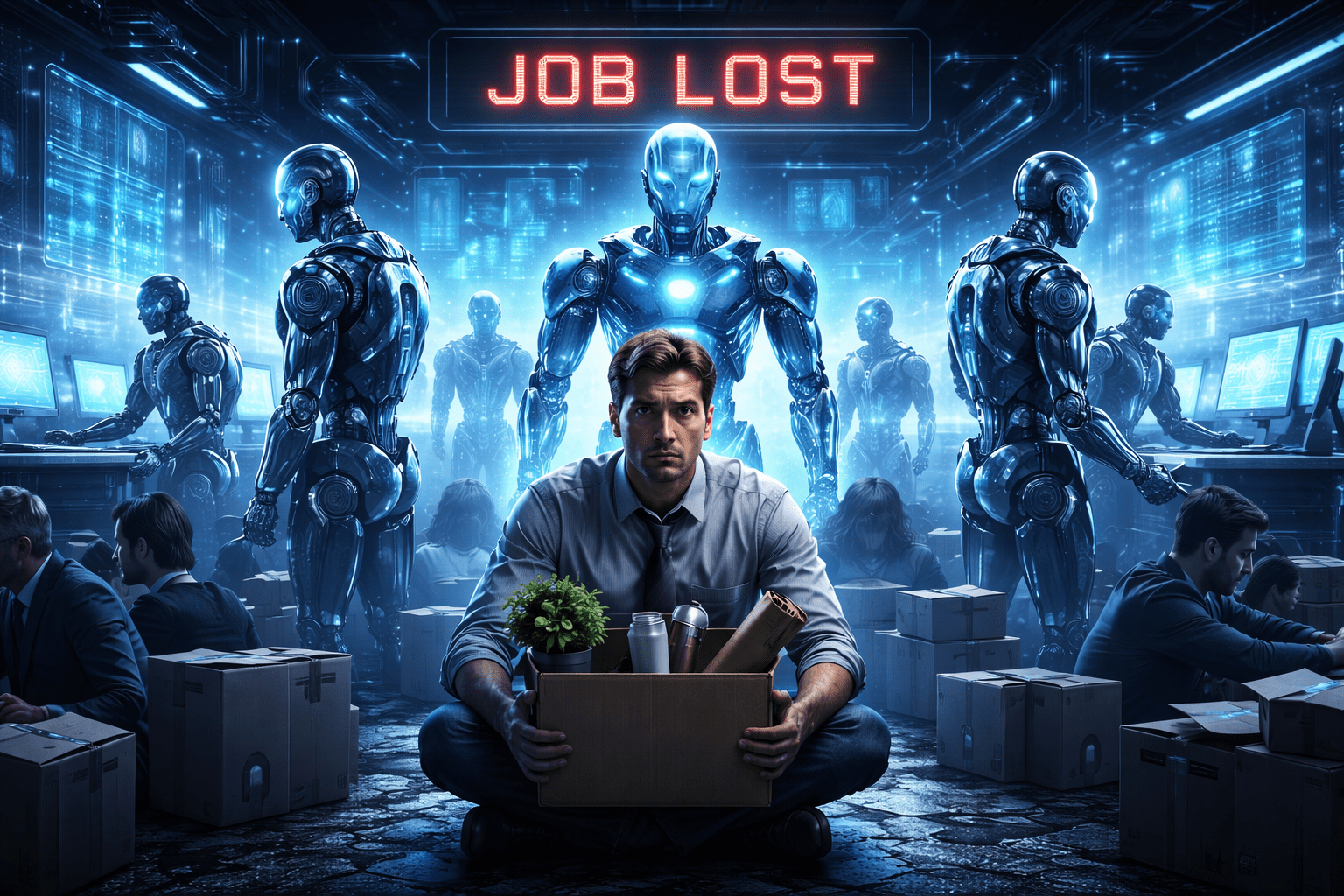
Artificial intelligence is no longer a future threat to jobs — it is already reshaping the global labor market at a pace that governments and institutions are struggling to keep up with. Across industries, from customer service and finance to law, logistics, and even software development, AI is steadily replacing not just manual labor, but cognitive and creative work once considered uniquely human. Estimates suggest that up to 300 million full-time jobs globally could be affected by AI, with automation capable of handling roughly 25% of current work tasks . More immediate projections show 85 million jobs potentially displaced by 2026, while employers expect workforce reductions of up to 40% due to AI adoption .
What makes this wave fundamentally different from previous technological revolutions is its breadth. Unlike industrial automation, which primarily impacted blue-collar labor, AI is targeting white-collar professions — accountants, legal assistants, analysts, and even parts of software engineering. Studies show that roles like telemarketing (99% automation risk), accounting (94%), and legal support (85%) are highly vulnerable, while even developers face nearly 50% automation of coding tasks . This creates a structural shift in the economy: not just job displacement, but job compression, where fewer workers are needed across entire industries.
The result is a dangerous economic feedback loop. Modern economies rely heavily on consumer spending, which in turn depends on employment. If AI eliminates or compresses a significant percentage of jobs, the number of consumers capable of participating in the economy declines. Even today, early data shows AI-driven job losses outpacing job creation, with net monthly losses already being recorded in advanced economies . Over time, this leads to a paradox: companies become more efficient and profitable through automation, but the very consumers they rely on to buy products and services begin to disappear.
This is why the conversation is rapidly shifting from “Will AI take jobs?” to “How will economies function when it does?”
Universal Basic Income: From Theory to Inevitable Policy
As AI accelerates job displacement, Universal Basic Income (UBI) is moving from a fringe idea to a serious policy consideration across Western economies. The logic is simple but unavoidable: if large portions of the population are structurally unemployed or underemployed, governments must inject income directly into society to sustain consumption, prevent social instability, and keep the economic engine running.
This is no longer theoretical. Countries and governments are already exploring or testing versions of UBI:
- The United Kingdom has openly discussed UBI as a response to AI-driven job losses, with government officials acknowledging it may be necessary to cushion economic disruption
- Finland ran one of the most well-known UBI pilots, testing unconditional payments to unemployed citizens to measure effects on wellbeing and employment
- Canada has conducted multiple basic income trials at provincial levels
- United States has seen city-level pilots in places like Stockton, alongside growing political support from tech leaders and policymakers
- Spain introduced a form of guaranteed minimum income during economic stress periods
The underlying economic reality driving these experiments is clear: without income, there is no demand — and without demand, capitalism breaks down. AI does not just threaten jobs; it threatens the consumption layer of the economy itself.
Even within policy circles, the tone is shifting. Discussions now focus less on whether UBI is desirable, and more on whether it is unavoidable. As one perspective gaining traction suggests, UBI may not be a welfare policy — it may be a system requirement for an AI-driven economy.
Blockchain: The Missing Infrastructure for a Post-Work Economy
If UBI becomes inevitable, the next challenge is distribution, transparency, and control — and this is where blockchain technology could play a critical role. Traditional welfare systems are often inefficient, bureaucratic, and prone to corruption or misallocation. In a future where potentially millions — or even hundreds of millions — rely on direct income support, these inefficiencies become unacceptable.
Blockchain offers a radically different model. By using decentralized ledgers, governments could distribute UBI in a transparent, programmable, and auditable way. Smart contracts could automate payments, ensure eligibility, and even adjust distributions dynamically based on economic conditions. Digital identity systems — already being explored in various blockchain ecosystems — could enable secure verification of recipients without relying on centralized databases.
More importantly, blockchain could redefine how value flows in an AI-driven economy. If AI systems generate massive productivity gains, the question becomes: who owns that value? In a traditional system, it concentrates in the hands of corporations and capital owners. In a blockchain-enabled system, there is at least the possibility of redistributing value more broadly — through tokenized economies, decentralized ownership models, and on-chain revenue-sharing mechanisms.
There is also a deeper alignment between AI and blockchain. AI centralizes intelligence and production, while blockchain decentralizes ownership and distribution. Together, they could form the foundation of a new economic model — one where machines produce the majority of goods and services, and humans participate primarily as consumers, creators, and governors of decentralized systems.
Final Take
The rise of AI is not just a technological shift — it is an economic reset. As automation expands into every layer of work, the traditional link between labor and income begins to break down, forcing governments to rethink how economies function at a fundamental level. Universal Basic Income is emerging not as a radical idea, but as a logical response to a world where jobs are no longer the primary mechanism for distributing wealth.
At the same time, blockchain introduces a potential solution to one of the biggest challenges this transition presents: how to distribute value fairly, transparently, and at scale. While the path forward is uncertain, one thing is becoming increasingly clear — the future economy may not be built on jobs, but on systems designed to sustain people in a world where work is no longer the center of economic life.
Related: How AI, Blockchain, and Quantum Computing Will Reshape the Global Economy
About The Author