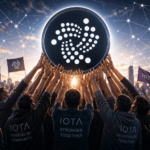

A new chapter in global trade cooperation is taking shape as the European Union and South Korea conclude their first Strategic Dialogue on Trade, Supply Chains, and Technology. At the center of this development is the endorsement of a finalized Digital Trade Agreement, a framework designed to strengthen collaboration across economic security, critical raw materials, advanced technologies, and battery supply chains. While the agreement itself is a policy milestone, its real significance lies in how it could reshape the infrastructure underpinning global trade—and create new opportunities for distributed ledger technologies like IOTA.
🇪🇺 and 🇰🇷 held their first Strategic Dialogue on Trade, Supply Chains & Technology, endorsing the Digital Trade Agreement final text.
Stronger cooperation on economic security 🔐, critical raw materials ⛏️, tech supply chains, and batteries.
🔗 https://t.co/DYCPcDq0Be#EUTrade pic.twitter.com/EKn8Wk2Rvy
— EU Trade 🇪🇺 (@Trade_EU) April 17, 2026
As trade becomes increasingly digitized, the need for transparent, interoperable, and secure systems has never been greater. Traditional supply chains, often fragmented and reliant on siloed databases, struggle to keep pace with the demands of modern commerce. The EU–South Korea agreement signals a commitment to addressing these challenges through coordinated digital frameworks. In this context, IOTA’s focus on machine-to-machine communication, data integrity, and feeless transactions positions it as a potential enabler of next-generation trade infrastructure.
Related: IOTA Sees Strategic Opportunity After Netherlands Legalizes Electronic Bills of Lading
Digital Trade Agreements and the Push for Secure Supply Chains
The newly endorsed agreement reflects a broader shift in how nations approach trade in a digital-first economy. Beyond tariffs and market access, modern trade deals increasingly prioritize data flows, cybersecurity, and technological interoperability. For the EU and South Korea, this includes cooperation on critical raw materials—essential for industries like electric vehicles and renewable energy—as well as battery supply chains, which are central to the global energy transition.
These sectors are particularly sensitive to disruptions, whether due to geopolitical tensions, resource constraints, or logistical inefficiencies. By aligning policies and standards, the agreement aims to create more resilient supply chains capable of withstanding external shocks. However, policy alignment alone is not enough; it must be supported by infrastructure that can provide real-time visibility and verifiable data across borders.
Related: IOTA Powers Healthcare Transformation in Argentina With Vitalnode Project
This is where distributed ledger technology becomes relevant. Systems built on blockchain-like architectures can track the movement of goods, verify their origin, and ensure compliance with regulatory requirements. In industries where provenance and authenticity are critical—such as raw materials and advanced manufacturing—these capabilities are not just beneficial but increasingly necessary.
Why IOTA Could Play a Role in Seamless Global Trade
Among the various blockchain platforms, IOTA stands out for its unique approach to scalability and cost efficiency. Unlike traditional blockchains that rely on transaction fees and sequential processing, IOTA uses a directed acyclic graph (DAG) structure, enabling feeless transactions and high throughput. These characteristics make it particularly suited for supply chain applications, where large volumes of data and micro-transactions must be processed continuously.
In the context of the EU–South Korea agreement, IOTA could serve as a trust layer that connects different stakeholders—manufacturers, logistics providers, regulators, and financial institutions—within a unified digital ecosystem. For example, it could facilitate the tracking of critical raw materials from extraction to final use, ensuring transparency and compliance at every stage. Similarly, in battery supply chains, IOTA could enable real-time monitoring of production, distribution, and recycling processes, supporting both efficiency and sustainability goals.
Related: IOTA Could Become Siemens’ Industrial Trust Layer — Here’s What’s at Stake
The concept of “seamless trade” extends beyond logistics to include automated processes and machine-to-machine interactions. As industries adopt more advanced technologies, including AI and IoT, the ability for systems to communicate and transact autonomously becomes increasingly important. IOTA’s architecture is designed with this future in mind, allowing devices and systems to exchange data and value without intermediaries.
While it remains to be seen how quickly such technologies will be integrated into official trade frameworks, the direction is clear. The EU–South Korea Digital Trade Agreement represents a step toward a more connected and technologically advanced global economy. For platforms like IOTA, it highlights a growing opportunity to move from experimental use cases to critical infrastructure.
Related: IOTA Expands TWIN Trade Push With Expert Advisory Board and UK University Collaboration
Ultimately, the success of this vision will depend on collaboration between governments, industries, and technology providers. If aligned effectively, the combination of policy innovation and decentralized infrastructure could redefine how goods, data, and value move across borders—making seamless, secure trade not just an aspiration, but a reality.
Related: How IOTA is Benefiting From Europe’s Battery Passport Compliance Initiative
About The Author