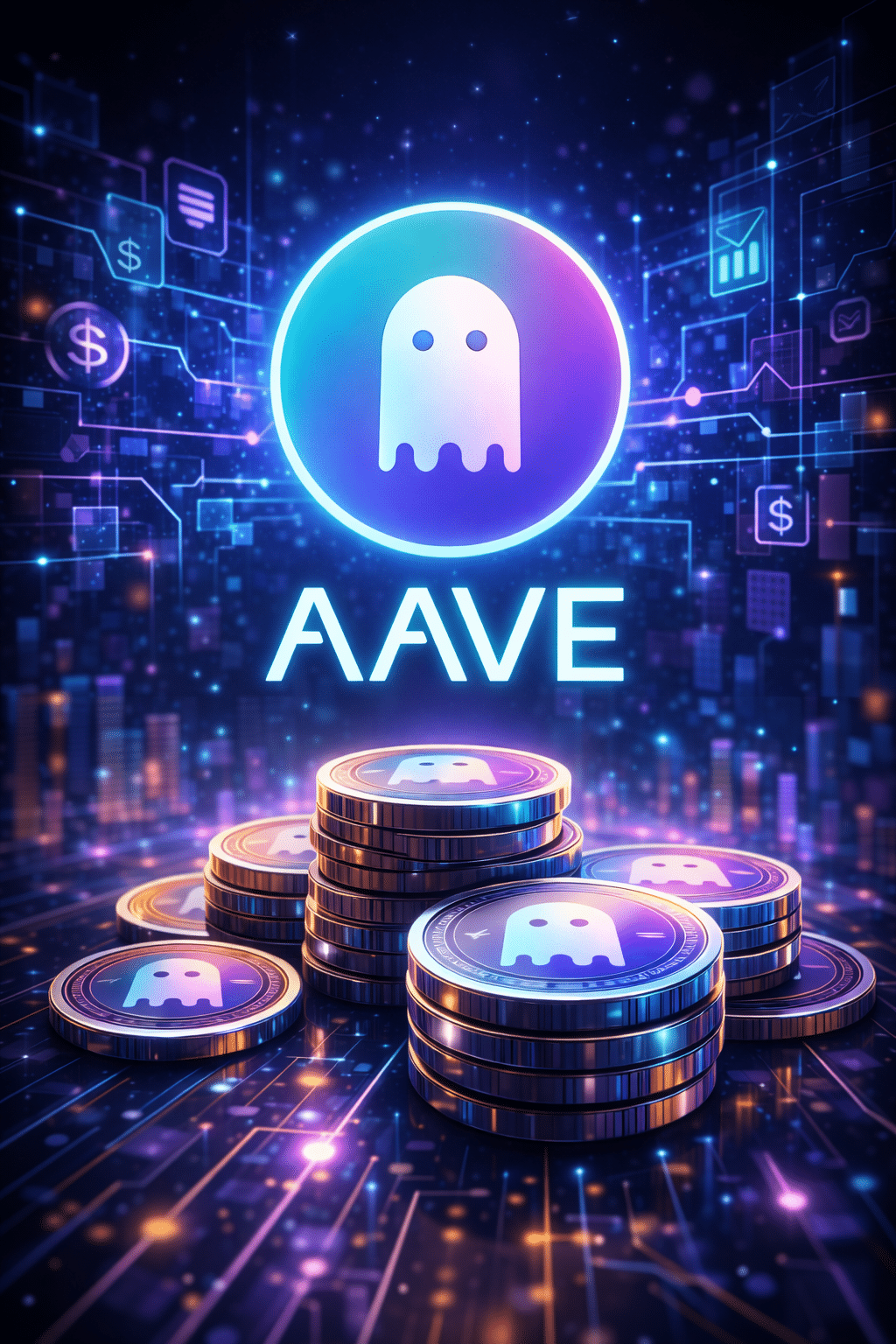
It has only been ten days since Aave v4 was officially released, marking what many considered the most ambitious upgrade in the history of Aave, yet the market reaction has been the exact opposite of what most participants expected, with the AAVE token dropping to its lowest level in the past year at around $90.56. This disconnect between a major milestone and a declining token price highlights a recurring theme in crypto markets, where technological progress does not always translate into immediate price appreciation, particularly in an environment where macro conditions, liquidity cycles, and broader risk sentiment often overpower protocol-specific developments.
The situation becomes even more interesting when viewed through the lens of social data, as engagement and mentions surged in the lead-up to the launch, only to fade shortly after, suggesting that much of the excitement may have been priced in well before the upgrade went live, leaving the market with a classic “buy the rumor, sell the news” dynamic that has played out repeatedly across both DeFi and broader crypto cycles.
It was only ten days ago when Aave v4 was shipped. It took two years to build. It was the defi protocol's biggest upgrade ever.
Yet after all that, $AAVE just hit the lowest point in the last year at $90.56 today.
Social mentions surged higher over the last several weeks but… pic.twitter.com/KdXHD36XDf
— LunarCrush (@LunarCrush) April 10, 2026
What makes this moment particularly important for Aave is that v4 was not a minor iteration but a two-year effort aimed at fundamentally improving the protocol’s architecture, efficiency, and scalability, meaning expectations were significantly higher than for a typical upgrade. When a release of that magnitude fails to support price action, it forces the market to reassess not just short-term sentiment but also the underlying narrative driving the asset, especially in a competitive DeFi landscape where capital is constantly rotating between protocols in search of yield, innovation, and perceived upside. In many ways, this reflects a broader shift in crypto markets where fundamentals alone are no longer sufficient to drive valuations, as participants increasingly demand clear catalysts for growth, user expansion, and revenue generation rather than simply technological improvements, no matter how significant they may be from a development perspective.
The Market Is Pricing Narrative, Not Just Fundamentals
The decline in AAVE despite the launch of Aave v4 underscores a critical reality about modern crypto markets: they are driven as much by narrative and positioning as they are by fundamentals, and sometimes even more so. When social mentions spike ahead of a major event, it often indicates that attention — and by extension speculative capital — has already flowed into the asset, creating a situation where the actual launch becomes a liquidity exit point rather than a new entry catalyst. This pattern is not unique to Aave, but it is particularly pronounced in DeFi, where sophisticated participants are quick to front-run expected developments and rotate out once the event materializes, especially in periods where overall market liquidity is constrained or risk appetite is uneven.
At the same time, the drop in social engagement following the launch suggests that attention is already shifting elsewhere, which can create a feedback loop where declining interest leads to reduced liquidity, further price weakness, and even less engagement over time. This does not necessarily reflect a failure of the protocol itself, but rather a mismatch between long-term development timelines and short-term market expectations, a gap that many projects struggle to bridge. In this context, Aave’s challenge is not just to deliver technological improvements but to sustain a narrative that keeps both users and capital engaged beyond the initial launch window, something that becomes increasingly difficult in a market saturated with new protocols, upgrades, and competing opportunities.
Related: Aave Featured in Bank of Canada Study on Decentralized Lending
What Comes Next for Aave
Looking ahead, the key question is whether Aave can convert the foundation laid by v4 into tangible growth metrics that the market can recognize and price in over time, such as increased total value locked, higher borrowing activity, expanded integrations, and new use cases that differentiate it from competitors. If the upgrade enables meaningful improvements in capital efficiency, risk management, and cross-chain functionality, it could gradually attract liquidity back into the protocol, even if the initial price reaction has been negative. However, this process is unlikely to be immediate, as markets often require time to validate whether new features translate into real adoption rather than remaining purely theoretical advantages.
Another factor to watch is the broader macro and crypto market environment, as even the strongest protocols can struggle to gain traction in periods where liquidity is tightening or risk assets are under pressure, meaning Aave’s trajectory will not be determined in isolation but in conjunction with the overall direction of the market. If conditions stabilize or improve, Aave could benefit from being one of the more established and battle-tested DeFi platforms, particularly if v4 positions it ahead of competitors in terms of functionality and user experience. On the other hand, if the current trend of declining attention and price weakness continues, the protocol may need additional catalysts — whether through new partnerships, integrations, or ecosystem expansion — to reignite interest and reverse sentiment.
Final Take
The muted market response to the launch of Aave v4 is a reminder that in crypto, timing and narrative often matter just as much as technological progress, and sometimes even more. While the upgrade itself may prove to be a significant milestone in the long-term evolution of Aave, the immediate price action suggests that expectations were already elevated and largely priced in ahead of the release, leaving little room for upside in the short term.
What comes next will depend on whether Aave can move beyond the launch phase and demonstrate real-world impact, translating its technical improvements into measurable growth and renewed market confidence. If it can, the current weakness may eventually be seen as a temporary disconnect between fundamentals and sentiment; if not, it could signal a deeper challenge in maintaining relevance and momentum in an increasingly competitive DeFi landscape.