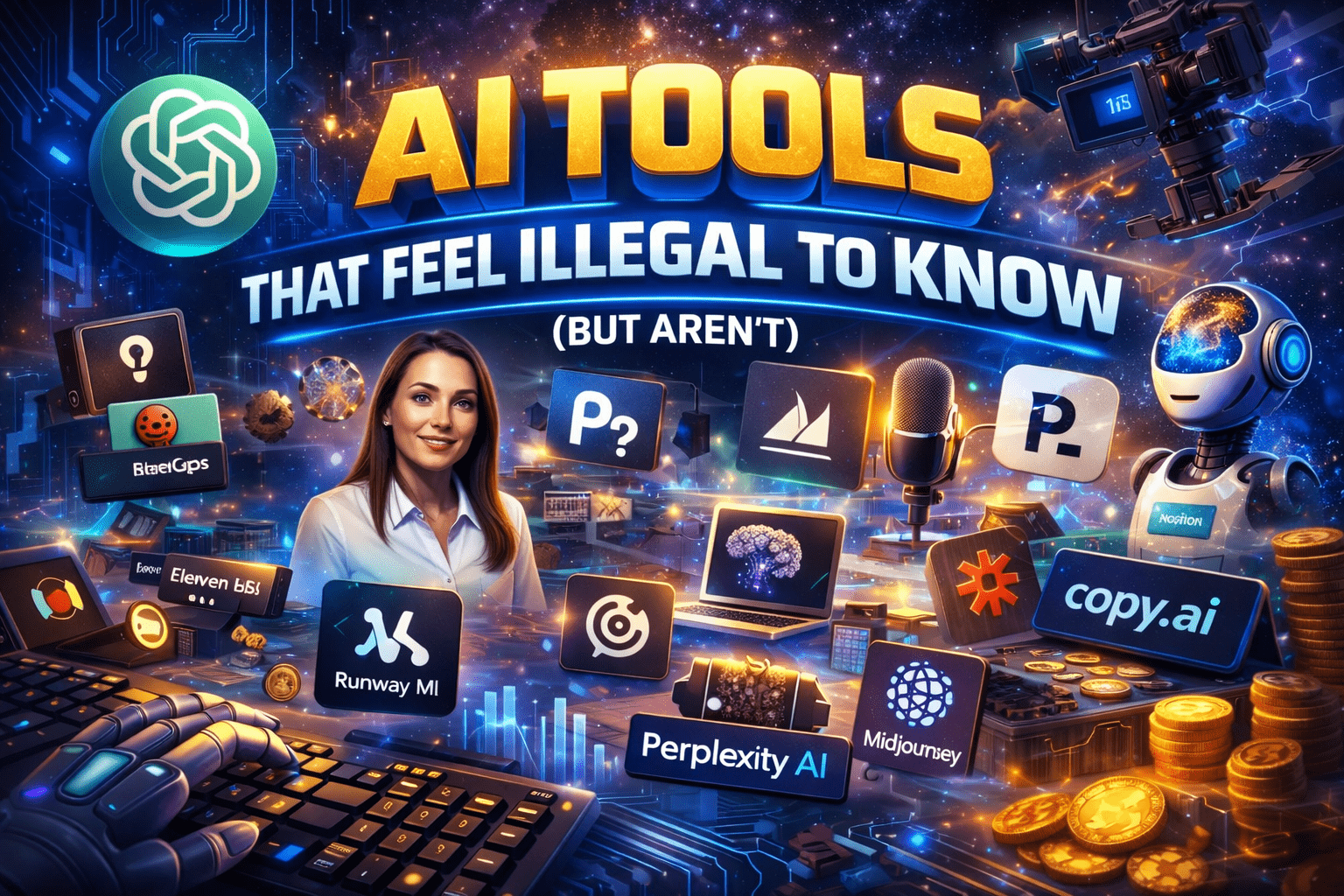
Artificial intelligence is no longer a futuristic concept—it’s a practical advantage. In 2026, the gap between those who use AI effectively and those who don’t is widening fast. Some tools are so powerful, efficient, and time-saving that they almost feel like they shouldn’t be publicly accessible.
From automating entire workflows to generating content, code, designs, and even business ideas in seconds, these tools are quietly reshaping how work gets done.
This guide breaks down the most powerful AI tools that feel “illegal” to know—because of how much leverage they give you, while remaining completely legitimate and widely accessible.
What Makes an AI Tool “Feel Illegal”?
Before diving in, it’s worth defining the concept.
These tools typically:
- Replace hours (or days) of manual work
- Deliver near-expert-level output instantly
- Cost little to nothing compared to human labor
- Give individuals leverage previously reserved for teams
In short, they create asymmetric advantage.
1. ChatGPT — Your All-in-One Intelligence Engine
Still the most versatile AI tool available, ChatGPT has evolved into a multi-purpose productivity powerhouse.
What it can do:
- Write articles, scripts, and reports
- Generate code and debug errors
- Brainstorm business ideas
- Summarize complex information
Why it feels illegal:
It replaces entire roles—writer, researcher, assistant—within seconds.
2. Midjourney — Hollywood-Level Visuals in Seconds
Midjourney produces stunning, high-quality images from simple text prompts.
Use cases:
- Blog thumbnails
- Marketing creatives
- Branding assets
- Concept art
Why it feels illegal:
You can generate agency-level visuals without hiring a designer.
3. Runway ML — AI Video Editing on Autopilot
Runway ML allows you to edit, generate, and enhance videos using AI, including removing backgrounds and generating scenes.
Use cases:
- YouTube content
- Social media videos
- Ad creatives
Why it feels illegal:
It eliminates the need for complex editing skills.
4. Perplexity AI — Smarter Than Google?
Perplexity combines search with AI reasoning to deliver direct, sourced answers.
Use cases:
- Research
- Fact-checking
- Quick learning
Why it feels illegal:
It compresses hours of research into minutes.
5. Notion AI — Your Second Brain
Integrated into Notion, this AI helps manage notes, documents, and workflows.
Use cases:
- Writing summaries
- Organizing projects
- Automating documentation
Why it feels illegal:
It turns chaotic workflows into structured systems instantly.
6. ElevenLabs — Realistic Voice Cloning
ElevenLabs generates human-like voiceovers from text.
Use cases:
- Narration
- Audiobooks
- Content creation
Why it feels illegal:
You can produce studio-quality voiceovers without recording anything.
7. Pictory — Turn Text Into Videos
Pictory converts scripts or blog posts into engaging videos.
Use cases:
- Repurposing blog content
- YouTube automation
- Social media clips
Why it feels illegal:
It transforms written content into video content instantly.
8. Copy.ai — Marketing Copy in Seconds
Copy.ai specializes in generating high-converting marketing content.
Use cases:
- Ads
- Emails
- Product descriptions
Why it feels illegal:
It removes the need for expensive copywriters.
9. Synthesia — AI Presenters Without Cameras
Synthesia allows you to create videos with AI-generated presenters.
Use cases:
- Training videos
- Explainers
- Corporate content
Why it feels illegal:
No filming, actors, or studios required.
10. Zapier — Automate Everything
Zapier connects apps and automates workflows without coding.
Use cases:
- Lead generation
- Email automation
- Data syncing
Why it feels illegal:
It replaces repetitive manual tasks entirely.
Key Insight: AI = Leverage
The real power of these tools isn’t just what they do individually—it’s how they combine.
For example:
- Use ChatGPT to write a script
- Generate visuals with Midjourney
- Turn it into a video with Pictory
- Add voice using ElevenLabs
- Automate distribution with Zapier
What once required a team of 5–10 people can now be done by one person in hours.
The Hidden Risk Most People Ignore
While these tools offer massive upside, there are risks:
- Over-reliance: Blindly trusting AI outputs
- Skill erosion: Losing fundamental abilities
- Content saturation: Everyone using the same tools
The advantage doesn’t come from using AI—it comes from using it better than others.
Final Thoughts
AI tools that “feel illegal” aren’t breaking rules—they’re rewriting them.
The individuals and businesses that win in this new era won’t be the ones working the hardest, but the ones who understand leverage.
Right now, we’re still early. Most people are barely scratching the surface of what these tools can do.
That’s where the opportunity lies.
Related: Solana Launches Agent Skills to Make AI Tools Blockchain-Native