Key Takeaways
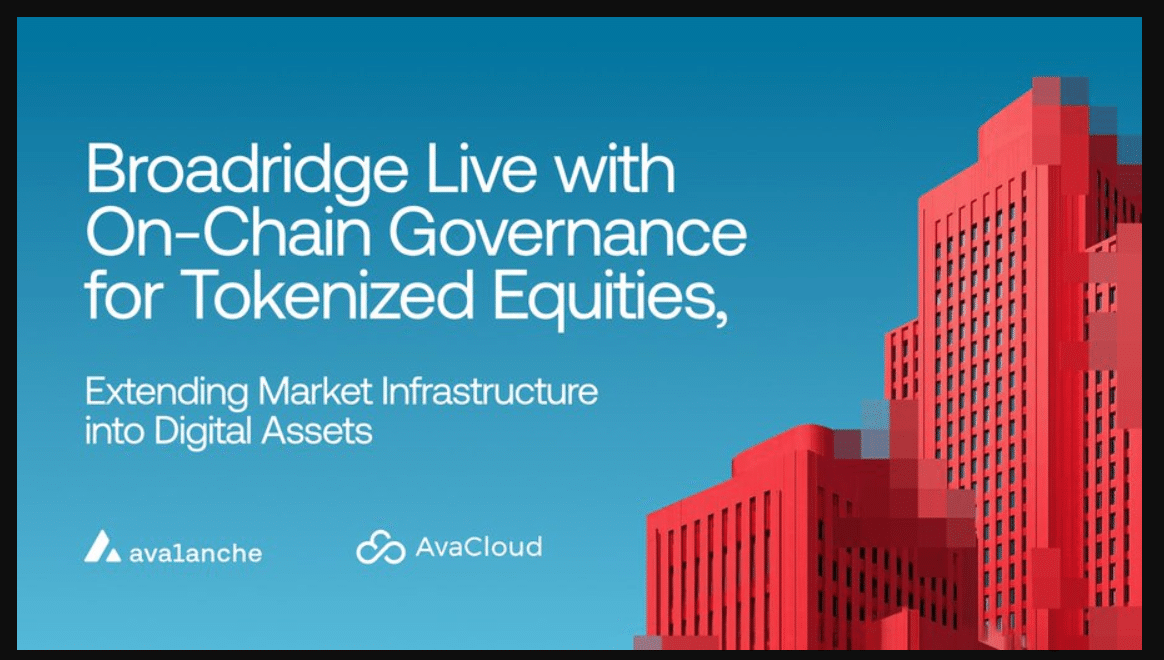
- What happened: Broadridge is extending its governance platform to support digital assets and will record proxy votes for tokenized equities on an Avalanche-based L1 built with AvaCloud. Galaxy will be the first live user for an upcoming shareholder vote in May.
- Why it matters: This addresses a critical missing piece in tokenized finance: shareholder governance and rights infrastructure.
- Bull case: If successful, the move could strengthen Avalanche’s role in institutional capital markets infrastructure and help make tokenized equities more viable.
- Bear case: Tokenized equities remain early, and capital markets adoption tends to move far slower than crypto narratives suggest.
- What to watch next: Galaxy’s live vote, additional issuer adoption, interoperability across tokenized and traditional holdings, and whether onchain governance becomes a standard feature of tokenized securities.
For years, tokenized equities have had a credibility problem.
The technology has looked promising. The infrastructure demos have gotten cleaner. The pitch — faster settlement, programmable ownership, 24/7 transferability — has become easier to understand. But one question has lingered beneath the surface: what happens to shareholder rights when stocks move onchain?
That is where the latest move from Broadridge Financial Solutions and Avalanche matters more than the average crypto partnership headline.
Broadridge said Monday it is extending its governance platform to support digital assets, bringing proxy voting, corporate actions, and shareholder communications into tokenized securities workflows. The system will record proxy votes on a dedicated Avalanche-based Layer 1 built with AvaCloud, with the first live implementation tied to a shareholder vote by Galaxy Digital in May. Broadridge said the platform is designed to let investors vote directly from wallets while allowing issuers to consolidate governance across traditional and tokenized holdings in a single system.
This is not just another “Fortune 500 company is building on blockchain” story.
It is a test of whether capital markets infrastructure can move onchain without stripping away the governance, controls, and operational rigor that public markets depend on.
That is a much bigger story.
Another Fortune 500 company is building on Avalanche.@Broadridge, a fintech company that processes trillions from thousands of public companies, is bringing proxy voting onchain, powering shareholder governance globally. pic.twitter.com/dOTi7KYRTl
— Avalanche🔺 (@avax) April 6, 2026
The Real Story Is Not Voting — It’s Market Structure
The Avalanche thread frames this as “proxy voting onchain.” That is true, but it undersells the significance.
Proxy voting is not an isolated shareholder convenience feature. It is part of the plumbing of ownership.
In public markets, owning a security is supposed to come with rights: the ability to vote on directors, approve or reject key corporate proposals, receive disclosures, and participate in governance. Those rights sound simple in theory. In practice, they are messy, fragmented, and often routed through layers of custodians, brokers, recordkeepers, tabulators, and communications providers.
That fragmentation is one of the least glamorous but most important bottlenecks in modern finance.
If tokenized equities are going to become more than a novelty, they need to preserve — and ideally improve — that governance stack. Otherwise, “onchain stocks” remain interesting technology wrapped around incomplete market rights.
Broadridge is trying to solve that exact problem.
And Broadridge is not some startup looking for relevance through blockchain branding. It is one of the companies already sitting at the center of the old system.
The firm says it supports more than 10,000 public companies, serves clients in over 100 countries, and its platforms underpin more than $15 trillion in daily trading activity while processing over 7 billion communications annually.
That is what makes this move notable.
When a company like Broadridge touches blockchain, it is not because it needs attention. It is because the market structure question is becoming harder to ignore.
Why Avalanche Fits This Better Than Most Public Chain Narratives
One of the most revealing parts of the announcement is not that Broadridge chose blockchain. It is which kind of blockchain architecture it chose.
Rather than dropping governance activity directly onto a general-purpose public chain in the loosest possible way, Broadridge is using a dedicated Avalanche L1 built through AvaCloud. That matters because shareholder governance is not a meme coin launch. It is a regulated, auditable, high-stakes workflow with legal, operational, and privacy requirements.
That is exactly the kind of environment where many enterprise blockchain experiments have broken down.
The reason Avalanche has a credible shot here is that its subnet/L1 architecture has long been marketed around application-specific environments — effectively allowing companies to build blockchain-based systems without inheriting every constraint or risk profile of a fully open consumer chain.
That makes sense for governance infrastructure.
You do not want annual meeting voting records, participant permissions, or compliance-sensitive workflows sprayed across an architecture that was optimized for retail speculation first and institutional process second. You want a system that can act like a shared, trusted record layer while still fitting inside existing compliance and operational expectations.
That is the strategic logic behind this design.
And it is one of the few enterprise blockchain pitches that actually sounds like it was built by people who understand the workflow they are trying to modernize.
Related: Why FIFA World Cup 2026 Right-to-Tickets on Avalanche Actually Matter
Why Galaxy’s Vote Matters More Than It Sounds
The first live use case will come from Galaxy, which Broadridge described as the first U.S. public company to issue native tokenized equity on a major public blockchain. Galaxy plans to use the platform for its upcoming annual meeting and shareholder vote in May, according to Broadridge.
That may sound like a symbolic pilot.
It is more than that.
The reason this matters is that tokenized equity has often existed in a weird in-between state: technically possible, legally interesting, but operationally incomplete. You can tokenize a share, but unless the investor can exercise the same rights they would expect in traditional markets, the product is still missing part of its value proposition.
Galaxy’s vote is a real-world attempt to close that gap.
If investors can receive materials in-wallet, confirm holdings, cast votes directly, and have those records preserved in a verifiable governance system, that starts to make tokenized ownership look less like a side experiment and more like a legitimate capital markets format.
That is the threshold the industry has been trying to cross.
And importantly, Broadridge says the platform is designed to support governance across registered, beneficial, and tokenized holdings in a single “pane of glass.” That is a crucial feature because the real world is not flipping from legacy securities to tokenized securities overnight. For years, maybe longer, markets will live in a hybrid state.
The companies that win will be the ones that make that hybrid state operationally manageable.
The Bull Case: This Is the Kind of Infrastructure Adoption Crypto Actually Needs
There is a very clear bullish interpretation here.
For Avalanche, this is not just another corporate logo on a slide deck. It is a credible capital markets validation.
For years, crypto has claimed it would modernize securities infrastructure. But most of the wins that matter are not going to come from token launches or retail hype cycles. They are going to come from deeply unsexy systems like governance, recordkeeping, reconciliation, disclosure, and investor communications.
That is where the real institutional value sits.
Broadridge’s move suggests Avalanche is becoming part of that stack — not just as a public chain brand, but as a private-grade infrastructure layer for regulated financial workflows.
That is a much more serious narrative than most “enterprise adoption” headlines deserve.
And for the broader market, it is a reminder that tokenized finance does not become real when assets are issued onchain. It becomes real when the entire rights-and-operations layer can move with them.
This announcement pushes that thesis forward.
The Bear Case: A Pilot Is Not a Market Structure Revolution
Still, nobody should confuse this with full-scale transformation.
There are real reasons to stay skeptical.
First, the tokenized equities market is still tiny relative to the broader public markets. One live shareholder vote — even one involving a meaningful player like Galaxy — does not mean the market has suddenly decided to migrate governance infrastructure onchain.
Second, public company governance is heavily regulated, legally sensitive, and operationally conservative. That means adoption cycles will be slow, and the burden of proof will be high. Reliability matters more than ideology here. One operational failure in a governance workflow is worth far more than a dozen successful testnet demos.
Third, the capital markets industry has a long history of liking blockchain conceptually more than it likes replacing entrenched intermediated systems operationally.
That tension still exists.
Broadridge itself has been exploring blockchain in proxy voting for years. The company ran a blockchain-based proxy voting pilot with major financial institutions back in 2017 and later secured a patent tied to proxy processing and related workflows.
That history cuts both ways.
On one hand, it shows Broadridge has taken this category seriously for nearly a decade. On the other, it reminds investors that “blockchain in capital markets” has often taken much longer to commercialize than enthusiasts expected.
Why This Matters Beyond Avalanche
The biggest implication here may have less to do with AVAX and more to do with what this says about the next stage of tokenization.
The first phase of tokenization was about proving assets could exist onchain.
The second phase is about proving markets can function onchain.
That means governance, disclosures, voting, ownership verification, transfer restrictions, record synchronization, and interoperability all have to work at institutional quality. Not in theory. In production.
That is what Broadridge is now trying to operationalize.
And if that works, the impact goes far beyond one blockchain or one fintech vendor. It starts to make the case that tokenized equities are not just a product wrapper. They are the beginning of a new market operating system.
That is still a big “if.”
But it is a more serious one than the market usually gets.
Bottom Line
Broadridge bringing proxy voting onchain through Avalanche is not flashy crypto theater.
It is a practical attempt to answer one of the most important questions in tokenized finance: can shareholder rights survive the transition to blockchain rails without becoming weaker, messier, or harder to exercise?
If the answer is yes, this is a meaningful step for Avalanche, for tokenized equities, and for the broader case that blockchain can upgrade real financial infrastructure.
If the answer is no, it will expose exactly where the next bottlenecks still are.
Either way, this is the kind of development that matters more than most price charts will capture in the short term.
Because if public markets are going onchain, governance has to go with them.
And now, for the first time in a way that actually counts, it is starting to.
Related: Avalanche Price Prediction 2026–2030: Can AVAX Become the Next Ethereum Challenger?