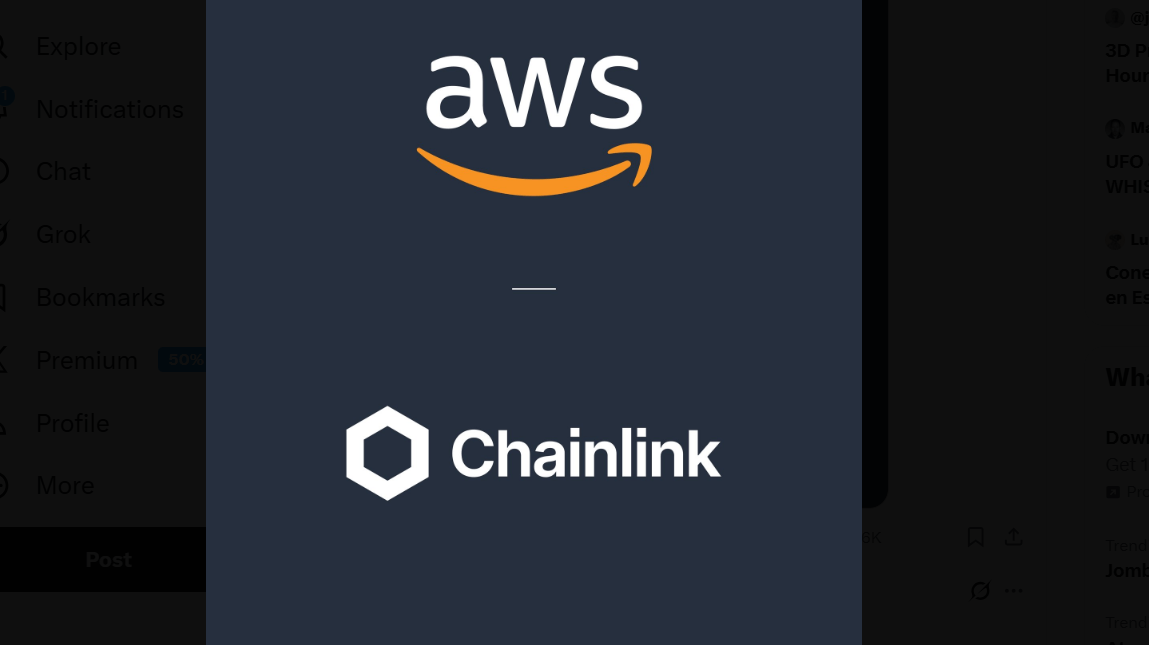
The Chainlink data standard is now live on the AWS Marketplace, marking a significant step in bridging traditional cloud infrastructure with blockchain-based applications. Through this integration, millions of developers using Amazon Web Services can now directly access decentralized data services required to build institutional-grade blockchain systems. The move effectively lowers the barrier to entry for enterprises seeking to incorporate blockchain into existing workflows. It also positions Chainlink as a default data layer within one of the largest cloud ecosystems globally.
At its core, this launch is about accessibility and standardization. Blockchain development has historically been fragmented, with developers needing to source and verify data feeds independently. By embedding Chainlink’s services into AWS Marketplace, these tools become as accessible as any other cloud-based service. This simplifies deployment while ensuring that applications are built on verified, tamper-resistant data infrastructure.
Chainlink services now available on AWS:
• Data Feeds: decentralized price and market data for valuation, settlement, and risk management
• Data Streams: high-speed, low-latency market data for real-time onchain execution
• Proof of Reserve: verifiable reserve data for…
— Chainlink (@chainlink) April 24, 2026
Expanding Blockchain Infrastructure Through Cloud Integration
The integration introduces a suite of Chainlink services directly into the AWS environment, including Data Feeds, Data Streams, and Proof of Reserve. Data Feeds provide decentralized price and market data that can be used for valuation, settlement, and risk management across financial applications. Data Streams offer high-speed, low-latency data delivery, enabling real-time execution for on-chain applications. Proof of Reserve adds a layer of transparency by verifying the backing of stablecoins and tokenized assets, addressing one of the most critical concerns in digital finance.
For developers, the significance lies in the ability to seamlessly connect smart contracts with real-world data without leaving the AWS ecosystem. This eliminates the need for complex integrations and reduces development time. Enterprises can now build blockchain-enabled applications using familiar cloud tools while relying on Chainlink’s infrastructure for secure data inputs. The result is a more cohesive development environment that aligns with existing enterprise workflows.
Related: Chainlink and OpenAssets Partnership Could Unlock a Trillion-Dollar Tokenization Boom
This integration also reflects a broader trend toward convergence between traditional cloud computing and decentralized technologies. As businesses explore tokenization and on-chain financial systems, the need for reliable data becomes increasingly important. Chainlink’s presence on AWS Marketplace ensures that this data is not only accessible but also standardized across applications. This standardization is key to scaling blockchain solutions beyond niche use cases.
From a strategic perspective, the collaboration enhances Chainlink’s reach into enterprise markets. AWS serves hundreds of thousands of businesses across industries, from finance to supply chain management. By embedding its services within this ecosystem, Chainlink gains direct exposure to organizations that may not have previously considered blockchain integration. This could accelerate adoption by making blockchain development a natural extension of existing cloud-based operations.
Institutional Adoption and the Future of On-Chain Applications
The availability of Chainlink services on AWS Marketplace is particularly relevant for institutional adoption of blockchain technology. Financial institutions, in particular, require robust data infrastructure to support applications such as tokenized assets, derivatives, and cross-border payments. Chainlink’s Data Feeds and Proof of Reserve capabilities address these needs by providing reliable, verifiable data inputs. This reduces the risk associated with relying on centralized or unverified data sources.
The integration also supports the growing trend of tokenization, where real-world assets are represented on-chain. Accurate pricing data, reserve verification, and real-time updates are essential for these systems to function effectively. By leveraging Chainlink within AWS, developers can build tokenized asset platforms that meet institutional standards for reliability and transparency. This is a critical step toward mainstream adoption of blockchain-based financial products.
Another important aspect is the role of developer experience in driving adoption. By making Chainlink services available through AWS Marketplace, the complexity of blockchain development is significantly reduced. Developers can deploy applications faster, experiment with new use cases, and scale solutions without needing deep expertise in decentralized infrastructure. This democratization of tools is likely to lead to a surge in innovation across industries.
Related: Chainlink Powers $11B Tokenization Deal for Arizona Copper-Gold Project
The partnership also highlights the importance of interoperability between different technological layers. Blockchain networks, cloud platforms, and enterprise systems must work together seamlessly to deliver real-world value. Chainlink acts as a bridge between these layers, enabling secure communication and data transfer. This interoperability is essential for building applications that can operate across multiple environments and use cases.
Looking ahead, the integration of Chainlink into AWS Marketplace could serve as a blueprint for similar collaborations between blockchain networks and cloud providers. As demand for decentralized applications grows, the need for reliable data infrastructure will only increase. By positioning itself within the AWS ecosystem, Chainlink is effectively aligning with the future direction of enterprise technology.
Ultimately, the launch represents more than just a new distribution channel for Chainlink services. It signals a shift toward making blockchain infrastructure a standard component of cloud-based development. For businesses and developers alike, this means easier access to the tools needed to build secure, scalable, and data-driven blockchain applications. As the lines between traditional and decentralized systems continue to blur, integrations like this will play a central role in shaping the next generation of digital infrastructure.
About The Author