
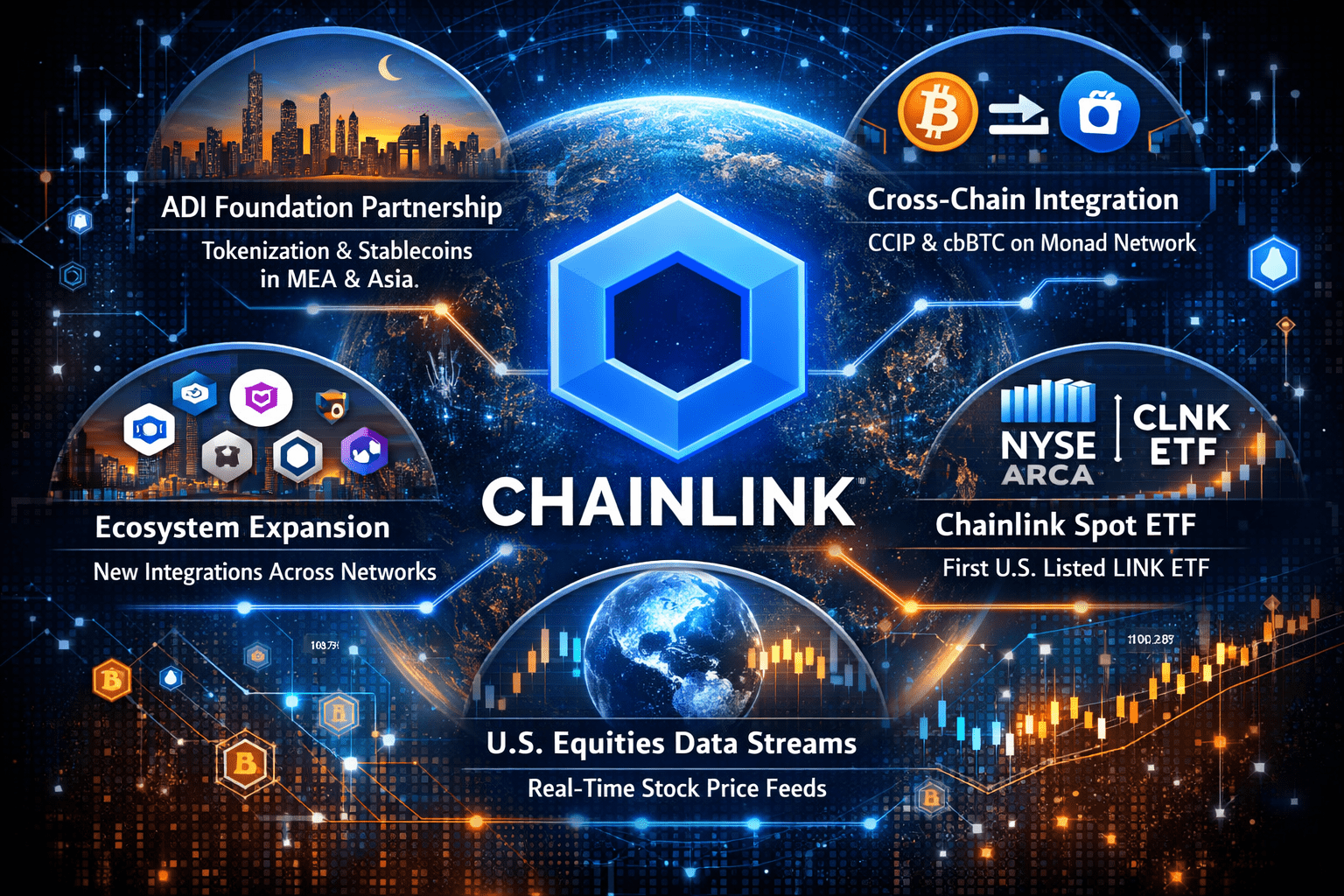
Few projects have managed to bridge the gap between traditional finance and decentralized systems as effectively as Chainlink. While many crypto platforms compete on speed, scalability, or token speculation, Chainlink has quietly built something far more consequential: a vast network of partnerships with some of the world’s most powerful institutions.
From global banks and asset managers to Big Tech firms and government agencies, Chainlink partnerships now span a wide cross-section of the global economy. The result is a growing perception among analysts that Chainlink is not merely another crypto protocol—it is becoming critical infrastructure for the next generation of financial systems.
The Foundation of Institutional Adoption
At the center of Chainlink’s rise is its ability to solve a fundamental problem in blockchain technology: how to securely connect smart contracts with real-world data and systems.
This capability has made Chainlink indispensable to institutions exploring tokenization, cross-border payments, and on-chain financial products.
Perhaps the most significant example is its collaboration with SWIFT, the messaging network that underpins much of the global banking system. Through this partnership, Chainlink enables interoperability between traditional financial infrastructure and multiple blockchain networks.
The implications are profound. Instead of requiring banks to overhaul their systems, Chainlink allows them to integrate blockchain functionality into existing frameworks, dramatically lowering the barrier to adoption.
Banking Giants and the Tokenization Wave
Chainlink’s reach extends deep into the global banking sector. Major institutions, including UBS, BNP Paribas, and Citi, have all participated in initiatives involving Chainlink’s technology.
These collaborations focus heavily on tokenized assets, one of the most closely watched trends in finance. Tokenization involves representing real-world assets—such as bonds, funds, or real estate—on blockchain networks.
In these experiments, Chainlink acts as the connective tissue:
- Enabling data feeds for pricing and valuation
- Facilitating cross-chain communication
- Supporting automated settlement processes
Other financial institutions, including BNY Mellon and Lloyds Banking Group, have also explored similar integrations, signaling broad institutional interest.
Asset Managers Enter the Blockchain Era
Beyond banks, some of the world’s largest asset managers are also part of the expanding ecosystem of Chainlink partnerships.
Firms such as Fidelity International, Franklin Templeton, and Schroders are exploring how blockchain can transform fund management and distribution.
For these firms, Chainlink provides:
- Reliable market data for on-chain assets
- Automation through smart contracts
- Infrastructure for tokenized funds
This shift suggests a future where traditional investment products are no longer confined to legacy systems but exist seamlessly across blockchain networks.
Financial Market Infrastructure: The Hidden Giants
While major banks often dominate headlines, some of Chainlink’s most strategically important partnerships involve financial infrastructure providers.
Organizations such as DTCC and Euroclear play a critical role in global markets, handling trillions of dollars in transactions annually.
By working with these entities, Chainlink is positioning itself at the heart of:
- Trade settlement systems
- Securities processing
- Cross-border asset transfers
If these integrations reach production scale, they could fundamentally reshape how global markets operate.
Payments and the Future of Transactions
The payments sector is another key frontier for Chainlink.
Partnerships with companies like Mastercard and institutions such as JPMorgan Chase highlight efforts to bridge traditional payment networks with blockchain-based systems.
These collaborations aim to enable:
- Seamless conversion between fiat and digital assets
- Automated payment settlements
- Cross-border transactions with reduced friction
As digital payments continue to evolve, Chainlink’s role could expand into becoming a universal interoperability layer for financial transactions.
Big Tech Collaboration: Data Meets Blockchain
Chainlink’s influence is not limited to finance. The network has also formed key partnerships with major technology companies, including Google Cloud and Oracle Corporation.
These collaborations focus on enabling hybrid smart contracts, which combine on-chain logic with off-chain data.
For example:
- Google Cloud can provide secure data feeds for blockchain applications
- Oracle’s enterprise systems can integrate with smart contracts
This intersection of cloud computing and blockchain represents a significant step toward mainstream enterprise adoption.
Governments and Central Banks Testing the Waters
Public sector institutions are also exploring Chainlink’s capabilities.
Entities such as the Bank of England and the Monetary Authority of Singapore have engaged in research and pilot programs involving blockchain and tokenization.
These initiatives often focus on:
- Central bank digital currencies (CBDCs)
- Cross-border payment systems
- Financial infrastructure modernization
Chainlink’s role in these projects underscores its growing relevance in policy-level discussions about the future of money.
Market Data and Exchange Integrations
Reliable data is the lifeblood of financial markets, and Chainlink has established partnerships to address this need.
Collaborations with firms like FTSE Russell allow financial indices to be delivered directly on-chain. Meanwhile, integrations involving exchanges such as CME Group support the use of accurate pricing data in decentralized applications.
These capabilities are essential for:
- Derivatives trading
- Risk management systems
- Automated financial products
The DeFi Layer: Where Chainlink Is Already Dominant
While institutional partnerships are expanding, Chainlink remains deeply embedded in decentralized finance.
Leading protocols such as Aave, Lido, and GMX rely on Chainlink for mission-critical infrastructure.
Its services power:
- Price oracles
- Liquidation mechanisms
- Security systems
In this domain, Chainlink is already considered the industry standard.
The Strategic Implication: Infrastructure, Not Hype
What distinguishes Chainlink partnerships from typical crypto collaborations is their depth and strategic importance.
Rather than focusing on short-term marketing gains, Chainlink has embedded itself into:
- Banking systems
- Asset management workflows
- Government research initiatives
- Enterprise technology stacks
This positions the network as a foundational layer for real-world asset tokenization and institutional DeFi.
Final Analysis: A Quiet Giant in the Making
In an industry often driven by hype cycles and speculative narratives, Chainlink has taken a different path—one defined by infrastructure, reliability, and institutional alignment.
Its growing list of partnerships suggests a future where blockchain is not an isolated ecosystem but an integrated component of global finance.
The success of this vision will depend on execution, regulatory clarity, and continued adoption. But if current trends hold, Chainlink may emerge not just as a leading crypto project, but as a critical bridge between traditional systems and the decentralized economy.
And in that future, its partnerships may prove to be its most valuable asset.