The global economy is on the brink of a technological convergence that could redefine how industries operate, how value is exchanged, and how trust is established in digital systems. At the center of this transformation are three powerful forces: artificial intelligence (AI), blockchain technology, and quantum computing. Each of these technologies is disruptive on its own. Together, they form a foundation for a new kind of digital infrastructure—one that is intelligent, decentralized, and exponentially more powerful than anything that exists today.
While much of the current conversation around these technologies happens in isolation, forward-looking investors and developers are beginning to explore how they intersect. The result is a growing realization that the next wave of innovation will not come from any one of these fields alone, but from their integration.
Artificial intelligence has already begun reshaping industries by enabling machines to analyze vast amounts of data, automate complex processes, and make predictive decisions. From finance to healthcare, AI is becoming the decision-making layer of the modern economy. However, it faces critical challenges, particularly around trust, transparency, and data ownership. Most AI systems today operate within centralized environments, where data is controlled by a handful of entities and decision-making processes are often opaque.
This is where blockchain technology enters the equation. Blockchain introduces a decentralized framework for trust, allowing data and transactions to be verified without relying on a central authority. By recording information on an immutable ledger, blockchain can provide transparency and accountability to AI systems. For example, an AI model’s decisions could be logged on-chain, creating an auditable trail that ensures fairness and reduces the risk of manipulation.
Projects such as Fetch.ai and SingularityNET are already exploring this intersection, building decentralized AI ecosystems where autonomous agents can interact, transact, and learn in a trustless environment. These systems point toward a future where AI is not controlled by a single corporation but distributed across a global network.
Quantum computing adds a third dimension to this evolving landscape. Unlike classical computers, which process information in binary bits, quantum computers use quantum bits, or qubits, allowing them to perform certain calculations at speeds that are currently unimaginable. This has profound implications for industries that rely on optimization, simulation, and complex problem-solving.
In the context of AI, quantum computing could dramatically accelerate machine learning processes, enabling faster training of models and unlocking new capabilities in areas like drug discovery, climate modeling, and financial forecasting. Companies such as Google and IBM are already investing heavily in quantum AI research, signaling that this convergence is not just theoretical—it is actively being developed.
However, quantum computing also introduces significant risks, particularly for blockchain systems. Many existing cryptocurrencies, including Bitcoin and Ethereum, rely on cryptographic algorithms that could be vulnerable to quantum attacks. Techniques such as Shor’s Algorithm could theoretically allow quantum computers to break encryption methods that are currently considered secure.
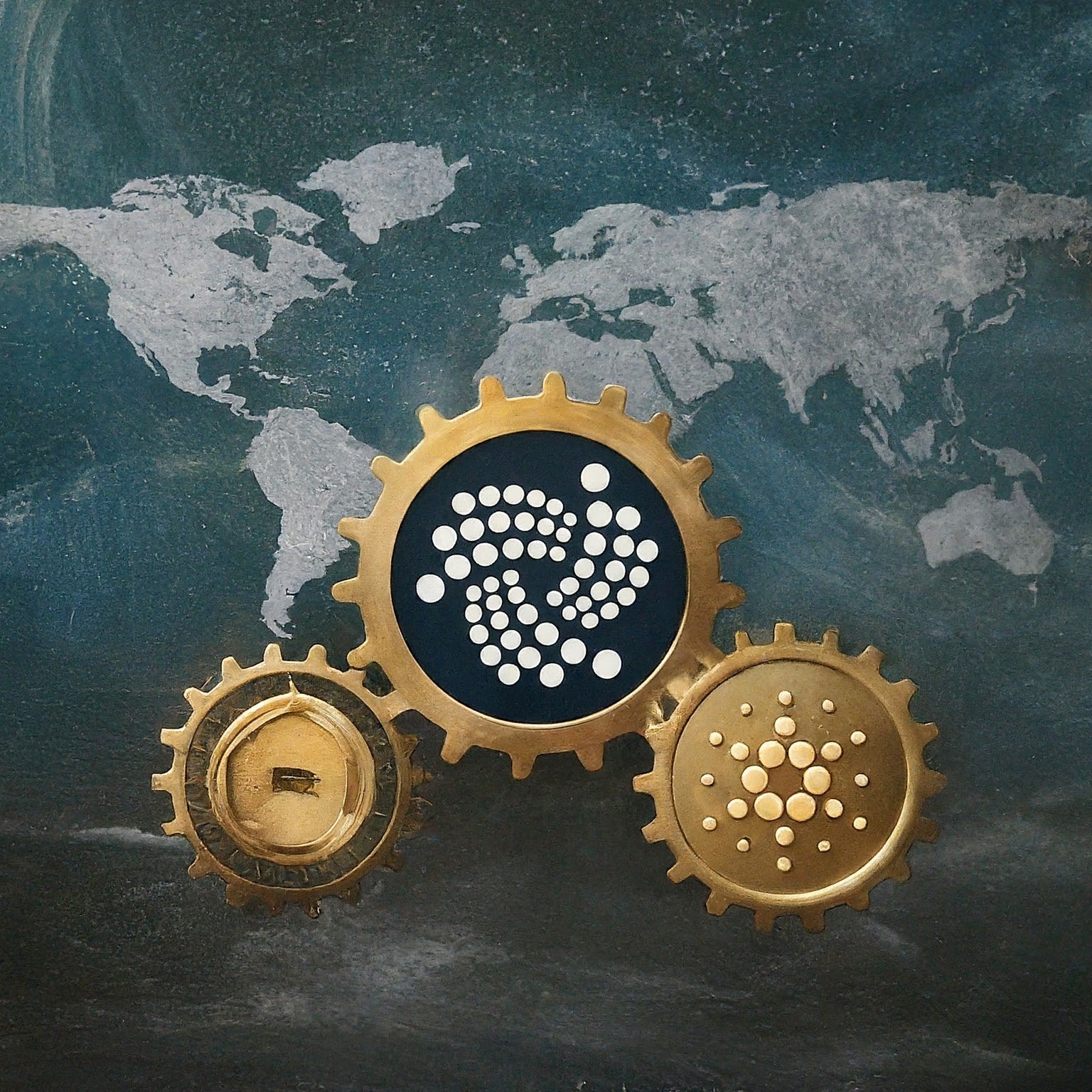
This has led to the emergence of quantum-resistant cryptocurrencies and post-quantum cryptography, which aim to protect digital assets against future threats. Projects like Quantum Resistant Ledger and IOTA are exploring new cryptographic techniques designed to withstand both classical and quantum attacks. Their development highlights a critical point: the technologies shaping the future economy are not just converging—they are also forcing each other to evolve.
When combined, AI, blockchain, and quantum computing have the potential to create fully autonomous digital systems. Imagine a global supply chain where AI algorithms predict demand and optimize logistics, blockchain networks verify transactions and enforce contracts, and quantum computers solve complex routing problems in real time. In such a system, human intervention would be minimal, and efficiency could reach levels that are currently impossible.
This convergence could also redefine financial markets. Decentralized finance (DeFi) platforms could become more intelligent, with AI-driven strategies optimizing yield and risk in real time. Blockchain would ensure transparency and security, while quantum computing could enhance market simulations and risk modeling. The result would be a financial system that is not only decentralized but also adaptive and highly efficient.
Despite these possibilities, significant challenges remain. Integrating these technologies is not straightforward. AI systems require massive amounts of data and computational power, which often leads to centralization—something blockchain aims to avoid. Quantum computing, while promising, is still in its early stages and not yet ready for widespread deployment. Additionally, the transition to quantum-resistant cryptography will require coordinated efforts across the entire blockchain ecosystem.
Regulation is another factor that will shape this convergence. Governments and institutions are beginning to recognize the implications of these technologies, particularly in areas such as data privacy, cybersecurity, and financial stability. As these frameworks evolve, they will influence how AI, blockchain, and quantum computing are adopted and integrated into the global economy.
For investors and businesses, the key takeaway is that this convergence represents a long-term trend rather than a short-term opportunity. While individual projects may rise and fall, the broader direction is clear. Systems that combine intelligence, trust, and computational power will define the next generation of digital infrastructure.
In many ways, this moment is comparable to the early days of the internet. At that time, few could predict how interconnected technologies would transform communication, commerce, and society. Today, AI, blockchain, and quantum computing are following a similar trajectory, laying the groundwork for a new economic paradigm.
The convergence of these technologies will not happen overnight. It will unfold gradually, through experimentation, innovation, and adaptation. But as it does, it will reshape industries, create new markets, and redefine what is possible in a digital world.
For those paying attention, the opportunity lies not just in understanding each technology individually, but in recognizing how they come together. The future of the global economy will not be built on a single breakthrough—it will be built at the intersection of many.