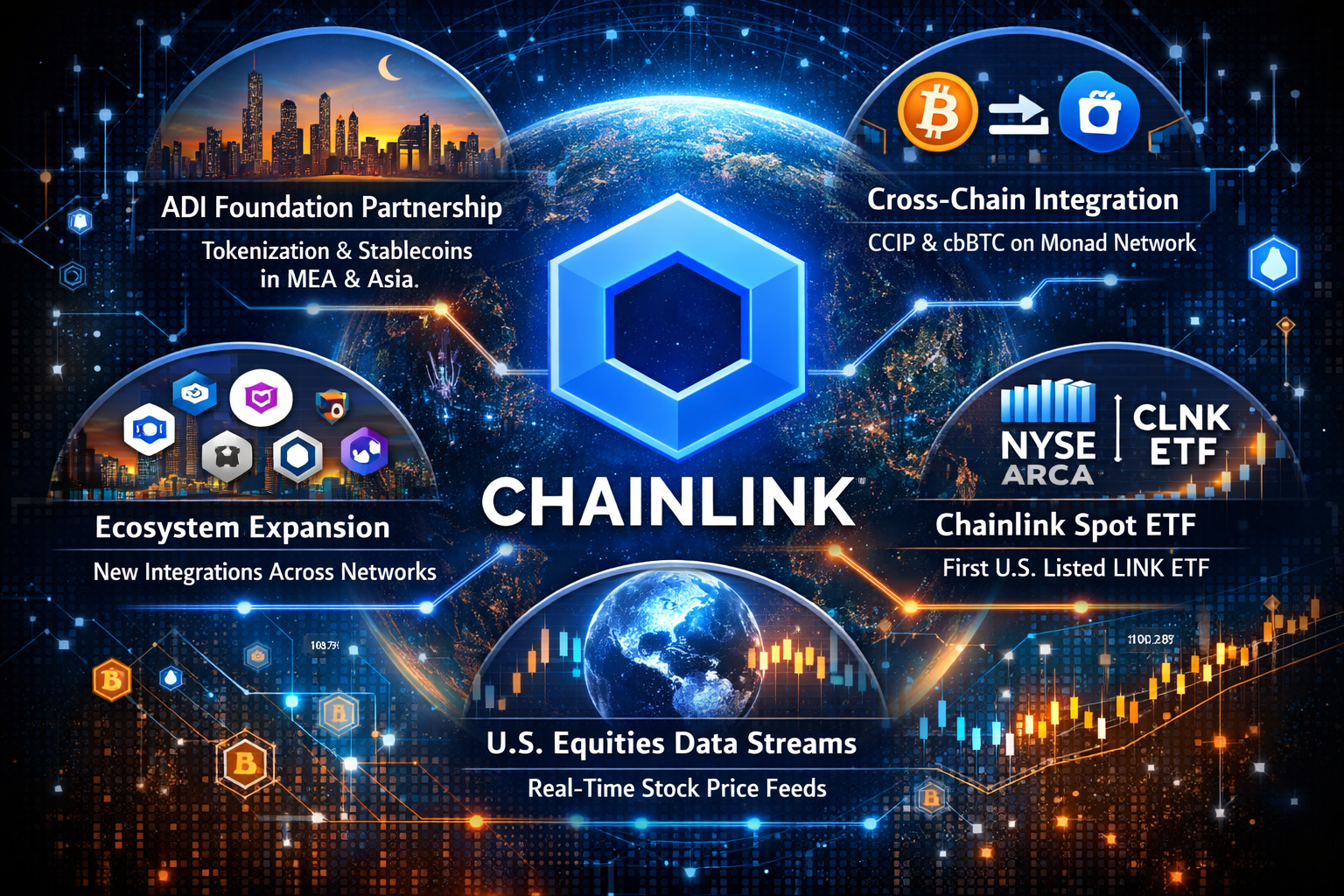
Chainlink, a blockchain network that connects smart contracts with real-world data.
Because many decentralized applications rely on accurate external data feeds—such as asset prices, weather information, or financial market data—Chainlink has become one of the most widely used oracle networks in the crypto industry.
For investors who want exposure to this critical piece of blockchain infrastructure, purchasing the network’s native token, Chainlink, is relatively straightforward. This guide explains how to buy Chainlink in 2026, including choosing an exchange, funding your account, and securely storing your tokens.
What Is Chainlink (LINK)?
Before purchasing any cryptocurrency, it’s important to understand the project behind it.
Chainlink is a decentralized oracle network that enables smart contracts on blockchains to interact with external data sources. Smart contracts by themselves cannot access data outside their blockchain environment. Chainlink solves this limitation by providing secure data feeds from the real world.
These data feeds power many applications across decentralized finance, including lending protocols, derivatives markets, and decentralized exchanges. Blockchains such as Ethereum and Avalanche rely heavily on Chainlink price feeds to ensure accurate market data.
The ecosystem is powered by the LINK token, which is used to pay node operators that supply data to the network.
Step 1: Choose a Cryptocurrency Exchange
The easiest way to buy Chainlink is through a reputable cryptocurrency exchange. These platforms allow users to convert fiat currencies or other cryptocurrencies into LINK.
Several major exchanges support LINK trading, including:
-
Binance
-
Coinbase
-
Kraken
-
KuCoin
When choosing an exchange, consider the following factors:
-
security reputation
-
trading fees
-
liquidity for LINK trading pairs
-
supported payment methods
-
regulatory compliance
Large exchanges typically offer better liquidity, which helps ensure efficient order execution.
Step 2: Create and Verify Your Account
Once you select an exchange, you’ll need to create an account.
Registration usually involves:
-
Providing an email address
-
Creating a strong password
-
Enabling two-factor authentication (2FA)
Most exchanges also require identity verification through a Know Your Customer (KYC) process. This typically involves uploading a government ID and completing a quick facial verification.
Verification increases account security and allows access to higher deposit and withdrawal limits.
Step 3: Deposit Funds
Before you can purchase LINK tokens, you must deposit funds into your exchange account.
Common deposit methods include:
Bank Transfers
Bank transfers are usually the cheapest option but may take a few days to process.
Debit or Credit Cards
Card payments allow instant purchases but typically involve higher fees.
Cryptocurrency Deposits
You can also deposit other cryptocurrencies, such as:
-
Bitcoin
-
Ethereum
-
Tether
Stablecoins like USDT are commonly used because they offer high liquidity in trading pairs.
Step 4: Buy Chainlink (LINK)
After funding your account, navigate to the exchange’s trading interface and search for Chainlink.
Common trading pairs include:
-
LINK/USDT
-
LINK/USD
-
LINK/BTC
-
LINK/ETH
You’ll typically encounter two main order types.
Market Orders
A market order purchases LINK immediately at the current market price. This is the simplest option for beginners.
Limit Orders
A limit order allows you to set the exact price at which you want to buy LINK. The order will only execute if the market reaches that price.
Once your order is completed, the LINK tokens will appear in your exchange wallet.
Step 5: Transfer LINK to a Secure Wallet
Although exchanges are convenient for trading, many investors prefer storing cryptocurrency in private wallets for added security.
Several wallets support Chainlink tokens, including:
-
MetaMask
-
Trust Wallet
-
Ledger Live
Hardware wallets produced by Ledger provide the highest level of security because private keys remain offline.
Best practices for storing cryptocurrency include:
-
writing down your recovery phrase offline
-
enabling two-factor authentication
-
avoiding unknown wallet software
-
never sharing private keys
Step 6: Consider Chainlink Staking
A major development in the Chainlink ecosystem is the introduction of staking.
Through staking, LINK holders can lock their tokens to help secure the network’s oracle services while earning rewards. This mechanism strengthens the reliability of Chainlink data feeds and incentivizes long-term participation.
Staking is expected to play an increasingly important role as the network expands into services such as cross-chain interoperability.
Why Investors Are Interested in Chainlink
Chainlink occupies a unique position within the blockchain ecosystem because it provides infrastructure rather than simply another financial asset.
Key reasons investors follow Chainlink include:
Dominance in the Oracle Market
Chainlink remains the leading decentralized oracle network used by DeFi platforms.
Growing Cross-Chain Infrastructure
New technologies such as the Cross-Chain Interoperability Protocol (CCIP) aim to connect multiple blockchains through secure messaging and token transfers.
Expanding Enterprise Adoption
Traditional financial institutions have shown increasing interest in oracle networks to connect blockchain systems with real-world data.
Risks to Consider
Despite its strong market position, investing in Chainlink still carries risks.
Potential challenges include:
-
cryptocurrency market volatility
-
competition from oracle networks such as Band Protocol and API3
-
regulatory uncertainty affecting digital assets
As with any crypto investment, diversification and careful research are important.
Final Thoughts
Buying Chainlink in 2026 is easier than ever thanks to the growing number of regulated exchanges and secure wallet solutions.
The process can be summarized in six steps:
-
Choose a reputable cryptocurrency exchange
-
Create and verify your account
-
Deposit funds
-
Purchase LINK tokens
-
Transfer them to a secure wallet
-
Consider staking to earn rewards
As decentralized finance and blockchain adoption continue to expand, the role of networks like Chainlink may become increasingly important.
For investors looking to gain exposure to the infrastructure powering smart contracts and real-world data integration, Chainlink remains one of the most closely watched projects in the cryptocurrency ecosystem.