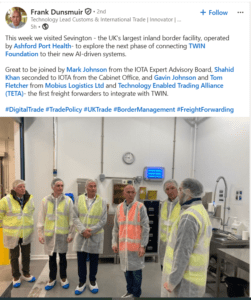
A recent visit to the UK’s largest inland border facility at Sevington Inland Border Facility highlights a growing shift toward digital infrastructure in global trade, with the IOTA Foundation playing a central role. The engagement focused on integrating the Trade Worldwide Information Network (TWIN) with emerging AI-driven systems designed to streamline customs and logistics processes. Industry participants, including representatives from government and private logistics firms, are increasingly exploring how distributed ledger technology can modernize cross-border trade. The collaboration reflects a broader push to digitize supply chains while improving transparency and efficiency.
At the center of this initiative is IOTA’s infrastructure, which is being positioned as a foundational layer for trusted data exchange in global trade. Unlike traditional blockchain systems, IOTA’s architecture is designed to handle high-throughput, feeless transactions, making it suitable for large-scale logistics environments. By integrating with TWIN, the goal is to create a seamless data-sharing framework that connects stakeholders across the supply chain. This includes customs authorities, freight forwarders, and port operators, all of whom rely on accurate and timely information.
IOTA and the Evolution of Digital Trade Infrastructure
The involvement of key stakeholders, including advisors and logistics operators, underscores the practical application of IOTA’s technology in real-world environments. Organizations such as Technology Enabled Trading Alliance and Mobius Logistics Ltd are already integrating with TWIN, signaling early adoption within the freight forwarding sector. These integrations aim to reduce friction in customs processes by enabling real-time data verification and automated compliance checks. The result is a more efficient system that minimizes delays and reduces administrative overhead.
AI-driven systems are a critical component of this transformation, complementing IOTA’s distributed ledger capabilities. By combining machine learning with decentralized data infrastructure, stakeholders can automate decision-making processes and identify inefficiencies in real time. For example, AI can analyze shipment data to detect anomalies or predict potential bottlenecks, while IOTA ensures that the underlying data is secure and tamper-proof. This synergy between AI and distributed ledger technology represents a significant shift forward in digital trade innovation.
Related: IOTA Expands TWIN Trade Push With Expert Advisory Board and UK University Collaboration
The TWIN initiative itself is designed to create a unified digital ecosystem for international trade. By standardizing data formats and enabling interoperability between different systems, TWIN aims to simplify the movement of goods across borders. IOTA’s role in this ecosystem is to provide a trusted layer for data exchange, ensuring that all participants have access to accurate and verifiable information. This is particularly important in customs operations, where discrepancies in data can lead to delays and increased costs.
The visit to Sevington also highlights the importance of public-private collaboration in driving technological adoption. Government entities, such as the UK Cabinet Office, are working alongside private companies to implement these solutions at scale. This collaborative approach is essential for overcoming regulatory and operational challenges, as well as for ensuring that new systems are aligned with existing frameworks. It also demonstrates a commitment to innovation within the public sector, which is increasingly recognizing the value of digital infrastructure.
Real-World Adoption and the Future of Logistics
The integration of IOTA with TWIN and AI-driven systems is not just a theoretical exercise; it represents a tangible shift toward modernizing global trade. Freight forwarders, as early adopters, play a crucial role in validating the effectiveness of these technologies. By participating in pilot programs and real-world deployments, they provide valuable feedback that helps refine the system. This iterative approach ensures that the technology evolves in response to practical needs rather than abstract concepts.
One of the key benefits of this integration is improved transparency across the supply chain. With IOTA’s distributed ledger, every transaction and data point can be recorded and verified, creating an immutable audit trail. This level of transparency is particularly valuable in customs operations, where accountability and compliance are critical. It also enhances trust among stakeholders, as all parties have access to the same verified information.
Related: Still Holding IOTA? Here’s Why It Feels So Hard Right Now
Efficiency gains are another major advantage, as digital systems can significantly reduce the time required for customs clearance and documentation processing. Automated workflows, powered by AI, can handle routine tasks such as data validation and risk assessment, freeing up human resources for more complex activities. This not only speeds up the movement of goods but also reduces costs for businesses. In a global economy where supply chain efficiency is a competitive advantage, these improvements are highly significant.
Looking ahead, the continued development of IOTA-based solutions within the TWIN framework could pave the way for broader adoption across international trade networks. As more stakeholders join the ecosystem, the benefits of interoperability and standardized data exchange will become increasingly apparent. This could lead to a more connected and efficient global trade system, where information flows seamlessly between participants.
Related: Quantum Computing Is Advancing—Here’s Why IOTA Isn’t Worried Yet
Ultimately, the collaboration at Sevington reflects a larger shift in how trade infrastructure is being designed and implemented. By leveraging technologies like IOTA and AI, stakeholders are moving toward a future where digital systems underpin every aspect of logistics and customs operations. While challenges remain, particularly in terms of scaling and regulatory alignment, the progress made so far suggests that this vision is well within reach.
About The Author