
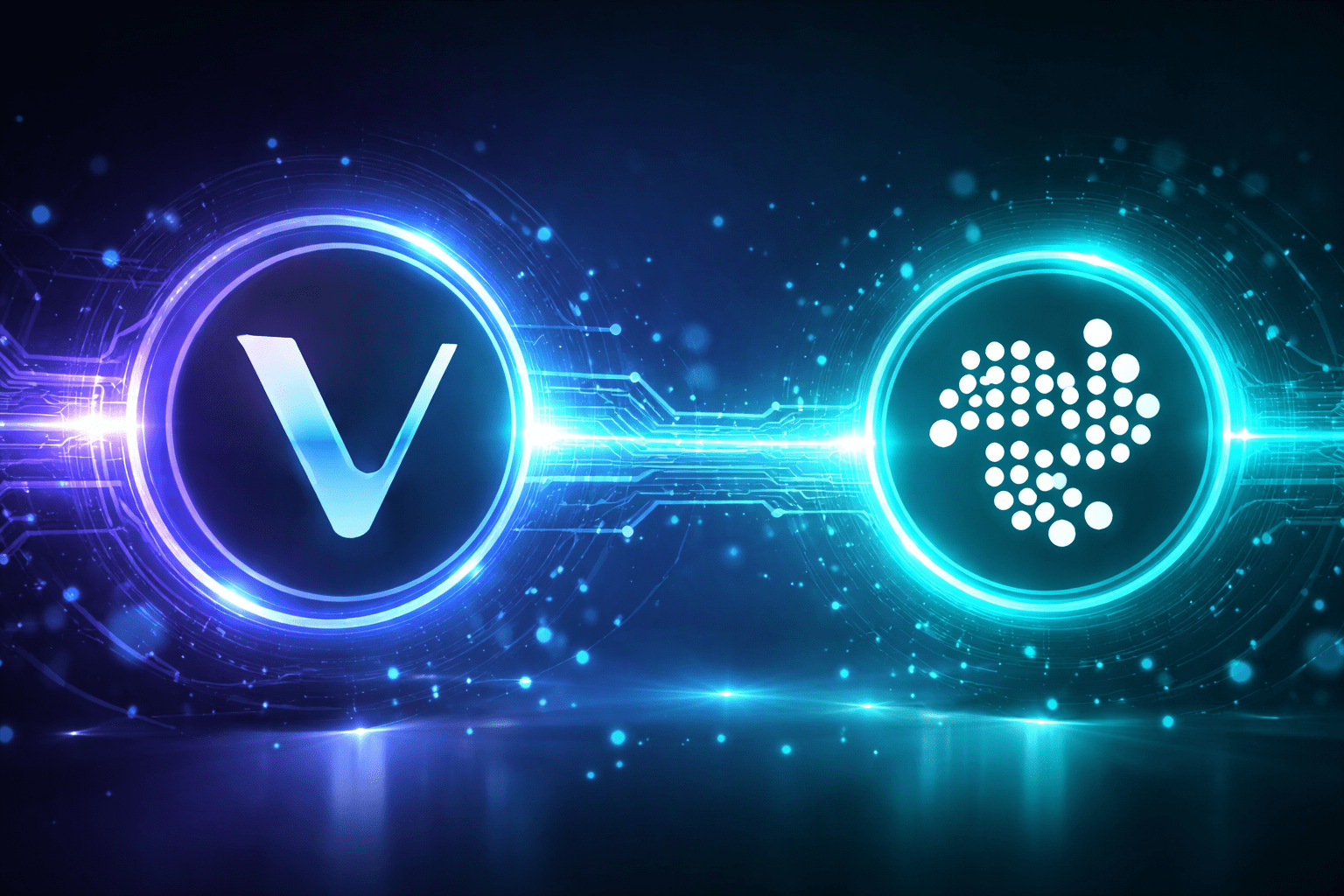
Can two fundamentally different distributed ledger systems—VeChain and IOTA—work together?
At first glance, the answer appears to be no. One is a traditional blockchain optimized for enterprise adoption; the other is a Directed Acyclic Graph (DAG) designed for machine-to-machine communication. Yet in 2026, interoperability is less about architectural similarity and more about engineering creativity.
This article explores not only whether VeChain and IOTA integration is possible, but how developers can already build practical bridges between the two—and why doing so could unlock a new class of industrial applications.
A Tale of Two Architectures
To understand the integration challenge, one must first appreciate the philosophical divide between these networks.
VeChain operates on a relatively conventional blockchain model, albeit one tailored for enterprise use. It prioritizes predictability, governance, and compliance. Its dual-token system—VET and VTHO—ensures that transaction costs remain stable, a feature that has attracted partnerships in logistics, retail, and sustainability tracking.
By contrast, IOTA was designed with an entirely different future in mind: a machine economy where billions of devices transact autonomously. Its Tangle architecture eliminates miners and fees, allowing for high-throughput microtransactions and real-time data exchange.
In essence:
- VeChain excels at trusted, auditable records
- IOTA excels at real-time, high-frequency data flows
Rather than competing, these systems occupy complementary layers of a potential digital infrastructure stack.
The Industrial Case for Integration
Consider a pharmaceutical supply chain—a sector where both transparency and real-time monitoring are critical.
IoT sensors embedded in shipping containers could stream temperature, humidity, and location data continuously via IOTA. This data, however, is too granular and voluminous to store efficiently on a traditional blockchain.
Enter VeChain. Instead of storing raw data, VeChain can anchor validated summaries—compliance checkpoints, certifications, and exception reports—creating a tamper-proof audit trail for regulators and partners.
This division of labor creates a powerful hybrid:
- IOTA as the data ingestion and streaming layer
- VeChain as the verification and settlement layer
Such architectures are not hypothetical. Variations of this model are already being explored in logistics, carbon tracking, and smart city deployments.
Why Native Integration Doesn’t Exist—Yet
Despite the compelling use cases, there is currently no native bridge connecting VeChain and IOTA.
The reasons are largely technical:
- Different consensus mechanisms: VeChain uses Proof-of-Authority, while IOTA relies on DAG-based validation
- No shared virtual machine: Smart contracts on VeChain are not directly compatible with IOTA’s architecture
- Divergent design priorities: Enterprise governance vs. decentralized machine autonomy
Yet these differences, while significant, are not insurmountable. In fact, they are precisely what make integration valuable.
Building the Bridge: A Practical Developer Approach
In the absence of native interoperability, developers must rely on middleware—an approach that has quietly become the backbone of cross-chain systems.
Below is a step-by-step guide to building a functional integration pipeline between IOTA and VeChain.
Step 1: Collecting Data from IOTA
Start by connecting to the IOTA network using its official SDK.
Example (Node.js):
import { ClientBuilder } from ‘@iota/client’;
const client = new ClientBuilder()
.node(‘https://api.mainnet.iota.org’)
.build();
async function getMessages() {
const messages = await client.getMessagesByIndex(‘sensor-data’);
console.log(messages);
}
getMessages();
This script retrieves IoT data streams indexed under a specific tag (e.g., “sensor-data”).
Step 2: Processing and Filtering Data
Raw IoT data is rarely suitable for direct blockchain storage. Instead, filter and aggregate it.
Example:
return messages.map(msg => {
return {
temperature: msg.payload.temp,
status: msg.payload.temp > 8 ? “ALERT” : “OK”,
timestamp: msg.payload.time
};
});
}
This step transforms raw inputs into actionable insights—exactly the type of data enterprises care about.
Step 3: Connecting to VeChain
Next, use VeChain’s SDK to write processed data onto the blockchain.
Example:
const thor = new ThorClient(‘https://mainnet.vechain.org’);
async function sendData(data) {
const tx = {
clauses: [{
to: ‘0xYourSmartContract’,
value: 0,
data: JSON.stringify(data)
}]
};
const result = await thor.transactions.sendTransaction(tx);
console.log(result);
}
This step anchors validated data onto VeChain, creating a permanent, auditable record.
Step 4: Automating the Pipeline
To make the system production-ready:
- Use cron jobs or event listeners
- Deploy on cloud infrastructure (AWS, Azure)
- Add monitoring and logging
At this point, you have a functioning cross-chain pipeline—without requiring a direct bridge.
Enhancing Trust with Oracles
For higher-stakes applications, developers can introduce oracle layers such as Chainlink.
In this model:
- IOTA data is verified by decentralized nodes
- Only validated inputs are pushed to VeChain
This reduces the risk of tampered data entering the system, albeit at the cost of added complexity.
The Role of Interoperability Networks
Looking ahead, emerging ecosystems like Polkadot and Cosmos aim to standardize cross-chain communication.
While neither currently offers a direct bridge between VeChain and IOTA, they signal a broader shift toward modular blockchain design.
In such a future, integration may no longer require custom middleware—interoperability could become a built-in feature.
Challenges That Remain
Even with middleware solutions, integration is not without risks:
- Data integrity: Ensuring that off-chain processing does not introduce vulnerabilities
- Latency: Bridging real-time systems with slower blockchains
- Security: Middleware becomes a potential attack vector
- Standardization: Lack of universal protocols increases development overhead
For enterprises, these challenges translate into cost, complexity, and risk management considerations.
A Glimpse Into the Future
If the past decade was about building blockchains, the next may be about connecting them.
The convergence of IoT, AI, and distributed ledgers is already reshaping industries—from logistics to energy markets. In this context, the ability to integrate systems like IOTA and VeChain is not merely a technical curiosity—it is a competitive advantage.
Developers who master these hybrid architectures today may find themselves at the forefront of tomorrow’s digital infrastructure.
Final Analysis
So, can VeChain integrate with IOTA?
Yes—but not directly, and not without effort.
The absence of native interoperability has not stopped developers from building practical solutions. Through middleware, oracles, and data anchoring techniques, it is already possible to create systems that leverage the strengths of both networks.
For enterprises, the payoff is significant:
- Real-time data from IOTA
- Trusted records on VeChain
- A unified system that bridges the physical and digital worlds
In 2026, interoperability is no longer a luxury—it is the next frontier. And for those willing to build the bridges, the opportunities are just beginning.
About The Author