Code to Customs: How IOTA’s TWIN Protocol is Rewiring the $35 Trillion Global Trade Market
For over a decade, the layer-1 blockchain narrative has played out inside a tightly sealed sandbox. Digital networks competed fiercely for speculative retail liquidity, trading volume for meme coins, and volatile non-fungible tokens. While these networks optimized for hype, the world’s most critical economic engine—the $35 trillion global trade sector—remained stubbornly analog, bound by an archaic web of paper bills of lading, manual PDF verification, and friction-laden phone calls.
At the World Knowledge Forum, IOTA Foundation Co-Founder Dominik Schiener signaled an abrupt end to this era. Speaking on the TWIN (Trade Worldwide Information Network) protocol, Schiener outlined a strategy that abandons standard crypto playbooks to embed decentralized ledger technology directly into state infrastructure.
“Our focus is to connect—country by country, around the world—to this global trade network that we’re building on top of IOTA,” Schiener stated.
"For us, our focus is to connect – country by country, around the world – to connect them to this global trade network that we're building on top of IOTA."@DomSchiener on TWIN at the @wkforum. pic.twitter.com/lAbecPz7N9
The initiative reveals a unique blueprint for how a public blockchain can transition from a speculative asset into a boring, indispensable utility backbone for global commerce.
Moving Past the “Single Window” Bottleneck
Historically, digitizing cross-border trade relied on “Single Window” software systems deployed by individual governments. While a step up from physical filing cabinets, centralized software introduces a geopolitical trust paradox. A Single Window model requires foreign corporations and neighboring nations to upload sensitive supply chain data into a portal managed by a single foreign government or monopolistic private vendor.
[Traditional Centralized Window] ──> Single Point of Failure (Sovereign Trust Issue)
[TWIN Neutral Architecture]     ──> Multi-Nation Verifiable Data Sharing (Zero Data Monopolies)
TWIN breaks this paradigm by introducing absolute infrastructure neutrality. Operating on top of IOTA’s Layer 1 architecture, the protocol functions as an open-source, decentralized bridge. Because no single entity owns the network, sovereign nations can instantly verify customs documentation, track agricultural certificates, and pass digital product passports across borders without ceding control of their data or exposing trade volumes to foreign surveillance.
From Pilot Schemes to Mainnet Realities
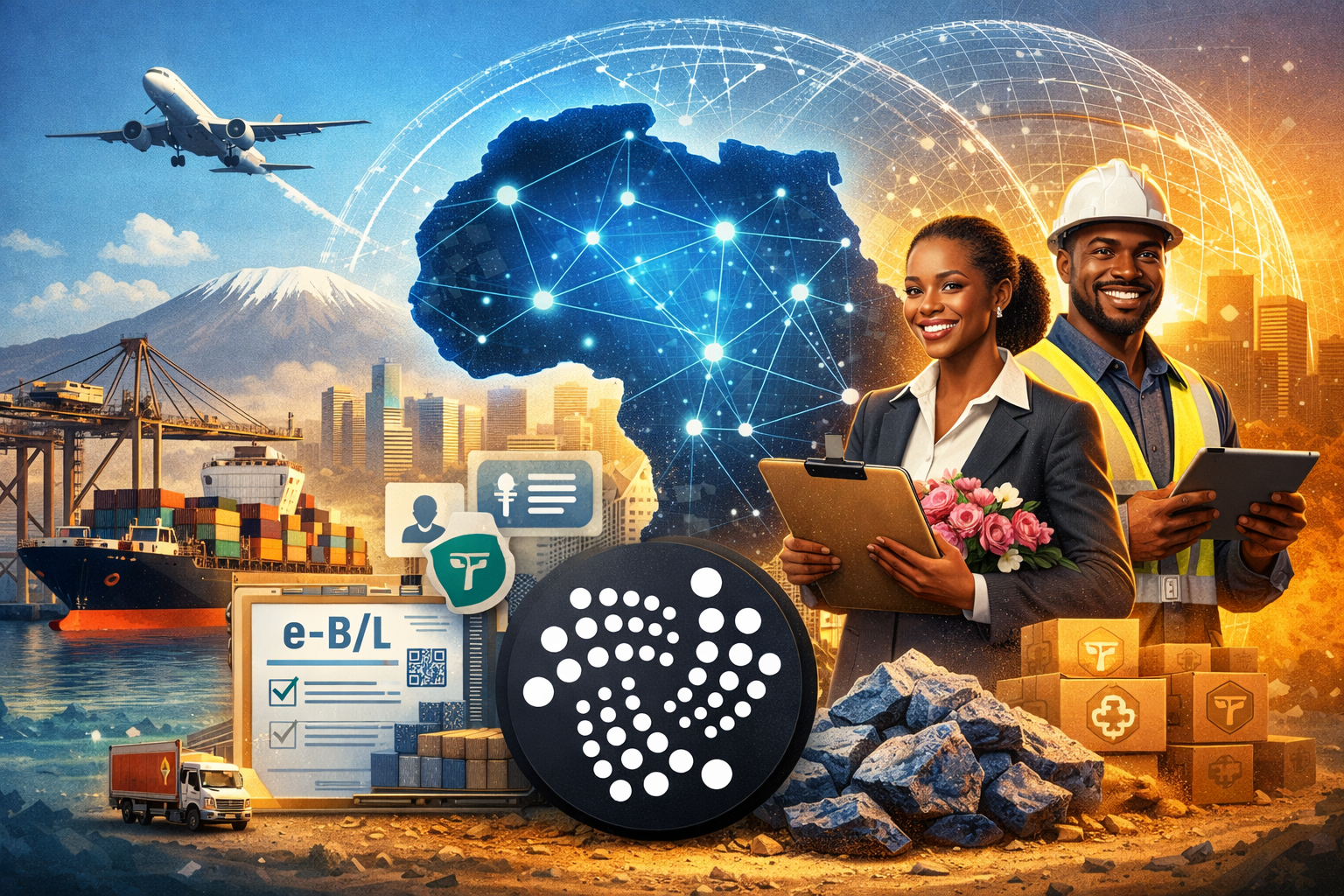
Unlike speculative crypto roadmaps, TWIN is actively logging production-grade transactions. Backed by a high-level consortium including TradeMark Africa, the World Economic Forum, and the Tony Blair Institute for Global Change, the protocol has established critical live corridors:
East African Agricultural Pipelines: In Kenya, the platform digitizes document workflows for high-volume flower and commodity exports, cutting through bureaucratic red tape.
European Freight Tracking: Across the UK, the platform has successfully logged over 2,000 poultry supply chain consignments originating from Poland, matching real-world tracking data with immutable ledger records.
The logistical implications are profound. Through the ADAPT Initiative, TWIN intends to scale across Africa to connect 1.5 billion people by 2035. Data from the World Economic Forum indicates that replacing paper-clogged borders with this verifiable framework yields an 80% reduction in transaction costs and a 35% boost in small-and-medium enterprise efficiency. Cross-border customs clearance windows that previously dragged on for 14 days can now be processed in mere hours.
The Architecture Behind the Asset
To scale to this magnitude, the protocol treats every physical shipment as a complex bundle of digital data. A single trade consignment on TWIN requires roughly 26 separate on-chain transactions to handle its multi-layered documentation. It utilizes a sophisticated stack of decentralized tools:
Self-Sovereign Identity (SSI): Authenticates the exact identity of exporters, inspectors, and customs officials without centralized databases.
Verifiable Dataspaces: Restricts access to sensitive shipping manifests, exposing data only to authorized border agents.
Digital Product Passports: Tracks the immutable lifecycle, origin, and environmental footprints of physical commodities.
To sustain this heavy throughput, IOTA deployed its Starfish upgrade, a critical mainnet evolution that optimizes consensus resilience and scales network performance specifically for enterprise workloads.
This structural intensity fundamentally alters the economics of the underlying network token. Rather than relying on retail speculation to generate value, the utility token functions as the core payment mechanism for secure network storage and gas.
If TWIN successfully secures a mere 1% of the global trade market, the protocol would naturally generate more than 650 million utility-driven transactions annually.
A Strategic Supply Chain Hedge
Beneath the technical architecture lies an underlying geopolitical thesis. Amid fractured international trade relations and unpredictable economic friction, Western institutions are actively seeking resilient supply corridors. Automating African and European trade networks via neutral protocol layers does more than just cut operational costs—it creates an economic hedge.
By replacing vulnerable, paper-heavy processing hubs with an automated, tamper-proof network, global entities secure reliable, fast pipelines for sourcing critical raw materials. IOTA’s corporate pivot reveals a profound market reality: the ultimate success of blockchain technology may not be found in redefining global finance from the outside, but in silently and systematically rewiring the invisible systems that keep global trade moving.