In recent weeks, we examined two difficult but necessary questions facing IOTA. First, in “IOTA Tried to Build Everything. Here’s Why It Didn’t Work,” we explored how years of strategic overreach diluted focus and slowed execution. Then, in “Still Holding IOTA? Here’s Why It Feels So Hard Right Now,” we looked at the emotional fatigue many long-term holders continue to experience after years of delays, pivots, and missed expectations. Those articles diagnosed the problem, but a diagnosis alone is not enough.
The more important question now is what happens next. IOTA still has functioning technology, an active foundation, and a loyal community that has stayed through some of crypto’s harshest cycles. Yet those assets mean very little if they continue operating without alignment. If IOTA is going to rebuild trust and create a thriving ecosystem, 2026 needs to become the year it shifts from explanation to execution.
The market has not been forgiving. As of early May 2026, IOTA is trading around $0.055, with a market capitalization of approximately $243 million, placing it far below its 2017 all-time high of approximately $5.25, a drawdown of roughly 99% from peak levels. Daily trading volume has hovered between $4 million and $13 million, reflecting modest but persistent market activity rather than any strong speculative resurgence.
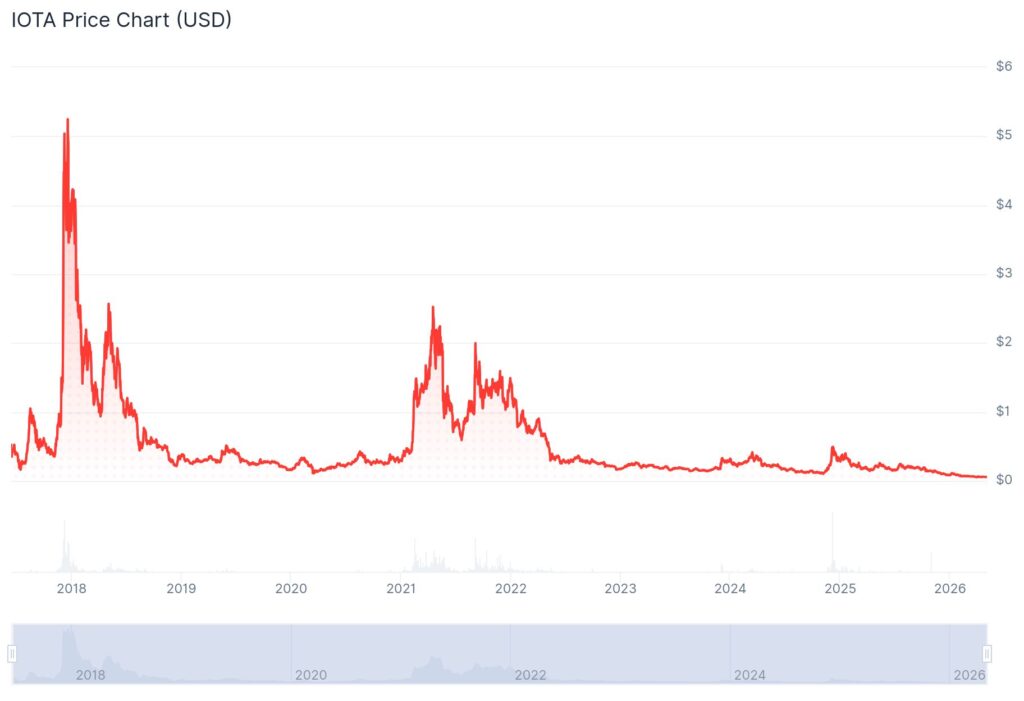
That price tells a deeper story than volatility alone. It reflects a market that has not fully abandoned IOTA but one that remains unconvinced about its direction. Price action at these levels suggests investors are waiting for proof, not promises. And if IOTA wants to change that, three critical shifts must happen immediately.
The Foundation Must Choose One Clear Identity
For years, IOTA has attempted to occupy multiple narratives at once. It has presented itself as the future of IoT payments, a smart contract platform, an enterprise infrastructure layer, a tokenization framework, and a digital trade backbone. While each of those ambitions may have technical merit, collectively they have created confusion rather than conviction. Markets rarely reward projects that struggle to explain what they are in one sentence.
This is where the Foundation must make its most difficult but necessary strategic decision. It has to choose a dominant identity and commit to it publicly, repeatedly, and consistently. If the long-term vision is tokenized trade infrastructure, then everything from partnerships to developer incentives should reinforce that. If the focus is smart contract scalability, then ecosystem messaging must revolve around builders, tooling, and application deployment.
Trying to preserve every legacy narrative is no longer sustainable. The crypto market in 2026 is far less patient than it was during IOTA’s early hype cycle. Competing Layer 1 networks have succeeded because they gave builders and investors a simple reason to care. IOTA needs that same clarity if it wants to remain relevant.
A clearer identity would also strengthen external perception. Investors evaluating blockchain ecosystems today compare not just technical architecture but strategic coherence. Right now, IOTA’s roadmap often feels more like a collection of initiatives than a unified ecosystem strategy. Until that changes, price recovery will likely remain limited to broader market sympathy rather than project-specific momentum.
The Community Must Stop Defending the Past and Start Demanding Accountability
One of IOTA’s greatest strengths has always been its community resilience. Very few crypto communities have endured as many resets, redesigns, and strategic pivots while maintaining engagement. That loyalty deserves recognition because it has kept the ecosystem alive during years when many projects simply disappeared. But resilience becomes counterproductive when it evolves into reflexive defense.
The reality is that honest criticism is not betrayal. A mature ecosystem depends on constructive pressure from its community to hold leadership accountable. When every setback is immediately rationalized or every concern dismissed as negativity, valuable feedback gets lost. Projects improve when difficult questions are asked early rather than after trust has already eroded.
This is especially important after the themes raised in our previous article, “Still Holding IOTA? Here’s Why It Feels So Hard Right Now.” Many holders are exhausted not because they stopped believing in the original vision, but because they feel trapped between hope and uncertainty. The healthiest response is not blind optimism or public despair. It is disciplined accountability.
That means demanding measurable milestones. Not abstract roadmaps, not future-facing architectural diagrams, and not another round of explanations for why progress takes time. The community should expect specific deliverables, transparent timelines, and public reporting on ecosystem growth metrics. Trust is rebuilt through consistency, and consistency only exists when performance is measurable.
If IOTA’s community shifts from passive defense to active strategic engagement, it could become one of the project’s strongest competitive advantages. In crypto, informed communities often become force multipliers for ecosystem growth. But that only happens when belief is paired with scrutiny.
Builders Need Real Incentives, and the Ecosystem Needs Visible Wins
No blockchain ecosystem survives on token holders alone. Real growth comes from developers building applications that users can interact with, businesses can integrate, and markets can measure. This is the area where IOTA’s future will ultimately be decided. No amount of technical refinement will matter if the ecosystem lacks meaningful application-level activity.
To change this, IOTA needs to become aggressively builder-focused. That means stronger grant programs, faster developer support, clearer documentation, and simplified onboarding for teams evaluating where to build. In today’s environment, developers have endless options. If choosing IOTA involves uncertainty or friction, most will simply build elsewhere.
More importantly, IOTA needs visible wins. Not experimental pilots buried in technical reports or enterprise collaborations that never surface into public utility. The ecosystem needs applications that users can actually point to and say, “this is working right now.” Whether that comes through DeFi, tokenized infrastructure, identity solutions, or trade finance tooling matters less than the fact that it exists and gains traction.
The market rewards evidence. Metrics such as active wallets, transaction growth, developer retention, and total value secured within applications matter far more than conceptual promise. Investors have become significantly more data-driven, especially after years of exaggerated crypto narratives. If IOTA wants capital to return, it must provide tangible ecosystem proof.
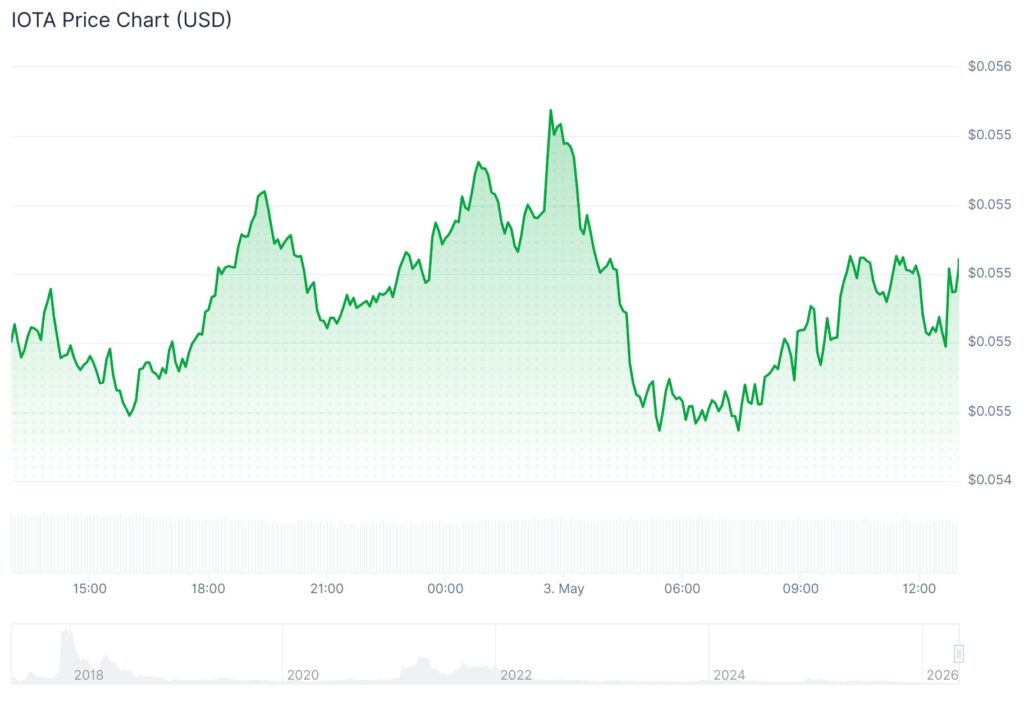
This is also where price could begin responding. At current levels around $0.055, IOTA appears to be trading in a prolonged consolidation zone, with support near recent lows around $0.052 and resistance emerging near the $0.059 to $0.060 range. A break above those levels would likely require clear ecosystem catalysts rather than broader market movement alone.
IOTA’s future is not predetermined. It is still technically alive, strategically relevant in several niche sectors, and supported by a community that continues to care. But the project has reached a point where survival alone is no longer enough. If the Foundation sharpens its focus, the community embraces accountability, and builders are given compelling reasons to stay, there is still a path to meaningful recovery.
The opportunity is still there. The question is whether everyone involved is finally ready to align around it.
About The Author