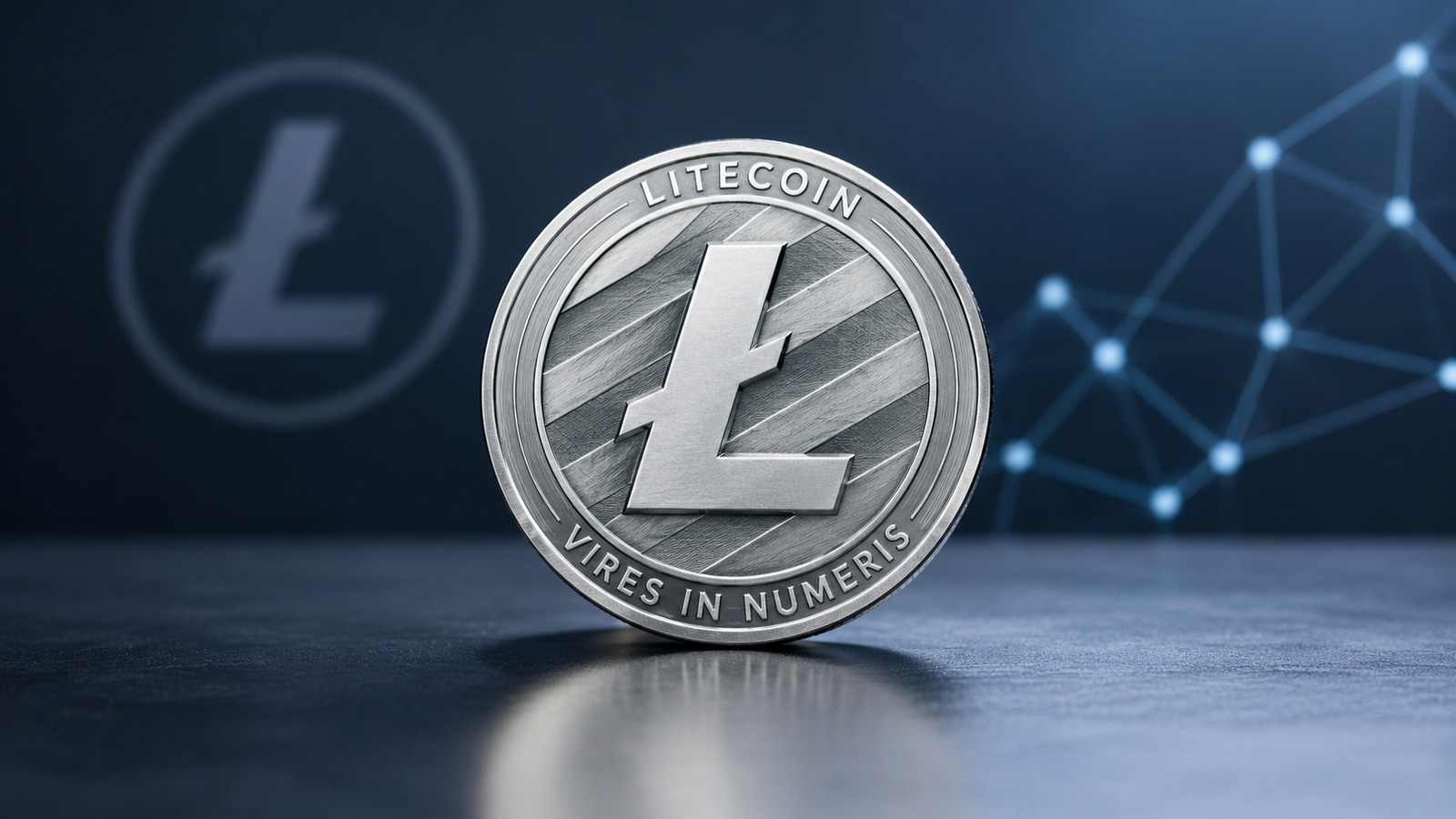
Litecoin has a feature that distinguishes it from many established payment cryptocurrencies: an optional privacy layer designed to conceal transaction amounts and make transfers harder to trace. Called MimbleWimble Extension Blocks (MWEB), the technology gives users a way to move LTC without exposing the same transaction details visible on Litecoin’s ordinary blockchain.
The upgrade addresses a real weakness in public blockchains. On a transparent network, transaction histories can reveal balances, payment amounts and relationships between addresses. But MWEB also introduces a difficult question: can Litecoin expand its privacy capabilities without making its coins harder to use across exchanges and regulated financial services?
The answer depends on more than cryptography. Wallet support, exchange policies, regulatory requirements and actual user demand will determine whether MWEB becomes a meaningful part of Litecoin’s future.
What Litecoin’s MWEB actually conceals
MWEB was activated in May 2022 as an optional extension to Litecoin’s existing blockchain. It uses technology based on the MimbleWimble protocol to improve transaction confidentiality and reduce the amount of transaction data that must be retained.
On the ordinary Litecoin blockchain, transaction amounts and address activity are publicly visible. MWEB changes that model by concealing transaction amounts and obscuring transaction relationships within its extension layer.
This is not the same as making every Litecoin transaction private. Users can continue sending LTC through the transparent blockchain, and entering or leaving MWEB creates observable on-chain activity.
That distinction matters. An analyst can observe LTC moving into or out of the privacy layer, even though the details of transfers within that layer are more difficult to inspect. Timing, amounts and other information around those transitions may also provide clues about user activity.
MWEB therefore improves privacy without eliminating every possible method of tracing funds. Its effectiveness depends on how it is used and what information is available outside the extension layer. The Litecoin project’s own documentation acknowledges practical limitations, particularly when users move between transparent and private balances.
The exchange compatibility problem
A privacy feature is useful only if people can access it through the wallets and services they actually use.
MWEB requires compatible software and support for its address format and transaction mechanisms. A wallet or exchange that supports ordinary LTC transfers does not necessarily support MWEB deposits and withdrawals.
This creates potential friction for users moving between self-custody and centralized trading platforms. Someone holding LTC in an MWEB-enabled wallet may need to move funds back to the transparent layer before transferring them to a service that does not support MWEB.
That extra step can complicate the user experience and may expose information about the movement of funds between the two layers.
There is also a regulatory dimension. Exchanges operating under anti-money-laundering and transaction-monitoring requirements may assess privacy features differently, depending on their jurisdiction and compliance obligations.
However, it would be inaccurate to assume that every exchange has restricted Litecoin because of MWEB. The relevant question is which platforms support MWEB transactions today, which do not, and whether their policies have changed.
For Litecoin, broader adoption will require more than technically successful private transactions. Users also need practical routes between private transfers, exchanges, merchants and other financial services.
Is MWEB actually being used?
The strongest test of MWEB is not whether the technology works. It is whether people use it consistently.
A 2026 research paper, Riding the Hogwarts Express: An Empirical Analysis of Litecoin’s MWEB Adoption and Usage Patterns, examined on-chain activity from May 2022 through November 2025. The researchers reported a period of accelerated adoption beginning in mid-2024, including a tenfold increase in MWEB transaction volumes and sustained accumulation reaching approximately 350,000 LTC in the privacy set.
The findings suggest that MWEB has developed beyond a purely experimental feature. But the figures need careful interpretation: coins held within a privacy layer are not the same as transaction volume, and neither measure independently establishes the number of users making everyday payments.
The next question is whether this activity represents recurring economic use or mainly transfers between wallets, private storage and exchanges.
A meaningful adoption assessment would examine several indicators together:
- MWEB transaction activity: Are private-layer transactions increasing over time?
- Net flows: Are more LTC entering the privacy layer than leaving it?
- Recurring usage: Is activity sustained across multiple periods rather than driven by a few large transfers?
- Wallet and exchange support: Can users access MWEB without unnecessary operational friction?
- Payment utility: Is the technology being used for commerce and routine transfers, rather than predominantly for holding or repositioning assets?
No single indicator answers all five questions. A rising MWEB balance may indicate demand for confidentiality, but it does not prove that Litecoin is becoming a more widely used payment currency.
Privacy versus transparency: a genuine trade-off
MWEB creates a tension between two desirable properties of digital money.
Privacy allows people to transact without exposing their financial activity to every blockchain observer. Fungibility means that one unit of a currency should be interchangeable with another unit of equal value, without differences in transaction history making some coins less acceptable.
By concealing transaction amounts and reducing the visibility of transaction relationships within its extension layer, MWEB aims to strengthen both properties.
Yet the same confidentiality can make independent transaction monitoring more difficult. Exchanges and other intermediaries must evaluate whether their compliance systems can accommodate transfers involving privacy-enhancing technology.
This is not proof that MWEB is inherently incompatible with regulation. Privacy technology and compliance are not mutually exclusive, and the implications depend on the legal framework and the capabilities of the businesses involved.
The commercial challenge is to make privacy accessible without leaving users uncertain about whether their funds can move smoothly between wallets and services.
Litecoin’s optional approach offers flexibility: users who do not need MWEB can continue using transparent transactions. But optionality alone does not guarantee broad adoption. The ecosystem still needs usable software, reliable integrations and clear policies from the services its users depend on.
What Litecoin must prove next
MWEB gives Litecoin a technical capability that goes beyond simply processing transparent payments. Whether that capability becomes a meaningful competitive advantage depends on adoption and usability.
Three developments would strengthen the case for MWEB.
First, sustained growth in private-layer activity would provide stronger evidence that users value the feature. Researchers and analysts should distinguish recurring transfers from changes in the amount of LTC held within the privacy layer.
Second, broader wallet and service compatibility would reduce friction for users who want privacy without losing access to ordinary cryptocurrency services. Current exchange support needs to be checked individually rather than inferred from general attitudes toward privacy coins.
Third, Litecoin needs a clearer demonstration of how MWEB contributes to real-world utility. Evidence of recurring payments, active wallet usage and reliable integrations would be more persuasive than a growing balance alone.
None of these outcomes is guaranteed. MWEB could remain a valuable specialist feature without becoming the primary way most Litecoin users transact.
The verdict
Litecoin’s MWEB upgrade addresses a genuine weakness of transparent blockchains, but its long-term success will depend on more than technical privacy.
The feature must attract sustained users, remain accessible through compatible wallets and services, and coexist with the compliance requirements faced by exchanges and other intermediaries.
The available research provides evidence of meaningful MWEB activity, but it does not establish that Litecoin has solved the broader challenge of mainstream payment adoption.
For investors, the important distinction is between a network possessing useful technology and a network generating measurable demand because of that technology.
MWEB gives Litecoin a stronger privacy proposition. Whether that proposition becomes a lasting commercial advantage remains an open question.
About The Author