Terra Classic is once again gaining attention across the crypto market as community members point to a growing list of catalysts that could shape the next phase of the network’s recovery story. After years of rebuilding following the historic collapse of the original Terra ecosystem, supporters now argue that the modern version of Terra Classic bears little resemblance to the chain that unraveled during the 2022 crisis.
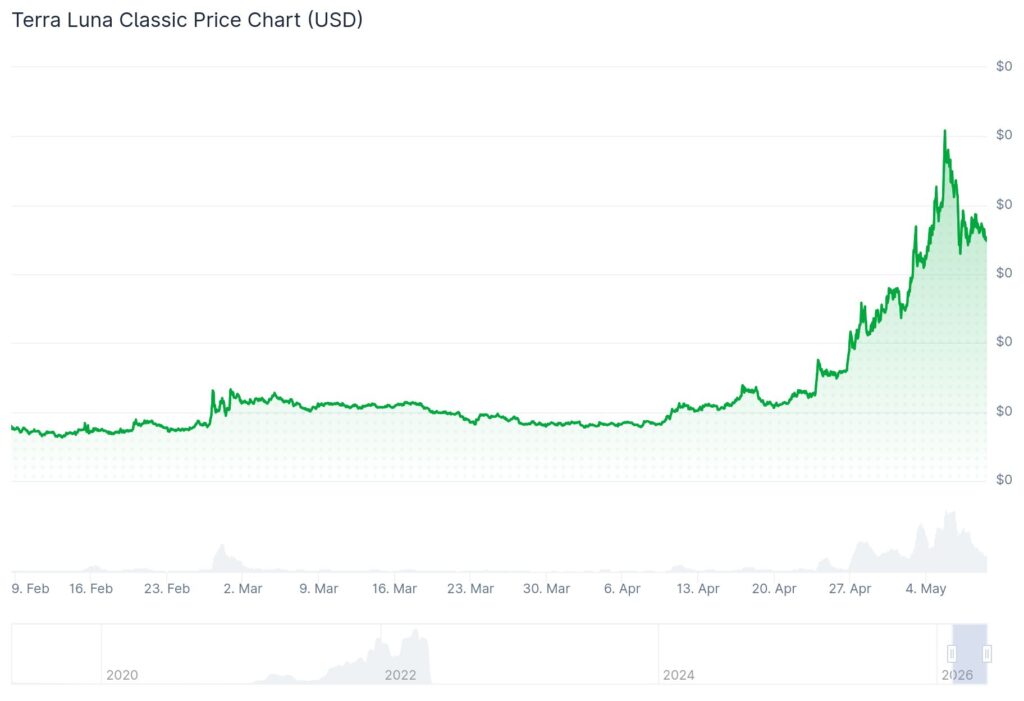
At the time of writing, LUNC is trading around $0.000094, with a market capitalization of roughly $515 million and daily trading volume exceeding $110 million, according to CoinMarketCap and CoinGecko data. The token recently reached intraday highs near $0.000107 as volatility returned to the Terra Classic ecosystem, while circulating supply remains above 5.4 trillion LUNC.
Despite still trading far below its 2022 peak, LUNC has seen a major resurgence in activity over recent months, fueled by Binance burn expectations, renewed community interest, and ongoing development surrounding the Terra Classic network and USTC ecosystem.
Momentum around LUNC has recently strengthened as traders focus on several major developments expected to impact the ecosystem throughout 2026. Among the biggest talking points are ongoing token burns from Binance, the effects of the network’s recent v4.0.1 upgrade, continued work surrounding the USTC repeg initiative, and broader infrastructure goals outlined in the Terra Classic roadmap.
Related: Binance Countdown Sparks Speculation of a LUNC Turning Point
One of the most closely watched drivers remains Binance’s periodic LUNC burn program. Since introducing support for Terra Classic burn mechanisms, Binance has removed billions of LUNC tokens from circulation through trading fee burns, helping reinforce the community’s long-term supply reduction strategy. Large burn events continue to attract attention from traders who believe sustained reductions in circulating supply could eventually support stronger price dynamics if ecosystem activity expands alongside it.
The recent v4.0.1 network upgrade has also become a major focus within the Terra Classic community. Supporters believe the upgrade lays additional groundwork for improved network performance, validator coordination, and future ecosystem development. While upgrades alone do not guarantee adoption, the continued pace of technical improvements has helped reshape sentiment around the blockchain, particularly among users who view Terra Classic as an actively maintained Layer 1 rather than an abandoned legacy chain.
At the same time, progress surrounding USTC remains one of the ecosystem’s most ambitious narratives. Community discussions continue around mechanisms designed to support a potential long-term repeg strategy for the stablecoin, alongside staking-related improvements and liquidity considerations. Although a full repeg remains highly speculative and technically challenging, the persistence of development discussions has kept interest alive among long-term supporters.
Related: Terra Classic (LUNC) Explores Post-Quantum Roadmap
The broader Terra Classic roadmap is another source of optimism for holders. Developers and validators within the ecosystem have increasingly emphasized utility expansion, decentralized infrastructure, and community-led governance as key pillars of the chain’s future. Unlike the pre-collapse Terra ecosystem, Terra Classic now operates without a centralized corporate structure controlling development decisions, with much of the network’s direction driven by validators, independent builders, and governance participants.
Supporters frequently argue that this transition toward a community-owned structure fundamentally changed the identity of the blockchain. Instead of relying on a centralized leadership model, the network now evolves through decentralized governance proposals, validator participation, and ecosystem collaboration.
Despite renewed enthusiasm, Terra Classic still faces major challenges. Competition across Layer 1 ecosystems remains intense, while the lingering reputation of the Terra collapse continues to weigh on investor confidence. In addition, long-term success will likely depend not only on burns and speculation, but on whether developers can attract meaningful applications, liquidity, and sustained on-chain activity.
Still, optimism around Terra Classic has clearly returned in recent months. For many supporters, the focus is no longer solely on the chain’s collapse history, but on whether the ecosystem can successfully transform itself into a sustainable blockchain network with real infrastructure, utility, and community-driven growth.
As new upgrades roll out, Binance burns continue, and USTC development progresses, Terra Classic supporters believe the next chapter of the LUNC story may still be unfolding.
About The Author