IOTA’s biggest problem is no longer whether its technology can work. It is whether the IOTA Foundation can turn years of research, repeated strategic changes and ambitious adoption plans into results that justify the community’s patience.
The Foundation has made genuine technical progress. It removed the original Coordinator in stages, launched a decentralized IOTA 2.0 testnet, introduced smart contracts and ultimately released IOTA Rebased in May 2025. But the journey has also involved abandoned approaches, revised deadlines, changed tokenomics and a new strategic focus on global trade.
For long-term holders, the central question is simple: after years of waiting, where is the measurable economic success?
The evidence does not prove that the Foundation has achieved nothing. It does, however, reveal a substantial gap between IOTA’s ambitions and the adoption, token performance and ecosystem activity that supporters hoped to see.
The timeline: how IOTA’s promises and priorities changed
The Foundation’s history provides the clearest starting point for evaluating its record.
| Date | Milestone or change | Why it matters |
|---|---|---|
| July 2019 | The Foundation published its Coordicide roadmap. | Removing the Coordinator was a central step toward a decentralized network. Source. |
| 2020 | IOTA 2.0 development was organized around the Pollen, Nectar and Honey stages. | The project pursued a staged path toward Coordinator-free consensus. Source. |
| October 2023 | Stardust replaced the single Coordinator with a permissioned validator committee. | Decentralization advanced, but full permissionless validation remained a future objective. Source. |
| April 2024 | The Foundation announced a functional IOTA 2.0 testnet. | A significant technical milestone, but not yet the final production network. |
| May 2024 | IOTA EVM launched, introducing Ethereum-compatible smart contracts. | IOTA expanded into competition with established smart-contract ecosystems. |
| November 2024 | The Foundation proposed IOTA Rebased, replacing its existing IOTA 2.0 direction with a Move-based architecture and delegated proof of stake. | A major strategic change after years of work on the previous approach. Source. |
| December 2024 | Token holders approved the Rebased proposal. | The change received a majority among participating voters, though participation was limited. |
| May 5, 2025 | IOTA Rebased mainnet launched. | A substantial technical achievement that reset the network’s development direction. Source. |
| 2025–2026 | The Foundation increasingly prioritized TWIN and digital trade infrastructure. | The project shifted from a broad blockchain ecosystem pitch toward a more specific institutional use case. Source. |
The timeline matters because these were not minor software updates. They involved fundamental decisions about how IOTA should achieve decentralization, support applications and generate economic activity.
The Foundation has legitimate explanations for changing course. Blockchain engineering is difficult, and a new architecture can be superior to an earlier design. But the community is entitled to ask how much time and money previous approaches consumed, which deliverables survived the transition, and what measurable advantage the latest direction has produced.
The strongest criticism is not that the Foundation changed its mind. It is that every major change raises the burden of proof for the next promise.
The price tells a brutal story
IOTA’s historical price performance is one of the clearest reasons long-term supporters have lost confidence.
According to CoinGecko’s historical data, IOTA closed at approximately $0.04652 on October 20, 2026. CoinGecko lists its all-time high at approximately $5.25, although other market-data providers report different historical peaks because of differences in exchange coverage and pricing methodology.
Using those figures:
Price decline from the all-time high
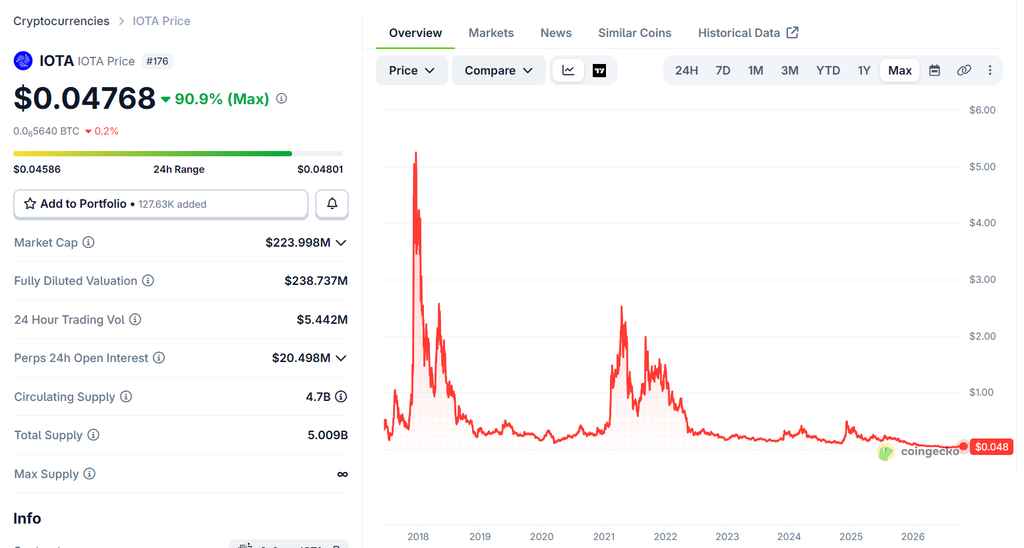
An investment worth $10,000 at $5.25 per IOTA would be worth approximately $88.62 at $0.04652, excluding trading costs, taxes and any additional tokens received.
That is a devastating outcome for anyone who bought near the historical peak and held without selling.
It is not, by itself, proof that the Foundation mismanaged the project. The 2017 cryptocurrency market was exceptionally speculative, and IOTA’s price has been affected by market cycles, competition and broader investor sentiment. Nor does every early holder have the same purchase price.
Nevertheless, a decline of this magnitude makes one question unavoidable: what has the project delivered economically since its peak that can support a credible case for long-term recovery?
A future recovery remains possible. But it requires more than pointing to technological improvements. Investors need evidence of adoption, demand and a competitive advantage that can endure.
Token supply increased substantially, too
The supply story is important because it complicates comparisons between IOTA’s historical price and its present valuation.
Before the Stardust upgrade, the original IOTA supply was approximately 2.78 billion tokens under the previous denomination. In September 2023, the Foundation announced a new token distribution that would expand total supply to 4.6 billion IOTA over four years, funding ecosystem development and related allocations.
That was a substantial change.
The expansion from approximately 2.78 billion to 4.6 billion represented an increase of roughly 65.5% in the nominal token supply.
The Foundation explained the rationale: funding ecosystem growth, supporting contributors and increasing the utility of IOTA. It also described how the new supply would be distributed. This was not a hidden change; it was a published decision.
However, the subsequent Rebased tokenomics introduced additional issuance and burning mechanisms. The May 2025 whitepaper documented an initial supply of 4.6 billion IOTA, with up to 767,000 tokens potentially minted per epoch, approximately one epoch per day, offset by token burns.
As of October 21, 2026, CoinGecko reported approximately:
- Circulating supply: 4.7 billion IOTA.
- Total supply: approximately 5.0 billion IOTA.
- Market capitalization: approximately $222 million, subject to market-price fluctuations.
The implication is straightforward: IOTA’s economic model has changed materially since its early years.
Increasing supply does not automatically destroy value. If additional tokens fund development that attracts enough users and economic activity, the trade-off could be justified. Burning mechanisms can also offset some issuance.
But holders should ask whether the ecosystem’s growth has justified the additional supply. Has the expansion generated sufficient demand to compensate for the dilution risk? Has token utility increased enough to support the new economic model?
Those are legitimate questions about execution, not arguments against token issuance in principle.
Independent network data raises another question
The Foundation’s technical achievements must ultimately be assessed against the network’s actual economic activity.
DeFiLlama provides one useful independent measurement of IOTA’s application ecosystem. Its figures are not a complete measure of IOTA adoption, particularly because the project’s trade infrastructure may operate differently from conventional decentralized finance. Nevertheless, the data offers a useful test of the claim that IOTA has developed a competitive smart-contract ecosystem.
As of October 21, 2026, DeFiLlama reported the following for IOTA EVM:
| Metric | Reported figure |
|---|---|
| Total value locked in DeFi | Approximately $343,700 |
| Active addresses over 24 hours | 26 |
| Transactions over 24 hours | 2,972 |
| Daily chain fees | Approximately $0.71 |
| Stablecoin market capitalization | Approximately $449,224 |
These figures are a snapshot, not a complete history. They can change significantly from day to day, and EVM activity does not capture every transaction on IOTA’s mainnet or every trade-related operation.
Still, they raise a difficult question.
A blockchain seeking to compete for developers, liquidity and applications must demonstrate that users have reasons to choose it over alternatives. Hundreds of millions of dollars in market capitalization alongside a DeFi ecosystem holding less than half a million dollars in TVL suggests a substantial gap between token valuation and the capital committed to that particular application ecosystem.
The broader IOTA network also reports hundreds of millions of cumulative transactions through its explorer. But cumulative transaction totals cannot establish sustained economic adoption on their own. They may include system operations, repeated activity from the same users and transactions that do not represent independent commercial demand.
What matters more is recurring activity from real users, capital deployed in applications, developers who continue building, and fees or other economic flows that demonstrate demand.
The Foundation should publish consistent data distinguishing genuine application usage from protocol-level operations. It should also show how these metrics have changed since Rebased launched in May 2025.
Without that comparison, it is difficult to judge whether the new architecture is producing the ecosystem growth that justified the strategic pivot.
TWIN and global trade: a genuine opportunity, but how much is operational?
The Foundation’s move toward global trade is arguably its most important strategic development in recent years.
TWIN, the Trade Worldwide Information Network, is intended to digitize trade documentation and connect participants across fragmented supply chains. Its predecessor, the Trade Logistics Information Pipeline (TLIP), was developed with partners including TradeMark Africa and Kenyan public-sector stakeholders.
There is evidence of real work.
The Foundation’s January 2026 manifesto states that TWIN’s first customers began operating on the IOTA mainnet in early January. It describes a shipment of chicken from Poland to the United Kingdom as an example of a consignment being tracked through the platform.
The Foundation’s Q1 2026 report also described multi-node connectivity involving KenTrade, the Kenya Revenue Authority and TLIP community nodes. It reported exploratory work with Rwandan stakeholders on a coffee-export pilot.
But the Q2 2026 report still described significant work in progress: developing a commercial model with TradeMark Africa, preparing legal frameworks for UK pilots, advancing integrations with port authorities and freight forwarders, and improving trade-document infrastructure. It also reported a 95% pass rate across active test profiles for TLIP v1.3.9.
These are meaningful milestones. They are not all equivalent to sustained commercial production.
A successful test establishes that software performs under defined conditions. A pilot establishes that a use case can be tested in a real or controlled environment. A production deployment means a service is being used operationally. Sustained commercial adoption requires further evidence: repeated shipments, continuing customers, measurable cost savings, recurring fees or other durable economic activity.
How many sustained production deployments can be independently verified?
The public evidence reviewed for this article does not establish a reliable total.
The Foundation claims that initial TWIN customers became operational on the mainnet in January 2026. That is evidence of claimed live use, and it should not be dismissed. However, the public reports reviewed do not provide an independently verified count of active commercial customers, monthly shipments processed, recurring revenue, or production deployments that have remained operational over a sustained period.
The Q2 report’s continued emphasis on pilots, legal preparation and integration work suggests that parts of the broader rollout remain under development. It does not prove that the entire initiative is a failure, nor does it mean that no production activity exists.
The proper conclusion is narrower: TWIN has moved beyond a purely theoretical proposal, but the public evidence is insufficient to establish the scale and commercial durability of its adoption.
That is exactly the kind of evidence the Foundation should make available if it wants the community to judge the strategy fairly.
The Foundation’s responsibility is to show what the token gains
The most important issue connecting IOTA’s roadmap, tokenomics and adoption is value accrual.
A trade platform can succeed without automatically generating significant demand for its underlying cryptocurrency. Businesses may use a blockchain’s infrastructure while minimizing direct exposure to its token. Transactions may be sponsored, fees may be small, and commercial value may accrue primarily to service providers rather than token holders.
That does not make the strategy worthless. It means the relationship between adoption and token value must be demonstrated rather than assumed.
The Foundation should answer several specific questions:
- How much trade activity is recorded on IOTA’s mainnet each month?
- How many independent businesses use TWIN in sustained production?
- How many consignments and trade documents are processed?
- What measurable time or cost savings have participating businesses achieved?
- How much recurring economic activity generates direct demand for IOTA?
- How do issuance, staking rewards and token burns affect the long-term supply?
- What targets will the Foundation use to judge the success or failure of its trade strategy?
These questions are answerable in principle. Some data may be commercially sensitive, but aggregate figures can still establish whether adoption is growing.
The Foundation should not be expected to guarantee a higher token price. It should be expected to explain how its strategy creates a credible path from technological utility to sustainable economic demand.
Has the IOTA Foundation failed its community?
The evidence supports a serious criticism, but not the simplistic claim that the Foundation has accomplished nothing.
It has delivered substantial technical changes, including Rebased. It has expanded the token supply through a disclosed ecosystem-funding strategy. It has developed trade infrastructure with institutional partners, and it reports initial live mainnet usage through TWIN.
Yet the price remains far below its historical peak, the DeFi footprint is small relative to the network’s valuation, and the publicly available evidence does not yet establish the scale of sustained commercial adoption claimed as the project’s future.
That combination leaves the Foundation with a credibility problem.
The community was asked to support a long-term technological vision. Over time, the route toward that vision changed considerably. The Foundation now needs to demonstrate that the latest direction is not simply another ambitious chapter in a project that has struggled to convert development into economic results.
The fairest test is not whether IOTA has made progress. It has.
The test is whether that progress is sufficient, measurable and economically meaningful—and whether the Foundation can show the community the evidence.
IOTA holders have already given the project years of patience. The Foundation’s next task is to prove that patience was justified.
About The Author