Zcash (ZEC) and Monero (XMR) share a mission: making cryptocurrency transactions private. But ask their communities how financial privacy should work, and you will quickly discover that they disagree on almost everything.
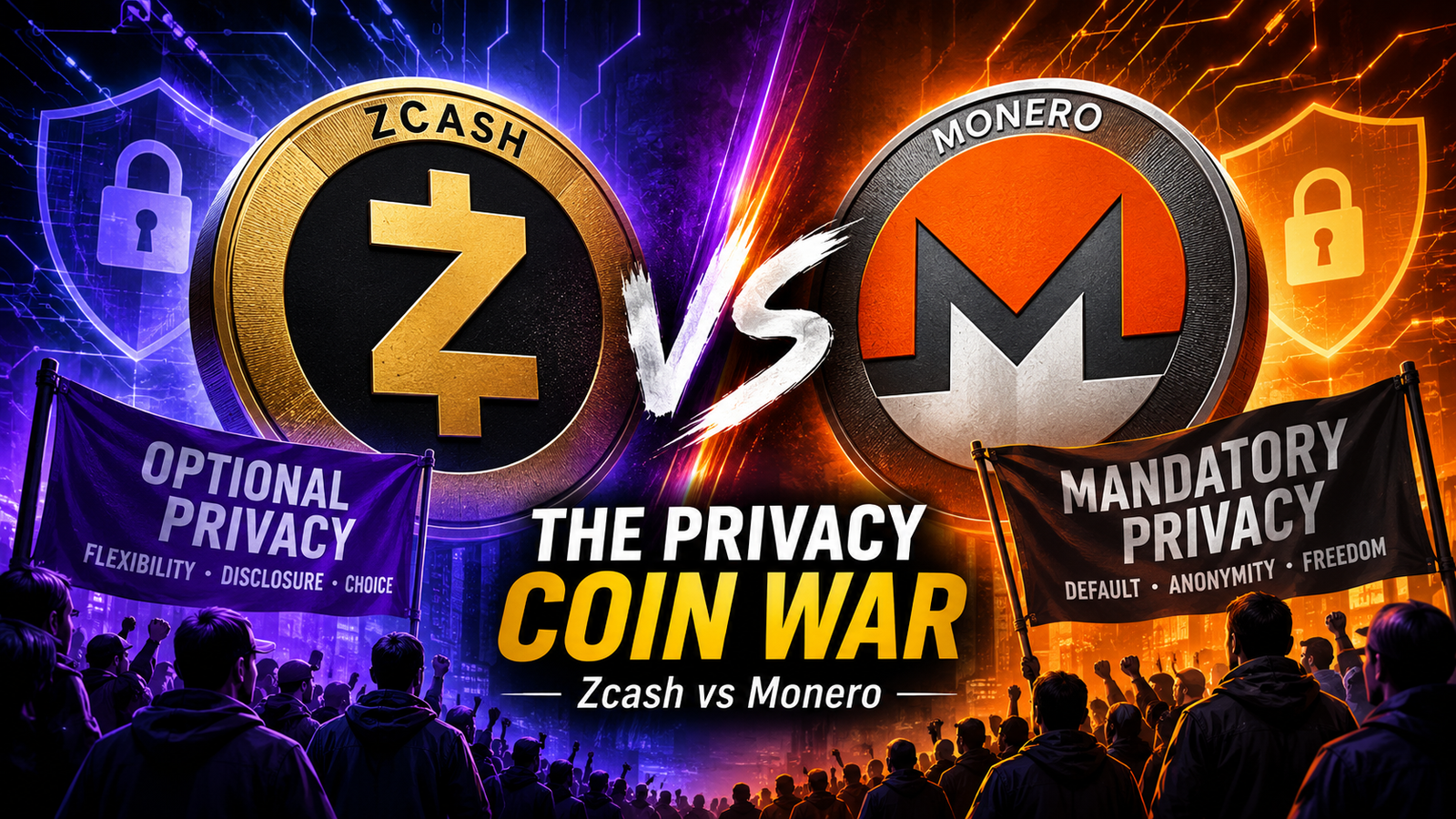
The battle is not simply about which coin has better technology. It is about two fundamentally different approaches to privacy: should it be mandatory or optional?
Monero: Privacy by Default
For Monero supporters, privacy should never be a user preference. It should be built into every transaction.
Monero (XMR) uses three core technologies:
- Ring Signatures: Mix a transaction’s real input with decoys, making it difficult to identify the actual sender.
- Stealth Addresses: Generate unique one-time addresses to conceal recipients.
- RingCT: Conceals transaction amounts.
The result is a network where privacy is the default rather than an additional feature users must activate.
Monero’s community argues that this creates a stronger anonymity set. If everyone uses privacy protections, there is less opportunity to distinguish private users from transparent ones.
Zcash: Privacy Through Choice
Zcash (ZEC) takes a different technical approach. Its defining innovation is zk-SNARKs, zero-knowledge proofs that allow transactions to be verified without publicly revealing the sender, recipient or amount.
However, Zcash supports both transparent and shielded transactions.
Its shielded pools provide strong cryptographic privacy, while transparent transactions offer public visibility. Users can also use selective disclosure mechanisms when they need to demonstrate specific transaction information.
Zcash supporters see this flexibility as an advantage. Businesses and individuals may need privacy without sacrificing every possibility of financial accountability.
Monero supporters see a weakness: optional privacy risks creating a smaller anonymity set when users fail to shield their transactions.
The Communities Are Fighting Over More Than Technology
This is where the rivalry becomes interesting.
Monero supporters often question why anyone would build a privacy coin that allows publicly visible transactions. Zcash supporters counter that mandatory privacy can create unnecessary friction with exchanges, businesses and regulatory requirements.
Both communities have legitimate arguments.
Monero must maintain its privacy guarantees while navigating increasing regulatory pressure and evolving cryptographic threats. Zcash must convince users to adopt shielded transactions consistently while maintaining confidence in its developers and ecosystem.
Neither project has solved every problem.
Who Gets to Define Financial Privacy?
The Zcash-Monero rivalry exposes a question the wider cryptocurrency industry cannot ignore.
If blockchain technology promises financial freedom, should users have to choose between privacy and accessibility?
Monero believes privacy should be universal. Zcash believes powerful privacy should come with flexibility.
But perhaps their biggest challenge is not defeating each other. It is convincing the world that financial privacy is worth protecting in the first place.
The real privacy coin war isn’t Zcash versus Monero. It’s a fight over what financial freedom should look like.
About The Author