


Global oil prices have climbed sharply in recent weeks, with Brent crude recently moving above $120 per barrel, levels not seen since the height of the 2022 energy crisis. That rise has been driven by supply disruptions, geopolitical instability, and tightening global inventories. For industries already operating under thin margins, the increase is translating into higher transport costs, more expensive manufacturing inputs, and growing pressure to improve efficiency across logistics networks.
These kinds of market shocks often expose weaknesses that remain hidden when energy prices are stable. Shipping delays, routing inefficiencies, and slow settlement processes suddenly become much more expensive when fuel costs surge. That broader economic pressure is what makes the current oil market environment relevant to IOTA.
Related: IOTA Fixes Blockchain’s Biggest Problem with Starfish Upgrade
The project has long positioned itself around industrial efficiency rather than speculative crypto narratives. Its architecture was designed for machine-to-machine coordination, real-time data exchange, and automated settlement between connected systems. As oil prices rise and operational efficiency becomes more urgent, that original thesis is worth re-examining.
Why Higher Oil Prices Matter for Industrial Systems
Oil remains deeply embedded in the global economy, influencing transportation, manufacturing, and energy distribution at nearly every level. Analysts estimate that a sustained 10% increase in crude prices can significantly raise logistics costs, particularly in freight-heavy sectors. When those costs rise, even small operational inefficiencies become financially significant.
For companies moving goods across global supply chains, this creates immediate pressure to optimize route planning, reduce idle time, and improve coordination between systems. Real-time operational data becomes far more valuable in these conditions because faster decision-making can directly reduce fuel expenditure. This is where distributed digital infrastructure becomes part of the conversation.
Related: IOTA Powers Next Phase of AI-Driven Trade at UK’s Largest Inland Border Facility
IOTA’s technical design was built around this kind of machine-level coordination. Unlike traditional blockchain systems, its structure allows for lightweight transaction validation intended for high-frequency automated interactions. That makes it conceptually suited for use cases such as smart logistics, energy balancing, and autonomous settlement between devices.
The link to oil is not direct. Rising crude prices do not influence IOTA’s price through any measurable historical correlation. Instead, they increase focus on the exact industrial inefficiencies the project was originally built to address.
IOTA Price Outlook and Market Reality
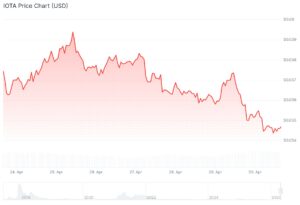
IOTA is currently trading around $0.054, giving it a market capitalization of roughly $240 million. That remains far below its 2017 all-time high above $5, meaning the asset is still down more than 98% from peak valuation. Over the last five years, it has struggled to regain sustained momentum despite network upgrades and broader ecosystem restructuring.
IOTA chart
In the short term, technical indicators suggest IOTA is likely to remain range-bound unless broader altcoin market sentiment improves. A bullish move could push the price toward the $0.07 to $0.09 range, particularly if liquidity rotates back into infrastructure-focused digital assets. On the downside, losing support near $0.045 could send it toward $0.035.
That said, oil prices alone are unlikely to move the market. Near-term price action will depend far more on overall crypto market conditions, ecosystem developments, and whether the project demonstrates practical enterprise traction. Macro energy trends may strengthen the relevance of IOTA’s use case, but relevance is not the same as adoption.
Related: Still Holding IOTA? Here’s Why It Feels So Hard Right Now
This is the critical distinction investors often overlook. Rising oil prices do not validate IOTA or guarantee renewed momentum. They simply highlight the growing importance of efficiency-focused infrastructure at a time when industrial systems are under increasing economic pressure.
For long-time observers, that may be the most important takeaway. The machine-economy vision that once seemed years ahead of its time is being tested against real-world economic conditions. Whether IOTA can convert that relevance into measurable adoption remains the unanswered question.
About The Author