
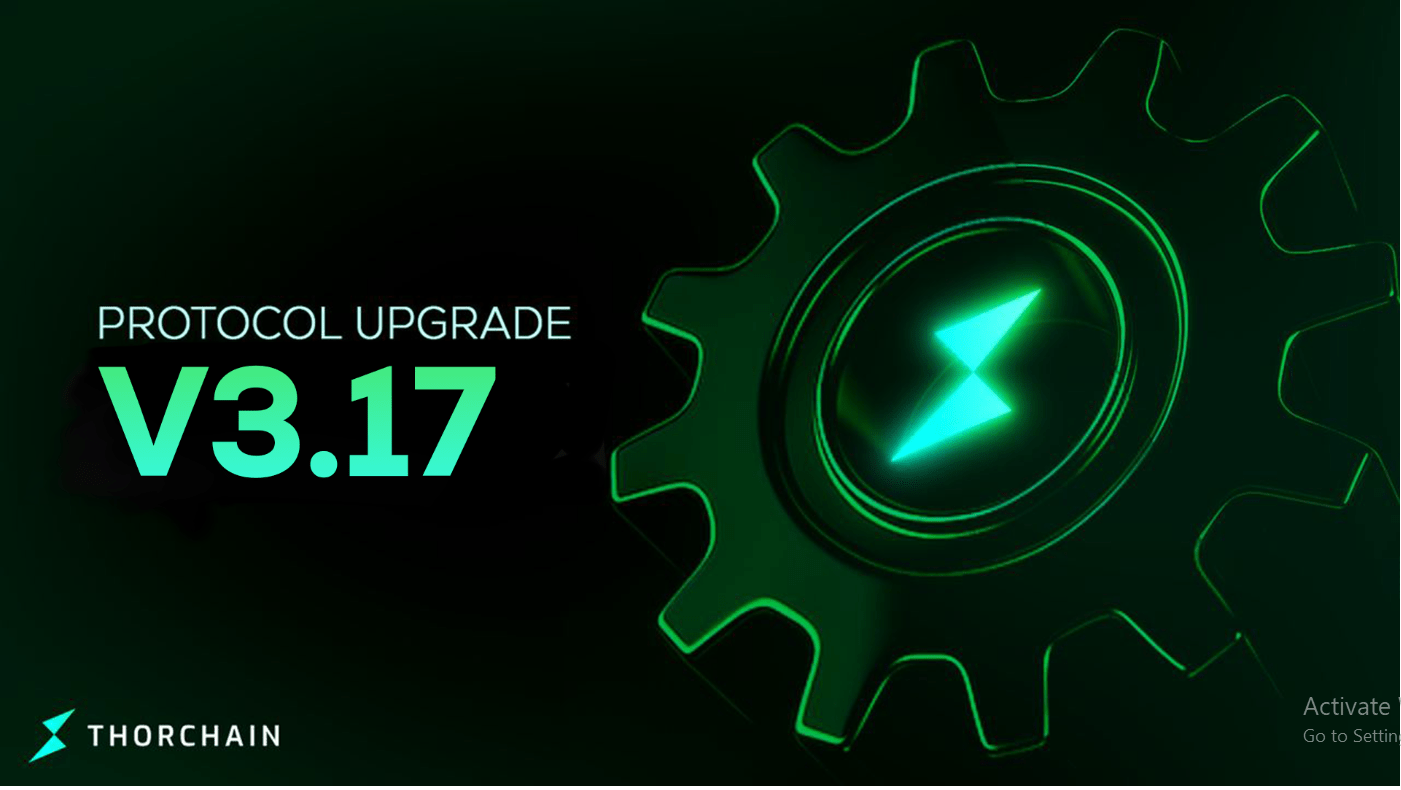
In an industry that often equates innovation with flashy product launches and headline-grabbing features, the latest upgrade from THORChain takes a notably different approach. Version 3.17.0, released in April 2026, introduces no major user-facing features. Instead, it delivers something far more consequential: structural resilience.
With over 100 merged improvements, the upgrade reflects a deliberate shift in decentralized finance (DeFi)—away from rapid experimentation and toward operational maturity. It is a release defined not by what it adds, but by what it stabilizes, secures, and refines. And in doing so, it raises an important question:
THORChain isn’t slowing down.
With the release of v3.17.0, the network just shipped one of its biggest upgrades yet; packed with 100+ improvements across security, swaps, cross-chain reliability, governance, and developer tooling.
The full recap breaks it all down 👇…
— THORChain (@THORChain) April 28, 2026
Is DeFi entering its infrastructure phase?
Stability Over Spectacle: A Strategic Pivot
The defining characteristic of THORChain v3.17.0 is its focus on reliability. While previous cycles in crypto were driven by feature velocity—new tokens, new primitives, new narratives—this upgrade leans heavily into performance consistency and system integrity.
Much of this acceleration in development has been enabled by Huginn AI, an internal tooling system that automates repetitive engineering tasks. This has allowed developers to focus on high-impact improvements across the protocol’s core architecture.
The result is a release that touches nearly every layer of the system: swap execution, liquidity accounting, validator operations, cross-chain integrations, and security enforcement. Instead of introducing risk through novelty, THORChain is systematically reducing it.
That’s not just a technical decision—it’s a market signal.
Tokenomics Recalibration: Aligning Perception With Reality
One of the most consequential updates in this release is the restructuring of the RUNE token supply. By reducing the effective supply held in reserve and aligning it more closely with circulating supply, THORChain is addressing a longstanding issue in crypto: misleading valuation metrics.
Fully diluted valuation (FDV) has often overstated the economic reality of tokens with large inactive reserves. By tightening this gap, THORChain is effectively making its financial metrics more transparent and institution-friendly.
This is not a cosmetic change. It reflects a deeper understanding that capital allocators—particularly those from traditional finance—require clarity, not abstraction. Tokenomics, in this context, becomes less about narrative engineering and more about financial accuracy.
Decentralization in Practice: Governance and Treasury Evolution
Another major development is the migration of the development fund to a 2-of-3 multisig structure. While this may sound incremental, it represents a meaningful shift in governance design.
By reducing reliance on a single custodian, THORChain is distributing control more evenly across stakeholders. This aligns with the broader ethos of decentralization while also introducing practical safeguards against operational risk.
At the same time, treasury flows have been restructured to improve accounting transparency. Excess funds are now routed directly to a dedicated treasury rather than being absorbed into reserves, enabling clearer tracking of protocol-level capital.
In a space where governance is often more theoretical than functional, these changes push THORChain closer to a model that institutions can actually trust.
Swap Engine Overhaul: Efficiency as a Competitive Edge
While much of the upgrade is infrastructure-focused, significant improvements have also been made to the swap engine—the core of THORChain’s value proposition.
Enhancements to streaming swaps, quote accuracy, and execution prioritization address long-standing inefficiencies in cross-chain trading. By refining how swaps are calculated and processed, the protocol reduces slippage discrepancies and improves user outcomes.
More importantly, these changes make the system more predictable.
Predictability is often overlooked in crypto, but it is essential for scaling. Whether for retail users or algorithmic traders, the ability to anticipate execution behavior is a prerequisite for serious capital deployment.
Cross-Chain Reliability: Fixing the Fragility Problem
Interoperability has long been one of DeFi’s greatest promises—and its greatest weaknesses. THORChain’s latest upgrade tackles this head-on with a series of fixes across multiple chains, including Solana, Litecoin, and Zcash.
These updates address critical issues such as double-spend edge cases, transaction validation errors, and dust threshold mismatches. While highly technical, the implications are straightforward: fewer failed transactions, fewer inconsistencies, and a more reliable cross-chain experience.
Related: THORChain Adds Zcash (ZEC)
In effect, THORChain is doing the unglamorous work required to make interoperability actually function at scale.
Security Hardening: Preparing for Adversarial Conditions
Security remains the defining challenge of decentralized systems, and THORChain v3.17.0 reflects a growing awareness of this reality.
The upgrade introduces a wide range of defensive measures, from gas limit validation across EVM chains to protections against denial-of-service attacks and consensus inconsistencies. It also ensures that failed transactions can be retried safely, reducing the risk of permanently locked funds.
Notably, the protocol has retired its traditional bug bounty program, signaling a shift toward more structured and internally managed security processes.
This suggests a move away from reactive security toward proactive system design—an essential transition for any protocol aiming to support large-scale financial activity.
Accounting and Solvency: Eliminating Hidden Risks
One of the more underappreciated aspects of the upgrade is its focus on accounting accuracy and solvency tracking.
In decentralized systems, small inconsistencies can compound into systemic risks. THORChain addresses this through atomic transaction handling, improved liquidity accounting, and more precise gas reporting.
These changes ensure that operations either complete fully or not at all, eliminating partial states that could lead to financial discrepancies.
For a protocol that handles billions in cross-chain liquidity, this level of precision is not optional—it is foundational.
The Bigger Picture: DeFi’s Infrastructure Era
Taken as a whole, THORChain v3.17.0 is less about immediate impact and more about long-term positioning. It reflects a broader shift in DeFi from experimentation to infrastructure.
In earlier cycles, success was often measured by growth metrics—TVL, token price, user counts. Today, the focus is increasingly on durability: uptime, security, execution reliability, and governance integrity.
Related: THORChain to Unlock Bitcoin with Monero Swaps—No KYC
This mirrors the evolution of traditional financial systems, where robustness ultimately outweighs innovation.
THORChain’s approach suggests that the next phase of DeFi will not be defined by new primitives, but by the refinement of existing ones.
Conclusion: Building for the Systems That Last
THORChain’s latest upgrade may not dominate headlines, but it doesn’t need to. Its significance lies in its intent.
By prioritizing stability, transparency, and security, the protocol is positioning itself as a foundational layer for cross-chain liquidity—one capable of supporting not just crypto-native users, but institutional flows as well.
In a market still recovering from cycles of excess and fragility, that kind of discipline stands out.
Because in the end, the systems that endure are not the ones that move fastest—but the ones that break least.
About The Author