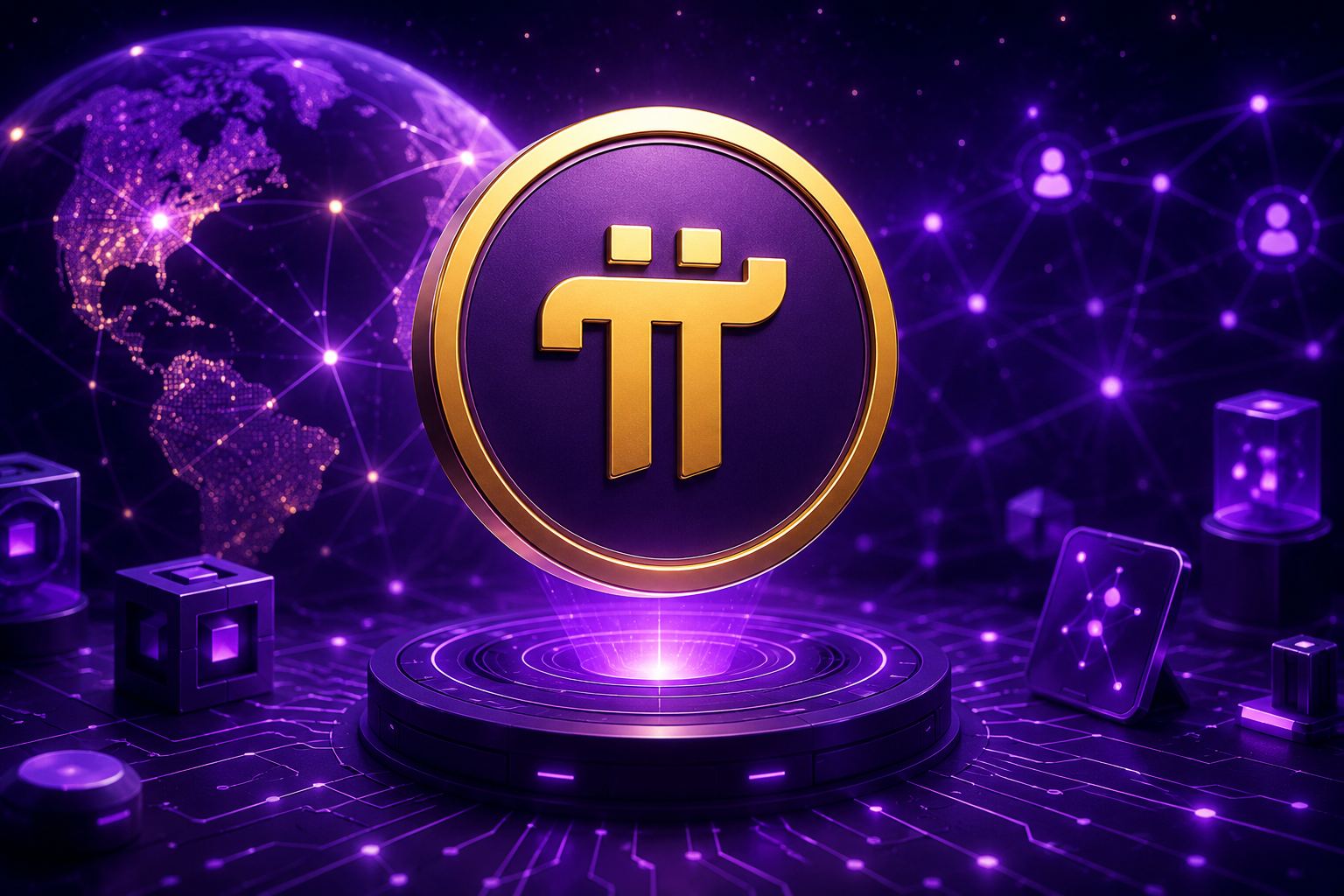
Pi Network has millions of users, a growing blockchain ecosystem, and a maximum supply of 100 billion PI. Yet the question that matters to investors is not how many people have mined the coin. It is how much demand the market would need to support a price of $1, $5 or $10.
The mathematics is straightforward. The implications are much harder to ignore.
As of October 21, 2026, PI trades at approximately $0.08, with a reported circulating supply of roughly 11.28 billion tokens. That puts its market capitalization near $900 million. Its maximum supply, however, is 100 billion PI, according to CoinMarketCap’s market data and Pi Network’s published tokenomics. [1][2]
At the current price, reaching $1 would require a substantial recovery. Reaching $10 would require a much larger repricing of the network and convincing evidence that demand can absorb its expanding supply.
1. The Market Capitalization Required at $1, $5 and $10
The first calculation is:
Market capitalization = PI price × circulating supply
Using approximately 11.28 billion PI in circulation, the targets imply the following valuations.
| PI price | Circulating market cap | Valuation at 100B PI |
|---|---|---|
| $0.08 | $902 million | $8 billion |
| $1 | $11.28 billion | $100 billion |
| $5 | $56.4 billion | $500 billion |
| $10 | $112.8 billion | $1 trillion |
Calculations use a rounded circulating supply of 11.28 billion PI and a maximum supply of 100 billion PI. These are illustrative valuations, not forecasts. Actual circulating supply will change over time.
The distinction between the two valuation columns is critical. Circulating market capitalization measures the market price multiplied by tokens currently in circulation. Fully diluted valuation (FDV) assumes all 100 billion PI are included.
At $1, PI would have a circulating market capitalization of roughly $11.3 billion. At $5, that rises to $56.4 billion. At $10, it reaches $112.8 billion.
On a fully diluted basis, the corresponding valuations are $100 billion, $500 billion and $1 trillion.
These are not equivalent measures of current market value. The FDV calculation does not mean that $100 billion must flow into PI for it to trade at $1. Market capitalization is a marginal-price calculation, not a measurement of cumulative investment. Nevertheless, the fully diluted figures expose the scale of the valuation the market would be assigning to the entire token supply.
2. Why PI’s Supply Changes the Calculation
Pi Network’s maximum supply is 100 billion tokens, allocated as follows:
- 65 billion PI: Community mining rewards.
- 20 billion PI: Core Team allocation.
- 10 billion PI: Foundation reserves.
- 5 billion PI: Liquidity allocation.
Pi Network says these allocations track the issuance of migrated community mining rewards, preserving the allocation proportions as the effective supply develops. [2]
That structure makes circulating supply especially important. The 11.28 billion tokens reported in circulation are not the same as the maximum supply, and the remaining tokens should not automatically be treated as immediately available for sale. Their eventual effect depends on migration, unlocks, lockups, transfers and holder behavior.
Pi’s second migration process also allows eligible users to move additional balances to Mainnet, including qualifying referral rewards. In March 2026, the project reported that more than 119,000 Pioneers had completed second migrations since the rollout began. [3]
Migration does not automatically create selling pressure: some holders will retain or use their PI. But it can expand the amount of transferable supply, making the relationship between new demand and available tokens central to the price outlook.
Consider the $1 target. At today’s approximate circulating supply, the implied market capitalization is $11.28 billion. If circulating supply eventually reaches 25 billion PI, the same $1 price would imply a $25 billion market capitalization. At 50 billion PI, it would imply $50 billion.
The price target remains the same, but the valuation burden increases as more tokens enter circulation.
3. What Each Price Target Would Require
PI at $1: A credible recovery backed by demand
A $1 PI price would represent a substantial improvement from approximately $0.08. The token would need to rise about 12.5 times, or 1,150%, from that reference price.
That is mathematically possible in cryptocurrency markets, but the price increase alone would not prove that Pi’s economy had become sustainable.
A stronger case for $1 would require several developments:
- Sustained demand from buyers outside the existing mining community.
- More applications that people use repeatedly rather than only during promotional events.
- Meaningful merchant activity and payments that create recurring reasons to acquire or spend PI.
- Sufficient exchange liquidity to support trading without excessive price slippage.
- Evidence that buying demand can absorb tokens becoming transferable through migration and other supply changes.
At this level, Pi would need to demonstrate that its user base can generate economic activity, not merely that the network can attract or retain accounts.
Verdict: $1 is the least demanding of the three targets, but it still requires a convincing recovery in demand and a market capable of absorbing additional supply.
PI at $5: A major blockchain valuation
At $5, PI’s implied circulating market capitalization would be approximately $56.4 billion using today’s circulating supply. Its fully diluted valuation would reach $500 billion.
That would place Pi in a very different valuation category. The network would need to compete for capital with major crypto ecosystems, rather than rely primarily on expectations about future adoption.
A credible $5 thesis would require evidence of substantial economic activity: applications with durable users, useful transactions, developers building products that survive beyond incentives, and businesses or consumers who have a reason to use the network.
Related: If PI Is Money, What Can You Actually Buy With It?
Token economics would also matter more. A rapidly expanding supply could make it harder for the price to sustain a high level unless demand grew alongside it.
A temporary speculative rally could produce a price spike without establishing these fundamentals. Sustaining $5 is a different proposition from briefly touching it.
Verdict: $5 would require Pi to establish itself as a major crypto ecosystem with demand strong enough to justify a valuation measured in tens of billions of dollars on a circulating basis.
PI at $10: A $1 trillion fully diluted valuation
The $10 target is the most demanding scenario.
At 11.28 billion circulating PI, the implied market capitalization would be approximately $112.8 billion. At the full 100 billion token supply, the valuation would reach $1 trillion.
That does not make $10 mathematically impossible. It does mean that the investment thesis must account for a valuation comparable to the scale associated with the largest crypto networks.
Pi would need more than an enormous community. It would need an economically important ecosystem, deep and resilient liquidity, sustained external demand, valuable applications and a token model that supports long-term ownership.
Related: Pi Network Summit to Unveil Developer Tools, App Showcases and a New Hackathon in November
The central question would be whether PI captures enough economic value from the network’s activity to justify such a valuation. A large number of users does not automatically translate into a proportionate amount of token demand.
Nor would a $1 trillion FDV mean that investors had deposited $1 trillion into Pi. It would be the implied value of the maximum token supply at that price. The practical challenge would be establishing and maintaining the marginal price as supply and demand changed.
Verdict: $10 would require Pi to become one of the most valuable crypto ecosystems in the market, supported by substantial and persistent economic demand. It is a highly ambitious scenario, not a baseline expectation.
4. The Real Test: Demand Versus Supply
The most useful question is not how many Pioneers Pi has recruited. It is whether the network can create enough demand to absorb the tokens that holders are willing and able to sell.
Three indicators would help determine whether that is happening.
First, recurring economic activity. Look for sustained use of applications, payments and services. Announcements and one-off events are weaker evidence than repeated activity from users who receive a tangible benefit.
Second, market liquidity. Trading volume, order-book depth and spreads can help reveal whether PI can absorb larger trades. A price increase in a thin market does not necessarily establish that the same price can survive significant selling.
Third, supply growth relative to demand. Track circulating supply, migration progress and the availability of additional tokens. If supply grows faster than demand, price appreciation becomes harder to sustain. If demand expands faster than sellable supply, the market has a stronger basis for a lasting recovery.
These indicators matter more than a price target taken in isolation.
Conclusion: Can PI Coin Reach $1, $5 or $10?
PI can mathematically trade at $1, $5 or $10. The more important question is what the market would need to believe about Pi Network to support those prices.
At $1, the implied fully diluted valuation is $100 billion. At $5, it is $500 billion. At $10, it is $1 trillion.
Those figures are not price predictions. They are the valuation hurdles behind the targets.
Pi’s community, migration system and ecosystem development give the project a foundation to build on. But the long-term investment case depends on whether those assets generate recurring demand for PI and whether that demand can keep pace with the supply that becomes available.
For Pioneers, the clearest measure of progress is not the number of people who have mined PI. It is the number of people and businesses who have a compelling reason to use it—and the economic activity that follows.
About The Author