In our previous coverage of IOTA, we explored how the project lost momentum through years of strategic overreach in “IOTA Tried to Build Everything. Here’s Why It Didn’t Work.” We then examined the emotional exhaustion many long-term holders now face in “Still Holding IOTA? Here’s Why It Feels So Hard Right Now.” Most recently, we outlined what the Foundation, community, and builders must do to rebuild alignment and restore trust. Together, those articles asked what went wrong and what needs to change.
Related: IOTA Has One Last Chance — Here’s What Must Change Now
But there is now a more urgent question. Even if IOTA fixes its internal alignment issues, can it still attract new investors in a crypto market that has become dramatically more competitive? Or has it become a legacy project largely sustained by long-term holders who continue to wait for a turnaround? The answer to that question may ultimately determine whether IOTA stages a meaningful recovery or slowly fades into irrelevance.
This is not just about price action. It is about capital rotation, narrative relevance, and whether IOTA can convince a new generation of investors that its future matters more than its past disappointments. That is the challenge now facing the ecosystem.
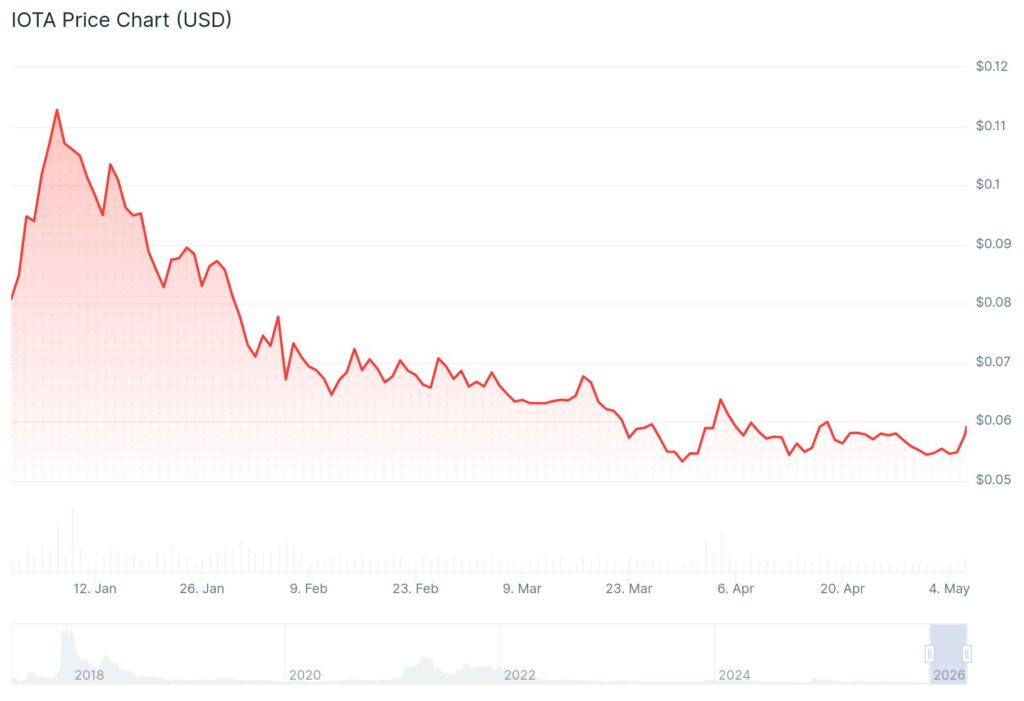
At the time of writing, IOTA continues trading near $0.055, still down roughly 99% from its all-time high above $5.25 reached during the 2017 bull cycle. Its market capitalization remains near $240 million, placing it well below many newer Layer 1 competitors that launched years later but have already captured significantly larger investor attention. This disconnect reflects a simple reality: technical longevity alone does not guarantee capital inflows.
At the time of writing, IOTA is trading for $0.05915 after a 6% rally in the past 24 hours, but is more than 26% in the past year.
The Core Problem: New Investors Are Buying Narratives, Not History
Crypto markets reward momentum. New investors entering the space in 2026 are largely focused on ecosystems with visible activity, expanding application layers, and narratives tied to emerging sectors like real-world asset tokenization, AI-integrated blockchain infrastructure, and modular execution environments. These investors are not emotionally attached to legacy projects. They evaluate ecosystems based on current traction and future opportunity.
This creates a serious challenge for IOTA. While older investors remember its early promise as a revolutionary feeless distributed ledger designed for machine-to-machine economies, newer entrants often know little about that story. If they do recognize the name, it is frequently associated with delays, repeated pivots, and unrealized expectations. In a market driven by perception as much as performance, that historical baggage matters.
The reality is that most new capital entering crypto is opportunistic rather than nostalgic. Investors are searching for ecosystems where they can clearly identify catalysts for adoption and price appreciation. IOTA’s messaging, while technically ambitious, still struggles to present a straightforward reason why fresh capital should choose it over newer competitors.
This is where the Foundation’s recent developments matter. Progress around protocol modernization and ecosystem infrastructure can create a foundation for renewed relevance. But unless those technical advances translate into visible user growth, applications, and measurable traction, they are unlikely to trigger meaningful investor migration.
Without a compelling public-facing success story, IOTA risks remaining a project discussed primarily by those who already own it. That is not how ecosystems grow.
How We Would Know New Money Is Actually Arriving
The clearest proof of new investor interest would not come from social media sentiment or isolated price spikes. It would emerge through measurable ecosystem indicators that suggest capital is entering because of conviction rather than speculation. These are the metrics that matter.
First, sustained increases in daily trading volume would be critical. Short-term spikes often reflect volatility traders, but consistent volume expansion over several weeks would suggest renewed market participation. If IOTA were to move from its current average daily volumes in the low millions toward sustained activity above $30 million to $50 million, that would indicate meaningful fresh attention.
Second, wallet growth and transaction activity would need to accelerate. New investors entering a blockchain ecosystem often bring broader participation beyond token trading. Increased on-chain activity would show that capital is interacting with the network rather than simply rotating through exchanges.
Third, builder traction would be essential. Investors increasingly follow developer migration because strong builder activity often precedes capital inflows. If IOTA begins attracting visible projects, especially those delivering live products, investor perception could shift quickly.
Finally, exchange behavior matters. Expanded listings, deeper liquidity, and improved derivatives market participation often signal rising institutional or professional interest. These infrastructure shifts often precede broader retail re-engagement.
How much capital could this realistically bring in? If IOTA successfully rebuilt confidence and regained only a fraction of the speculative attention it captured during previous cycles, its market capitalization could potentially revisit the $1 billion to $2 billion range over time. That would imply a several-fold increase from current levels of $261,465,629. But such growth would require tangible ecosystem evidence, not simply broader market optimism.
What This Means for Legacy Holders
This is the question many long-term investors are quietly wrestling with. After years of holding through volatility, delays, and changing roadmaps, should they continue accumulating, maintain existing positions, or finally move on? The honest answer depends less on emotion and more on what happens next.
Legacy holders face a difficult psychological dynamic. Many remain because they believe IOTA’s original vision was genuinely ahead of its time. That belief is not irrational. The concepts of feeless infrastructure, scalable machine economy systems, and digital trade coordination remain relevant today. In some ways, the broader market is only now catching up to ideas IOTA introduced years ago.
But belief in an idea must eventually be matched by belief in execution. This is where many holders are reaching their decision point. If recent developments begin producing measurable adoption, continued conviction may look justified. If they fail to generate ecosystem traction, then many investors may conclude that technological potential is no longer enough.
This does not make the decision binary. Many experienced crypto investors increasingly treat legacy positions like IOTA as asymmetric watchlist assets rather than conviction-heavy allocations. They maintain exposure while requiring evidence before increasing it. That is a more disciplined framework than emotional averaging or panic-driven exits.
The bigger reality is that IOTA’s future will not be decided by what old investors do next. It will be decided by whether new investors arrive.
That is the real test now. Legacy holders have carried this ecosystem through years of uncertainty. If IOTA is going to move beyond survival and into genuine recovery, it must prove it can inspire confidence among people who have no historical attachment to the project.
And until that happens, the market will continue asking the same question: Is IOTA building its future or simply managing its past?
About The Author