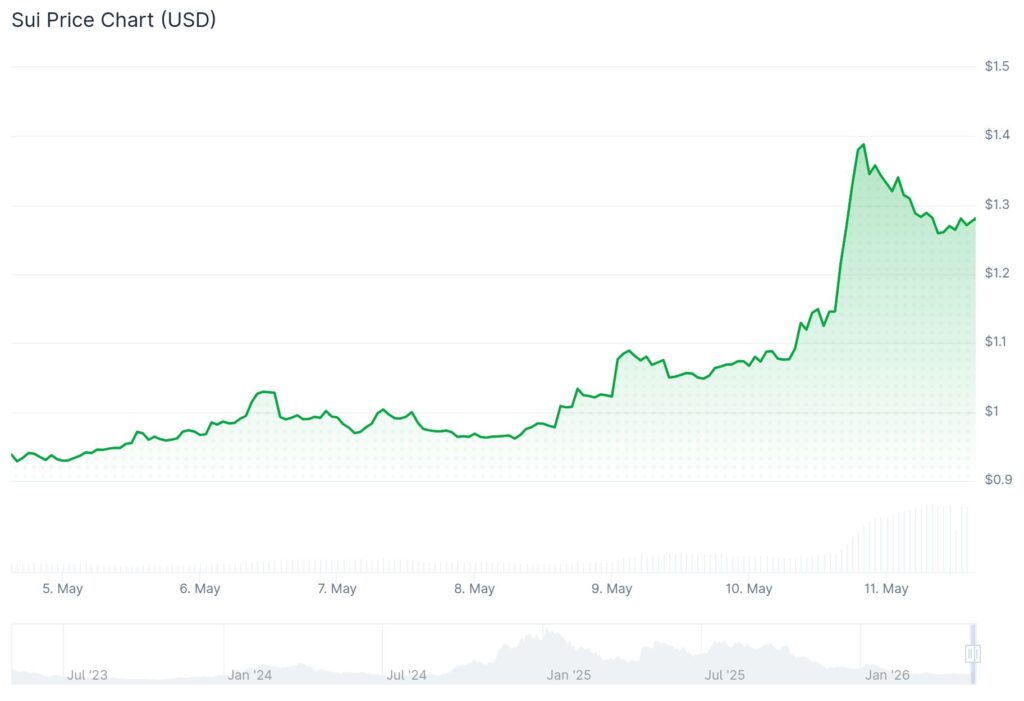
Sui has emerged as one of the strongest-performing major crypto assets in recent weeks after surging roughly 50% from its baseline levels, with on-chain data suggesting the move may be driven more by institutional supply dynamics than by traditional retail speculation.
The rally pushed SUI from approximately $0.92 to a peak near $1.39 on May 10 before stabilizing around the $1.26 range, while daily trading volume exploded from roughly $213 million to nearly $2.5 billion during the same period. Although sudden price spikes are common across crypto markets, analysts monitoring blockchain activity believe the structure of this rally looks fundamentally different from many previous altcoin surges.
Rather than being driven primarily by social media hype or retail FOMO, the latest SUI breakout appears heavily tied to supply reduction and institutional positioning. One of the most important catalysts came when SUI Group Holdings, listed under NASDAQ ticker SUIG, transferred its entire 108.7 million SUI treasury from decentralized finance protocols into direct staking on May 10. That move effectively removed approximately 2.7% of SUI’s circulating supply from liquid market float at a time when an estimated 74% of the network’s total supply was already staked.
In practical terms, the treasury shift tightened available market liquidity significantly. When large amounts of supply become locked into staking systems rather than remaining available on exchanges or within DeFi markets, it can create stronger upward price pressure if demand simultaneously increases. Traders increasingly describe the move as an example of institutional supply locking, where long-term positioning reduces the amount of available inventory circulating across the market.
Related: Sui Expands Into Real-World Payments With RedotPay Integration Across 130M Merchants
The scale of the staking environment surrounding SUI has become one of the most closely watched elements of the rally. With a large majority of tokens already staked before the treasury transfer occurred, the additional removal of liquid supply amplified scarcity conditions across the market. Analysts argue that this type of on-chain setup behaves differently from purely retail-driven speculative rallies because it changes actual market liquidity rather than simply increasing short-term trading excitement.
At the same time, market participants also began pricing in broader institutional developments surrounding the SUI ecosystem. One of the biggest catalysts involves the planned launch of SUI futures contracts by CME Group on May 29. The introduction is particularly notable because SUI will reportedly become only the fifth major Layer-1 blockchain asset to receive regulated derivatives access through CME infrastructure.
Institutional Access and Real-World Partnerships Are Expanding the SUI Narrative
The upcoming CME futures launch has become a major talking point because regulated derivatives products often represent a significant milestone in the institutionalization process of digital assets. Futures markets provide hedge funds, institutional traders, market makers, and professional investors with regulated exposure and hedging tools that are difficult to access through spot markets alone.
Historically, CME listings have played an important role in legitimizing crypto assets within traditional finance circles. Bitcoin and Ethereum futures helped establish pathways for broader institutional participation years before spot ETF products eventually arrived. For SUI supporters, the addition of regulated futures markets signals that the blockchain is increasingly being viewed as an institutional-grade ecosystem rather than simply another speculative Layer-1 project.
The ecosystem has also benefited from growing attention around real-world payment infrastructure partnerships. One of the latest developments involves collaboration with Paga, a major African fintech platform focused on cross-border payment systems and financial access infrastructure. The partnership has fueled speculation that SUI may increasingly position itself around practical payment utility and emerging-market financial applications.
Related: Sui-Backed WaterX Introduces AI-Native Trading Engine for a 24/7 Autonomous Market Era
Africa continues to represent one of the most closely watched growth regions for crypto adoption because of rising mobile payment penetration, remittance demand, and expanding digital financial infrastructure. Blockchain ecosystems capable of supporting low-cost transactions and cross-border settlement systems are increasingly competing for relevance within these rapidly growing markets. For SUI, partnerships tied to payment rails and fintech infrastructure help strengthen the broader narrative that the network may be evolving beyond speculative trading activity into utility-focused adoption.
The combination of institutional futures access and real-world payment integrations has created a powerful narrative mix for traders. Instead of relying solely on meme-driven speculation, SUI’s recent momentum is increasingly being framed around infrastructure growth, liquidity dynamics, and institutional participation.
Social Metrics Suggest the Rally May Not Be Overheated Yet
One of the more interesting aspects of the recent SUI rally is that social activity appears relatively subdued compared to the scale of the price movement. According to social dominance metrics tracked during the rally, SUI discussions represented approximately 0.13% to 0.15% of broader crypto market conversation volume — notably below the roughly 0.38% social spike that reportedly preceded the initial breakout phase.
For some analysts, this divergence is important because it suggests market conversation may not yet be running ahead of price action. In many speculative crypto rallies, retail excitement and social media activity explode rapidly before momentum eventually weakens. In SUI’s case, however, the comparatively moderate social dominance readings imply the move may still be driven more by structural market conditions and institutional positioning than by widespread retail mania.
This distinction has fueled broader discussion about how institutional crypto rallies behave differently on-chain compared to retail-driven speculation cycles. When institutional participants accumulate or lock supply through staking, treasury strategies, or regulated financial products, price movement can emerge gradually through liquidity compression rather than explosive retail-driven leverage cycles.
The rally has also renewed attention around staking economics within proof-of-stake ecosystems more broadly. High staking participation rates reduce liquid circulating supply, which can create powerful scarcity effects during periods of rising demand. However, critics also warn that heavily staked ecosystems may face heightened volatility if large portions of supply eventually unlock or rotate back into active trading circulation.
For now, SUI remains one of the strongest-performing major Layer-1 ecosystems in the market, supported by a combination of institutional staking activity, regulated derivatives expansion, rising trading volume, and growing ecosystem partnerships. Whether the momentum continues will likely depend on whether demand keeps outpacing the increasingly constrained liquid supply currently available across the market.
About The Author