
Bitcoin exchange balances have climbed sharply since late July, reversing most of the supply decline that had supported the recent “supply squeeze” narrative. New data from Santiment shows that roughly 28,000 BTC have returned to exchanges in less than three weeks, bringing exchange-held Bitcoin to its highest level since June 15.
The change is significant because Bitcoin held on centralized exchanges represents a more immediately available pool of coins that can potentially be sold or traded. According to the figures shared by Santiment, exchange balances fell from approximately 1.337 million BTC on June 12 to about 1.304 million BTC on July 28, a decline of roughly 33,000 BTC.
That trend has now largely reversed.
By August 16, exchange balances had risen to approximately 1.332 million BTC. That means about 84% of the previous 33,000-BTC decline has effectively been recovered. The rebound also happened much faster than the original decline: the exchange drain took around six weeks to develop, while most of the reversal occurred in less than three weeks.
The development does not necessarily mean Bitcoin is facing a wave of selling. But it does weaken one of the more straightforward supply-side arguments that had been used to explain potential upward pressure on BTC.
Bitcoin exchange balances reverse most of the recent drain
Approximate exchange-held BTC at key points highlighted by Santiment.1.3M1.3M1.3M1.3M1.3MJun 12Jul 28Aug 16
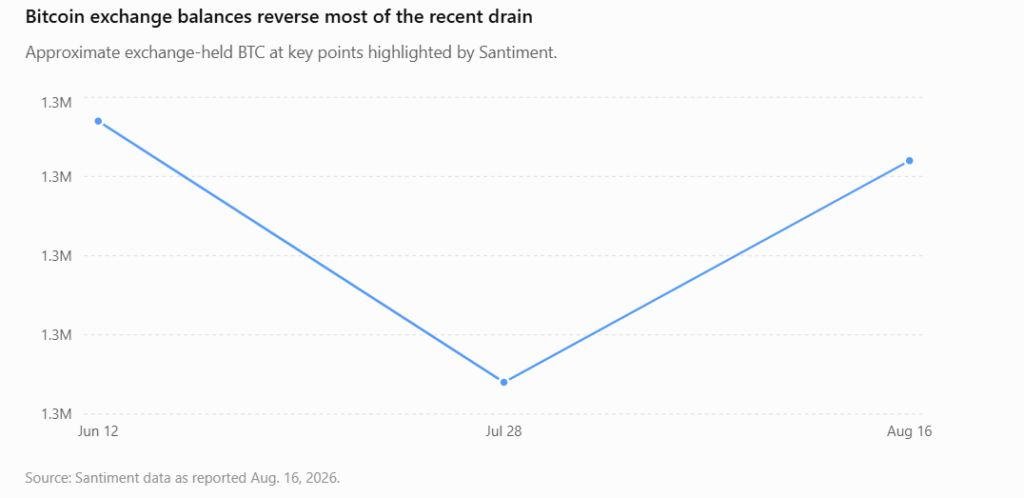
Source: Santiment data as reported Aug. 16, 2026.
Bitcoin Supply Squeeze Has Mostly Unwound
The original decline in exchange balances was substantial even though the absolute percentage change was relatively modest.
From June 12 through July 28, approximately 33,000 BTC left exchanges. Against a starting balance of around 1.337 million BTC, that represented a decline of approximately 2.5%.
Such movements matter because exchange balances are often watched as a proxy for immediately accessible Bitcoin supply. When coins consistently leave exchanges, investors may interpret the move as evidence that holders are transferring BTC into longer-term custody, reducing the amount readily available for trading.
That interpretation helped reinforce the supply-squeeze argument.
But the latest data changes the picture. Bitcoin exchange balances have now climbed back to roughly 1.332 million BTC, leaving the market only about 5,200 BTC below the June peak.
In other words, most of the supply contraction that developed between June and July has disappeared.
Santiment’s data shows that the refill has started to flatten around the 1.332 million BTC level over the past few days. That could become important if the stabilization continues, because it would suggest the rapid return of Bitcoin to exchanges may have paused rather than continuing indefinitely.
The distinction matters.
A rising exchange balance does not automatically mean that holders intend to sell. Bitcoin can move to exchanges for many reasons, including trading, collateral management, market-making, custody changes and preparation for transactions.
The metric therefore needs to be interpreted alongside price, trading volume, ETF flows, derivatives positioning and other on-chain indicators.
Why Bitcoin ETF Inflows Can Coexist With Rising Exchange Balances
At first glance, rising exchange balances may appear inconsistent with continued Bitcoin ETF demand.
If investors are buying spot Bitcoin ETFs, the argument goes, shouldn’t those purchases reduce available BTC supply?
Not necessarily.
The ETF creation process does not require every newly purchased Bitcoin to come directly from visible centralized exchange wallets. Coins can be sourced through over-the-counter desks, market makers and existing holders.
This creates an important distinction between ETF demand and exchange balances.
A Bitcoin ETF can receive substantial creations while the amount of BTC held on exchanges rises at the same time. ETF-related demand may absorb coins from holders or OTC markets, while other market participants simultaneously move BTC back onto exchanges.
That is why Santiment’s latest observation should not be interpreted as evidence that ETF demand has disappeared.
Instead, it shows that the visible exchange-supply component of the Bitcoin supply squeeze has weakened substantially.
The broader institutional picture remains more complicated. A mid-2026 report from 21Shares noted that U.S. spot Bitcoin ETF holdings remained near historical highs even after roughly $3 billion in year-to-date net outflows at the time of its report, illustrating that ETF holdings and flows can tell different stories depending on the period being measured.
The key takeaway is that investors should avoid treating any single supply metric as a complete explanation for Bitcoin’s price.
What the Exchange-Balance Reversal Means for BTC
The latest data creates several implications for Bitcoin investors:
1. The supply squeeze is weaker.
With approximately 28,000 BTC returning to exchanges, most of the June-July decline has been reversed.
2. Selling pressure is not confirmed.
Higher exchange balances indicate greater potential liquidity, not necessarily imminent selling.
3. ETF demand can still exist.
ETF creations can be supplied through OTC markets and existing holders without requiring a reduction in exchange balances.
4. The next trend matters more than the current level.
If balances continue rising, the bearish interpretation becomes stronger. If they stabilize or begin falling again, the supply-tightness narrative could regain credibility.
5. Price needs to confirm the on-chain signal.
Exchange balances alone cannot establish whether Bitcoin is preparing for another decline or a recovery.
The Bitcoin Market Is Now Facing a More Balanced Supply Picture
The most important part of Santiment’s observation may be the speed of the reversal.
Bitcoin exchange balances declined by about 33,000 BTC over roughly six weeks. They then recovered approximately 28,000 BTC in less than three weeks.
That is a meaningful change in market behavior.
The market is no longer operating under the same exchange-supply conditions that existed at the July 28 low. The amount of Bitcoin sitting on exchanges is now close to its June level, leaving only a relatively small portion of the original decline intact.
However, the current figure remains slightly below the June peak.
That means the supply squeeze has not been completely erased. It has instead been substantially reduced.
The next few weeks could therefore be more informative than the previous six weeks. A renewed decline in exchange balances would suggest that the late-July reversal was temporary. Continued accumulation of BTC on exchanges would point toward a further normalization of readily tradable supply.
For Bitcoin bulls, the ideal combination would be renewed exchange outflows alongside sustained institutional demand. That would indicate that market participants are absorbing available supply while moving coins away from venues where they can be readily traded.
For bears, continued exchange inflows would provide a different signal: more Bitcoin becoming available to the market at a time when price demand may already be under pressure.
Neither scenario is guaranteed.
What is clear is that the simple argument that Bitcoin’s exchange supply is steadily disappearing is no longer supported by the latest Santiment figures. The six-week drain has largely been undone in under three weeks.
Bitcoin Investors Should Watch the Next Move in Exchange Balances
The Bitcoin market is now at an important point.
Exchange balances have reached approximately 1.332 million BTC, compared with roughly 1.304 million BTC at the July 28 low and 1.337 million BTC on June 12. The latest figure is therefore only about 5,200 BTC below the June peak.
That substantially changes the supply picture.
But it does not settle the direction of Bitcoin’s next major move.
The exchange-balance metric is best viewed as one part of a larger market framework. ETF flows, institutional holdings, long-term holder behavior, derivatives positioning, stablecoin liquidity and macroeconomic conditions will all influence whether the additional exchange supply becomes an actual source of selling pressure.
For now, the clearest conclusion is straightforward: Bitcoin’s recent exchange-supply squeeze has largely unwound.
The question for the market is whether this is a temporary refill before another wave of accumulation—or the beginning of a longer period in which more Bitcoin becomes available for trading.
That is the on-chain trend Bitcoin investors should be watching next.
About The Author