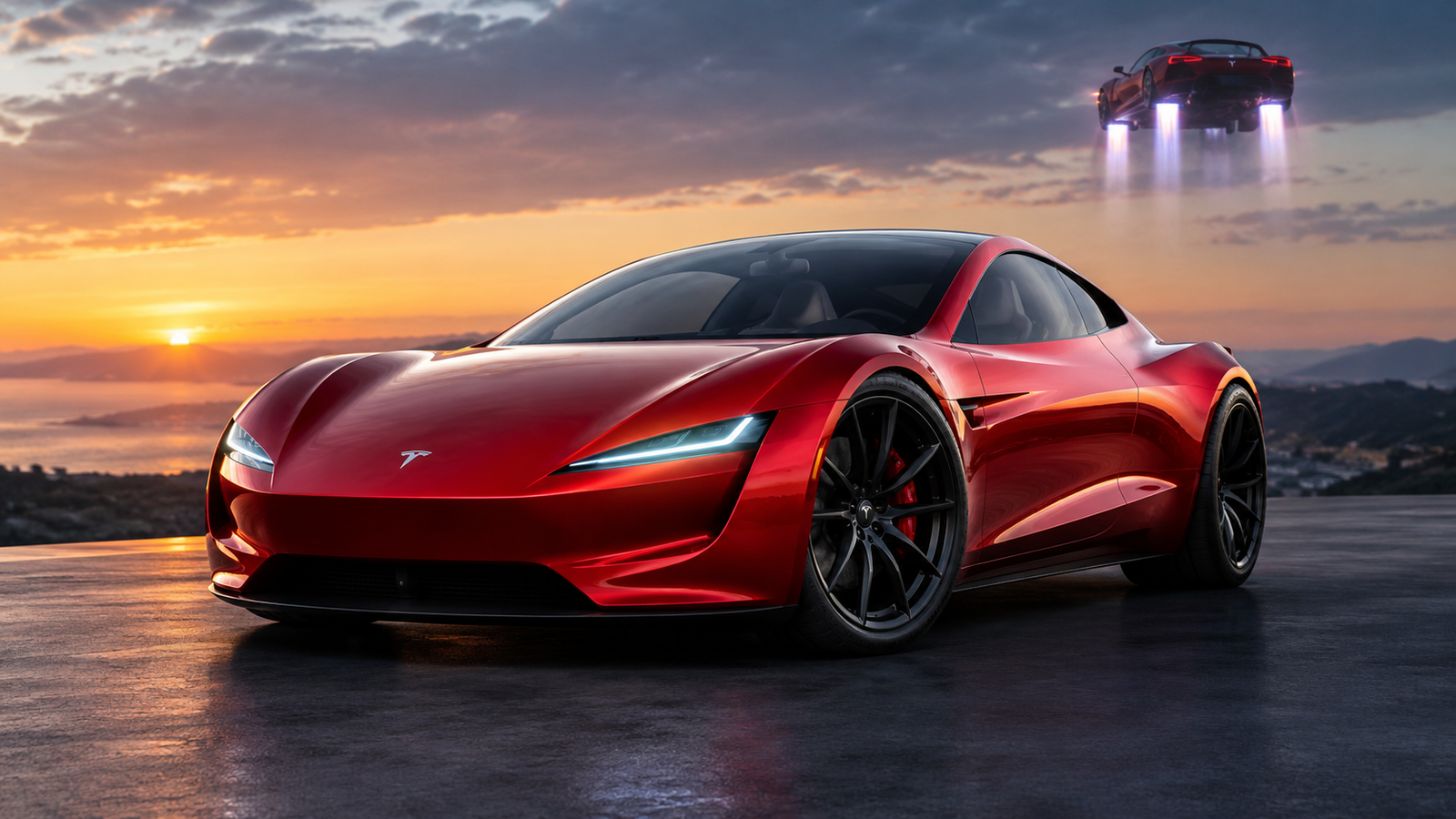
Tesla has finally revealed its redesigned second-generation Roadster, and the company is no longer relying on acceleration alone to distinguish its electric supercar. Unveiled in October 2026, the new vehicle combines extreme performance claims with technology developed alongside SpaceX, including rocket-style thrusters designed to lift and maneuver the car through the air. Production is targeted for 2028, nearly a decade after Tesla first presented the next-generation Roadster in 2017.
The Tesla Roadster’s Most Extraordinary Feature Is No Longer Its Speed
The headline claim is acceleration from zero to 60 mph in less than one second. Tesla also demonstrated a system combining high-powered fans and SpaceX-developed thrusters that allowed the vehicle to lift off the ground, turn in the air and perform maneuvers that would be impossible for a conventional road car.
These features make the Roadster fundamentally different from the electric supercars already competing on public roads. However, the demonstrations are not proof that every advertised capability will be available in a production vehicle or legally usable on public streets.
Tesla has also described the Roadster as a vehicle capable of exceeding 230 mph and traveling more than 300 miles on a charge, according to reporting from its unveiling. These figures remain claims that buyers will want to see validated under real-world conditions.
SpaceX Technology Could Make the Roadster More Than a Supercar
The collaboration between Tesla and SpaceX is the most distinctive aspect of the new Roadster. Rocket-style propulsion introduces engineering possibilities that conventional electric drivetrains cannot offer, although it also creates substantial challenges involving weight, energy storage, control systems and safety.
The distinction between a spectacular demonstration and a commercially usable vehicle matters. A system capable of briefly lifting a car is not automatically suitable for everyday driving. Regulatory approval, passenger protection and the reliability of its propulsion systems will determine whether the technology becomes a practical product or remains a specialized performance feature.
Tesla has not established that the flying capabilities will be approved for ordinary public-road use. The Rocket configuration has been described as a single-seat version with a full flight system, while the standard Performance and Thrust configurations offer different levels of capability.
The Biggest Risk Is Tesla’s History of Delays
Tesla first introduced the second-generation Roadster in November 2017 and originally targeted deliveries in 2020. That deadline passed, followed by repeated delays as the company concentrated on higher-volume vehicles and other priorities.
The latest announcement moves the production target to 2028. That is an important distinction: unveiling a vehicle is not the same as manufacturing it at scale, delivering it to customers and supporting it over the long term.
Tesla has not announced a final purchase price at the latest event. Its reservation page reportedly listed a $50,000 deposit for the Performance version and $250,000 for the Thrust version, while the Rocket configuration was described as invitation-only. These deposits should not be confused with the final vehicle prices.
For prospective buyers, the central question is whether Tesla can turn its latest engineering demonstration into a finished product on the promised schedule. Until production vehicles reach customers, performance, pricing, reliability and road legality remain important uncertainties.
What the New Roadster Means for Tesla
The Roadster is unlikely to be as important to Tesla’s sales volumes as its mass-market vehicles. Its strategic value lies elsewhere: demonstrating engineering ambition, attracting attention and reinforcing the company’s identity as a technology business rather than simply an electric-car manufacturer.
That positioning comes at a time when Tesla is increasingly emphasizing artificial intelligence, autonomous driving and robotics. A highly specialized sports car will not resolve the commercial challenges associated with those businesses, but it could give Tesla a compelling product that showcases its engineering capabilities.
The Roadster’s success should therefore be measured against two separate standards. As a technological showcase, its flying demonstration has already generated extraordinary attention. As a commercial vehicle, it still has to prove that its specifications, pricing and delivery schedule can survive the transition from presentation to production.
The Verdict
The new Tesla Roadster may become one of the most unusual performance cars ever developed, combining electric acceleration with technology borrowed from the aerospace industry. Its sub-one-second acceleration claim and airborne demonstrations make it a remarkable engineering proposition.
But Tesla’s history with this project demands caution. The company has spent almost nine years moving toward a production-ready Roadster, and the latest unveiling does not erase those delays.
The real breakthrough will not be making the Roadster fly during a demonstration. It will be delivering a reliable, legally usable production car that performs as promised. Until Tesla achieves that, the new Roadster remains an extraordinary promise rather than a proven commercial success.
About The Author